S. 723 explained · 119th Congress · Became law
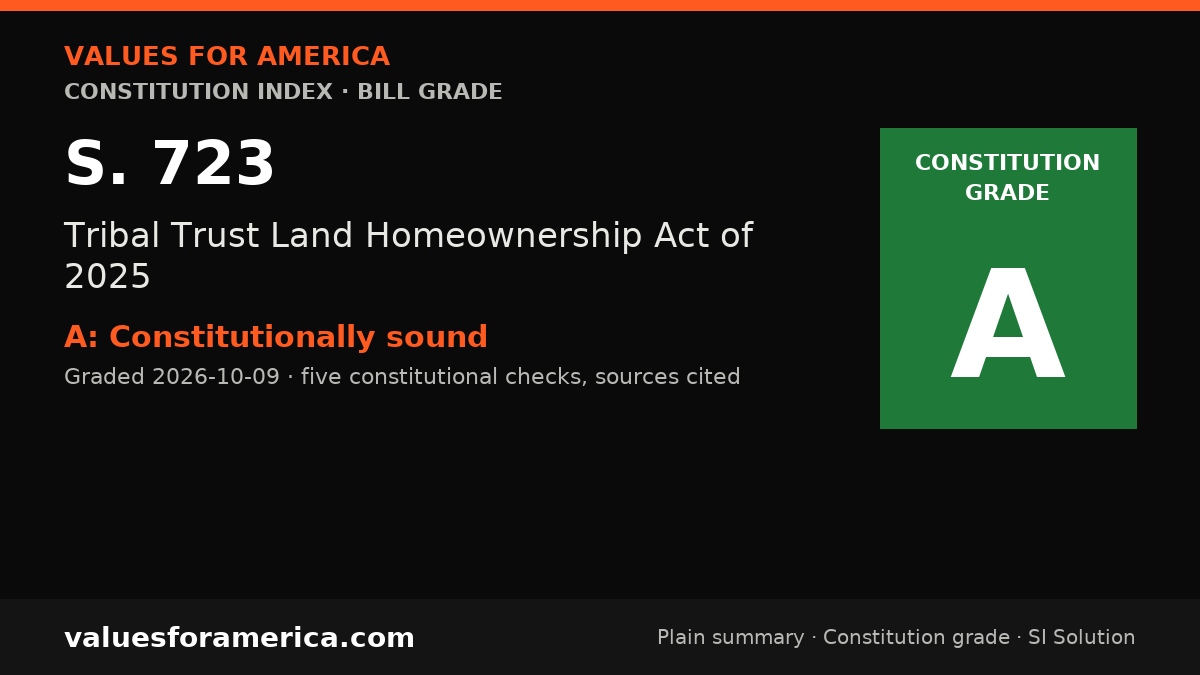
Tribal Trust Land Homeownership Act of 2025
Cosponsors: 3 (1 D, 2 R) · per Congress.gov, 2026-10-08
Introduced: 2025-02-25
Latest action (2026-05-04): Became Public Law No: 119-88.
What S. 723 does, in plain terms
Tribal Trust Land Homeownership Act of 2025 This act sets forth requirements for the processing of a proposed residential leasehold mortgage, business leasehold mortgage, land mortgage, or right-of-way document by the Bureau of Indian Affairs (BIA). The BIA must notify lenders upon receipt of such documentation, perform a preliminary review of such documents not later than 10 days after receipt, and approve or disapprove of such documents within 20 or 30 days, depending on the type of application. Additionally, the act sets forth requirements for the BIA regarding (1) response times for the completion of certified title status reports, (2) notification of delays in processing, and (3) the form of notices and delivery of certain reports. The act also provides relevant federal agencies and Indian tribes with read-only access to the Trust Asset and Accounting Management System maintained by the BIA. The Government Accountability Office must report on digitizing documents for the purpose of streamlining and expediting the completion of mortgage packages for residential mortgages on Indian land. Finally, the act establishes within the BIA's Division of Real Estate Services the position of Realty Ombudsman.
Official summary by the Congressional Research Service, via Congress.gov.
Constitution Index
“VFA Constitution grade”
Constitutionally sound
Graded 2026-10-09
SI-generated grade · five published checks · not individually reviewed by a person · methodology
The Tribal Trust Land Homeownership Act of 2025 is a procedural and administrative reform governing the Bureau of Indian Affairs' processing of certain land documents on federally held Indian trust land. It operates squarely within Congress's constitutional authority over Indian affairs and federal trust property, does not infringe individual rights, does not concentrate decision-making beyond the existing federal trust relationship, and enhances rather than bypasses procedural fairness. The grade is A.
-
✓ Passes · Enumerated powers
Congress has express authority under Article I, Section 8, Clause 3 to regulate commerce with Indian tribes, and the federal government holds title to Indian trust land, placing management of that land within federal authority. Article IV, Section 3, Clause 2 also gives Congress authority over federal property. This bill regulates BIA processing of trust land mortgages and rights-of-way, which is … -
✓ Passes · Bill of Rights
The act imposes administrative deadlines, notice requirements, system access provisions, a GAO report, and an ombudsman position. It does not restrict speech, religion, assembly, press, petition, the right to keep and bear arms, quartering of soldiers, search and seizure protections, self-incrimination protections, trial rights, jury rights, or protections against cruel and unusual punishment. No … -
✓ Passes · Individual sovereignty
This act does not restrict what individuals may do with their own person, property, speech, labor, or belief. Instead, it limits government action by requiring BIA to respond within specified timeframes, provide notice, and improve transparency. It facilitates voluntary mortgage transactions and property rights on trust land. The burden is on the government to process documents, not on individuals… -
✓ Passes · Decentralization
Individual families cannot independently process trust land mortgages because legal title to trust land is held by the United States. Local counties and communities cannot manage federal trust land or BIA trust systems, and states have no authority over Indian trust land or the federal-tribal trust relationship. The act does not consolidate decision-making at a higher level than the minimum necess… -
✓ Passes · Due process and takings
The act strengthens procedural fairness by imposing deadlines, requiring notice of delays, specifying notice forms and delivery, and establishing a Realty Ombudsman. It does not bypass due process, does not alter the presumption of innocence, and does not take private property without just compensation. Trust land remains in trust, and the act does not authorize any taking of property.
Sources: Congress.gov: S 723 summary
Report an error in this grade
What should pass
“VFA SI Solution”
No solution yet
A sourced SI draft appears here once it passes automated checks (Constitution citation, source verification, independent SI critic). How publication works.
Related on VFA

For journalists and bloggers
“Embed this grade”
Free to use with the link back. The badge and card update when the grade changes. Embed terms →
