S. 630 explained · 119th Congress · Pending in Congress
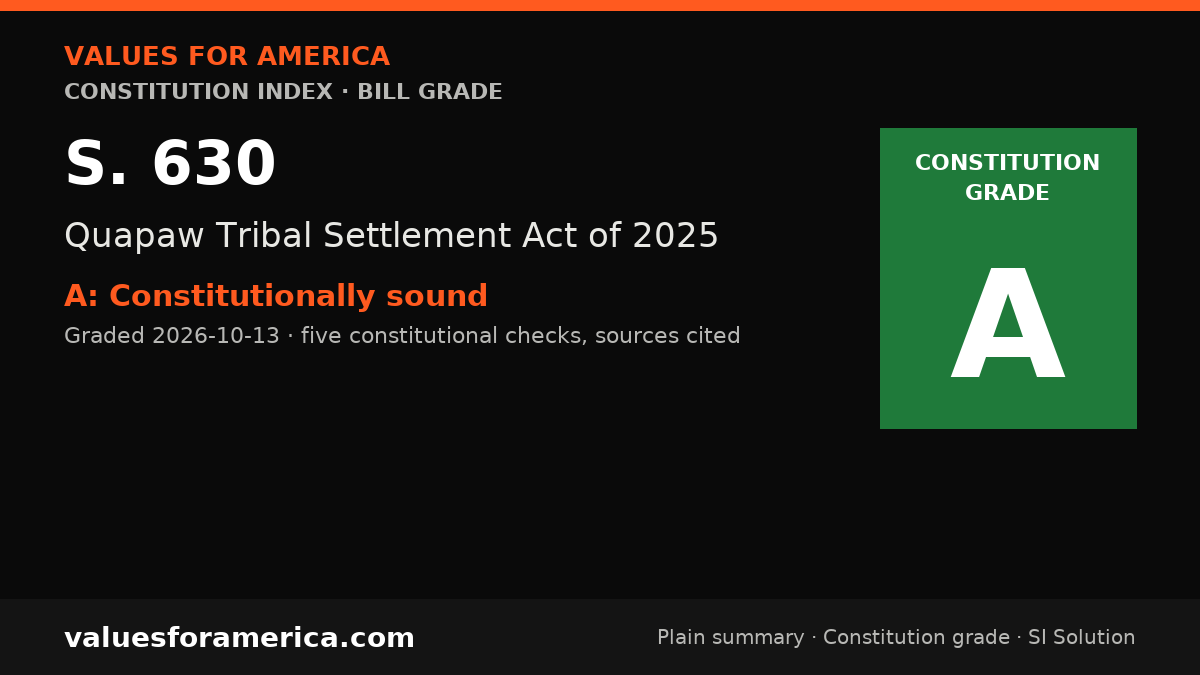
Quapaw Tribal Settlement Act of 2025
Cosponsors: 2 (0 D, 2 R) · per Congress.gov, 2026-10-10
Introduced: 2025-02-19
Latest action (2026-06-03): Committee on Indian Affairs. Hearings held.
What S. 630 does, in plain terms
Quapaw Tribal Settlement Act of 2025 This bill creates a trust account, funds the account, and establishes a distribution process to settle certain claims between the federal government and the Quapaw Nation (a tribe in Oklahoma). Specifically, the bill establishes the Quapaw Bear Settlement Trust Account and directs the Department of the Interior's Bureau of Trust Funds Administration to administer all funds appropriated to the trust account. Interior must make payments to the tribe and individual members of the tribe in accordance with the January 2020 recommendation of the review panel of the U.S. Court of Federal Claims. The bill outlines the distribution process for the settlement funds in the trust account.
Official summary by the Congressional Research Service, via Congress.gov.
Constitution Index
“VFA Constitution grade”
Constitutionally sound
Graded 2026-10-13
SI-generated grade · five published checks · not individually reviewed by a person · methodology
The Quapaw Tribal Settlement Act of 2025 is a constitutionally sound exercise of federal authority to settle claims with a Native American tribe. It falls squarely within the federal government's enumerated powers over Indian affairs, does not infringe on individual rights, and appropriately delegates administration to the Department of the Interior. The bill's distribution process follows a judicial recommendation, ensuring due process and just compensation for the tribe and its members.
-
✓ Passes · Enumerated powers
The federal government has explicit constitutional authority over Indian affairs under Article I, Section 8, Clause 3 (the Indian Commerce Clause), which grants Congress the power to regulate commerce with Indian tribes. Additionally, the treaty-making power under Article II, Section 2, Clause 2 and the historical trust responsibility support federal action to settle claims with the Quapaw Nation.… -
✓ Passes · Bill of Rights
The bill does not infringe on any of the first ten amendments. It creates a trust account and establishes a distribution process, which does not implicate speech, religion, assembly, press, petition, arms, quartering, search and seizure, self-incrimination, due process, takings, fair trial, jury, cruel and unusual punishment, unenumerated rights, or reserved powers. The Tenth Amendment is not viol… -
✓ Passes · Individual sovereignty
The bill does not restrict individual liberty or property rights. Instead, it provides a mechanism for the Quapaw Nation and its members to receive settlement funds, which is a benefit, not a restriction. The distribution process is based on a judicial recommendation, ensuring that the rights of individual members are respected. There is no burden on individual sovereignty; rather, the bill facili… -
✓ Passes · Decentralization
This action involves a settlement between the federal government and a tribe, which is a matter of federal-tribal relations. The federal government has a unique trust responsibility to tribes, and the Constitution grants it authority over Indian affairs. The bill does not consolidate decision-making at a higher level than necessary; it is a federal action because the claims are against the federal… -
✓ Passes · Due process and takings
The bill establishes a distribution process that follows the January 2020 recommendation of the review panel of the U.S. Court of Federal Claims. This ensures that the settlement is based on a judicial determination, providing procedural due process. The bill does not take property without just compensation; rather, it provides compensation to the tribe and its members. The trust account and distr…
Sources: Congress.gov: S 630 summary
Report an error in this grade
What should pass
“VFA SI Solution”
No solution yet
A sourced SI draft appears here once it passes automated checks (Constitution citation, source verification, independent SI critic). How publication works.
Related on VFA

For journalists and bloggers
“Embed this grade”
Free to use with the link back. The badge and card update when the grade changes. Embed terms →
