S. 629 explained · 119th Congress · Became law
Emergency Conservation Program Improvement Act of 2025
Cosponsors: 2 (2 D, 0 R) · per Congress.gov, 2026-10-08
Introduced: 2025-02-19
Latest action (2026-07-12): Became Public Law No: 119-102.
What S. 629 does, in plain terms
Emergency Conservation Program Improvement Act of 2025 This act revises the Emergency Conservation Program (ECP) and the Emergency Forest Restoration Program (EFRP) to expand eligibility for payments to agricultural producers and owners of forest land impacted by natural disasters. The act also provides additional options to receive an advance on cost-sharing payments before carrying out emergency measures. The act expands advance ECP payments to include the replacement, repair, or restoration of farmland or conservation structures requiring an immediate response. Producers may receive an advance on cost-sharing payments for 75% of the cost of the replacement and 50% of the cost of the repair or restoration. Current law limits advance payments to 25% of the cost of the repair or replacement of fencing. Under EFRP, the act allows owners of nonindustrial private forest land impacted by a natural disaster to receive an advance on cost-sharing payments for up to 75% of the cost of the emergency measures. Currently, advance payments are not available under the program. ECP and EFRP recipients must use the funds within 180 days after the funds are disbursed. This provides additional time to ECP recipients who currently must use the funds within 60 days. The act also expands eligibility for payments under the programs to include emergency measures to address damages caused by (1) a wildfire that is not caused naturally, if the damage is caused by the spread of the wildfire due to natural causes; and (2) a wildfire that is caused by the federal government.
Official summary by the Congressional Research Service, via Congress.gov.
Constitution Index
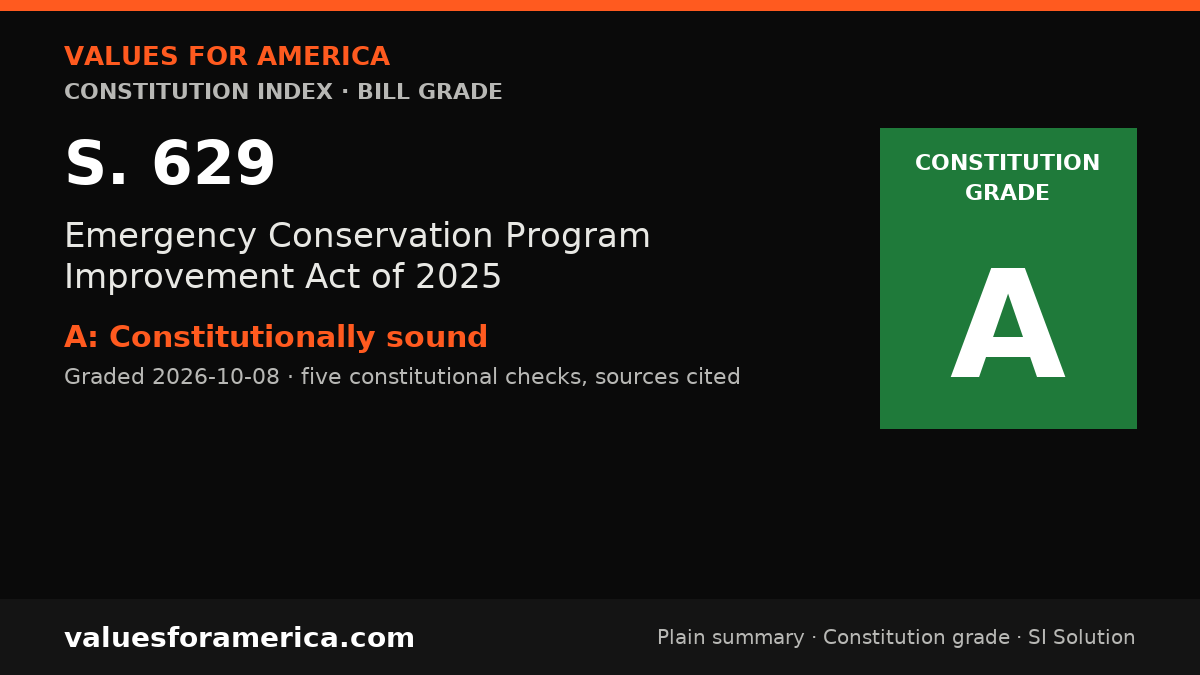
“VFA Constitution grade”
Constitutionally sound
Graded 2026-10-08
SI-generated grade · five published checks · not individually reviewed by a person · methodology
Voluntary disaster cost-share expansion within Congress spending power under Article I, Section 8, Clause 1. No rights restricted, no mandate imposed, no property taken, and no power consolidated beyond existing programs.
-
✓ Passes · Enumerated powers
Federal disaster cost-share payments rest on Article I, Section 8, Clause 1, the power to lay and collect taxes to provide for the general Welfare, as implemented through voluntary spending programs. The Act amends advance-payment percentages, timelines, and eligibility within the existing Emergency Conservation Program and Emergency Forest Restoration Program, including wildfire spread by natural… -
✓ Passes · Bill of Rights
The Act creates no restriction on speech, religion, press, assembly, petition under the First Amendment, imposes no search or seizure under the Fourth Amendment, compels no testimony under the Fifth Amendment, and takes no arms, property, or trial rights. It offers voluntary cost-share payments to producers and forest owners who elect to apply. No enumerated right in Amendments 1-10 is infringed. -
✓ Passes · Individual sovereignty
The Act restricts no personal conduct, belief, speech, labor, or use of property. Participation is elective: a producer or forest owner may seek an advance of 75 percent or 50 percent of emergency costs and must use funds within 180 days, or decline and act privately. The government bears no burden here because it imposes no prohibition; it expands an optional benefit consistent with Fifth and Nin… -
✓ Passes · Decentralization
Widespread natural disaster restoration exceeds individual and local capacity, satisfying questions 1-2 as false. A state could partly handle relief, so state_can_handle is true, but a limited federal cost-share under existing programs does not commandeer states, preempt state law, or consolidate regulatory control in violation of the Tenth Amendment. No new federal police power is created; decisi… -
✓ Passes · Due process and takings
Under the Fifth Amendment Due Process and Takings Clauses, the Act takes no private property, imposes no fine, penalty, or deprivation, and adjudicates no guilt. It distributes benefits on application with a 180-day use condition for advanced funds. Any denial would involve standard administrative notice and review, with no presumption of guilt reversed and no physical or regulatory taking requiri…
Sources: Congress.gov: S 629 summary
Report an error in this grade
What should pass
“VFA SI Solution”
No solution yet
A sourced SI draft appears here once it passes automated checks (Constitution citation, source verification, independent SI critic). How publication works.
Related on VFA

For journalists and bloggers
“Embed this grade”
Free to use with the link back. The badge and card update when the grade changes. Embed terms →
