S. 5517 explained · 119th Congress · Pending in Congress
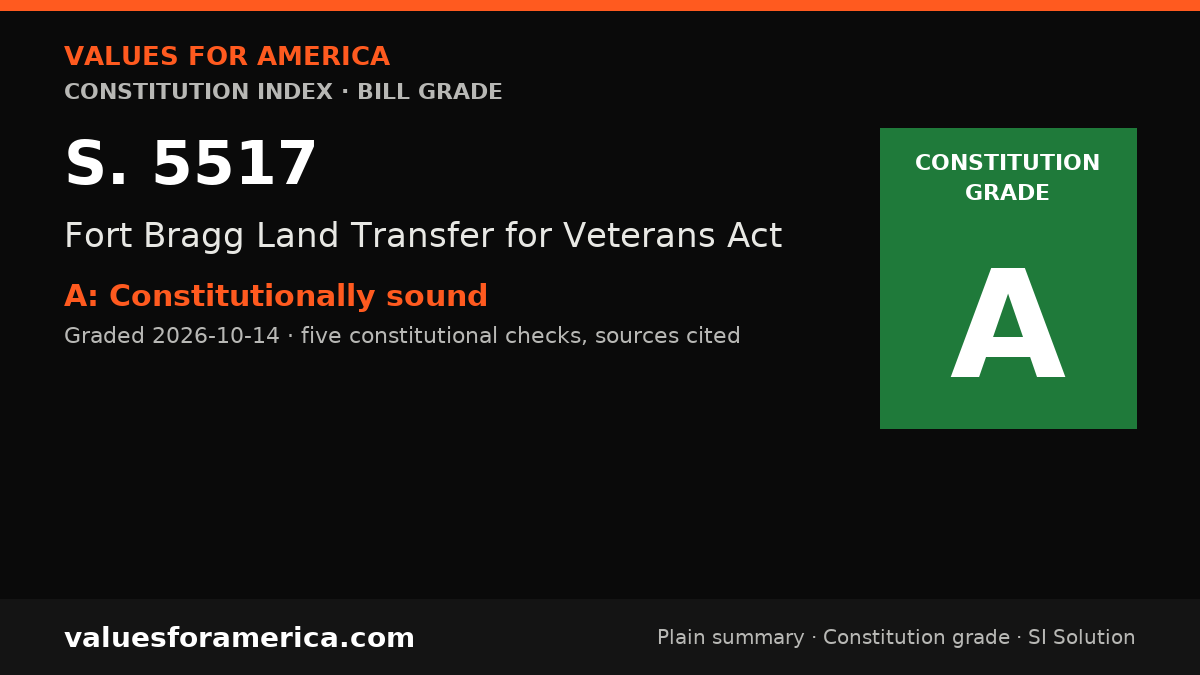
Fort Bragg Land Transfer for Veterans Act
Cosponsors: none · per Congress.gov, 2026-10-14
Introduced: 2026-09-24
Latest action (2026-09-24): Read twice and referred to the Committee on Armed Services.
What S. 5517 does, in plain terms
Fort Bragg Land Transfer for Veterans Act This bill authorizes the Department of the Army to transfer, without compensation or other consideration, all right, title, and interest to a specified 20-acre parcel of land on Fort Bragg to the State of North Carolina for the purpose of constructing a state home under the jurisdiction of the North Carolina Department of Military and Veterans Affairs. (A state home is a home established by a state for veterans who are disabled by age, disease, or otherwise and are incapable of earning a living because of such disability. The term also includes a home that furnishes nursing home care for veterans.) Specifically, the bill authorizes the conveyance of a 20-acre parcel of land situated on the Fort Bragg Training Area in Harnett County, North Carolina, that is commonly referred to as Parcel 3B. The State of North Carolina must cover all costs to carry out the conveyance. If the Department of the Army determines the property is not being used for activities related to a state home, all right, title, and interest in the property may revert to the United States.
Official summary by the Congressional Research Service, via Congress.gov.
Constitution Index
“VFA Constitution grade”
Constitutionally sound
Graded 2026-10-14
SI-generated grade · five published checks · not individually reviewed by a person · methodology
The bill is a straightforward, voluntary transfer of federal property to a state for a legitimate public purpose, authorized by Congress under its enumerated powers over federal property and military affairs. It does not infringe on any constitutional rights, respects federalism by empowering the state, and includes due process protections through a reversion clause. The transfer is without compensation, which is permissible as a gift of federal property, and the state bears all costs, ensuring no uncompensated taking.
-
✓ Passes · Enumerated powers
Congress has explicit authority under Article I, Section 8, Clause 17 to exercise exclusive legislation over federal enclaves and to dispose of federal property. Additionally, Article IV, Section 3, Clause 2 grants Congress the power to dispose of and make all needful rules and regulations respecting the territory or other property belonging to the United States. The transfer of a 20-acre parcel o… -
✓ Passes · Bill of Rights
The bill does not implicate any of the first ten amendments. It does not restrict speech, religion, assembly, press, petition, arms, quartering, search and seizure, self-incrimination, due process, takings, trial rights, or cruel and unusual punishment. The transfer is a property conveyance, not a governmental action affecting individual liberties. -
✓ Passes · Individual sovereignty
The bill does not restrict any individual's use of their person, property, speech, labor, or belief. It is a voluntary transfer of federal land to a state for a public purpose, and the state must cover all costs. No individual is compelled to act against their will, and no private property is taken without consent. -
✓ Passes · Decentralization
The bill passes all four questions of the decentralization test. (1) An individual or family could not handle the transfer of a 20-acre federal military installation parcel; this is inherently a government-to-government transaction. (2) A local community or county could not handle the transfer of federal property; only the state and federal governments have the authority and resources. (3) The sta… -
✓ Passes · Due process and takings
The bill does not involve a taking of private property; it is a voluntary transfer of federal property. The state bears all costs, so there is no uncompensated taking. The reversion clause provides a mechanism for the federal government to reclaim the property if it is not used for the intended purpose, which is a reasonable condition and does not deprive the state of property without due process.…
Sources: Congress.gov: S 5517 summary
Report an error in this grade
What should pass
“VFA SI Solution”
No solution yet
A sourced SI draft appears here once it passes automated checks (Constitution citation, source verification, independent SI critic). How publication works.
Related on VFA

For journalists and bloggers
“Embed this grade”
Free to use with the link back. The badge and card update when the grade changes. Embed terms →
