S. 550 explained · 119th Congress · Became law
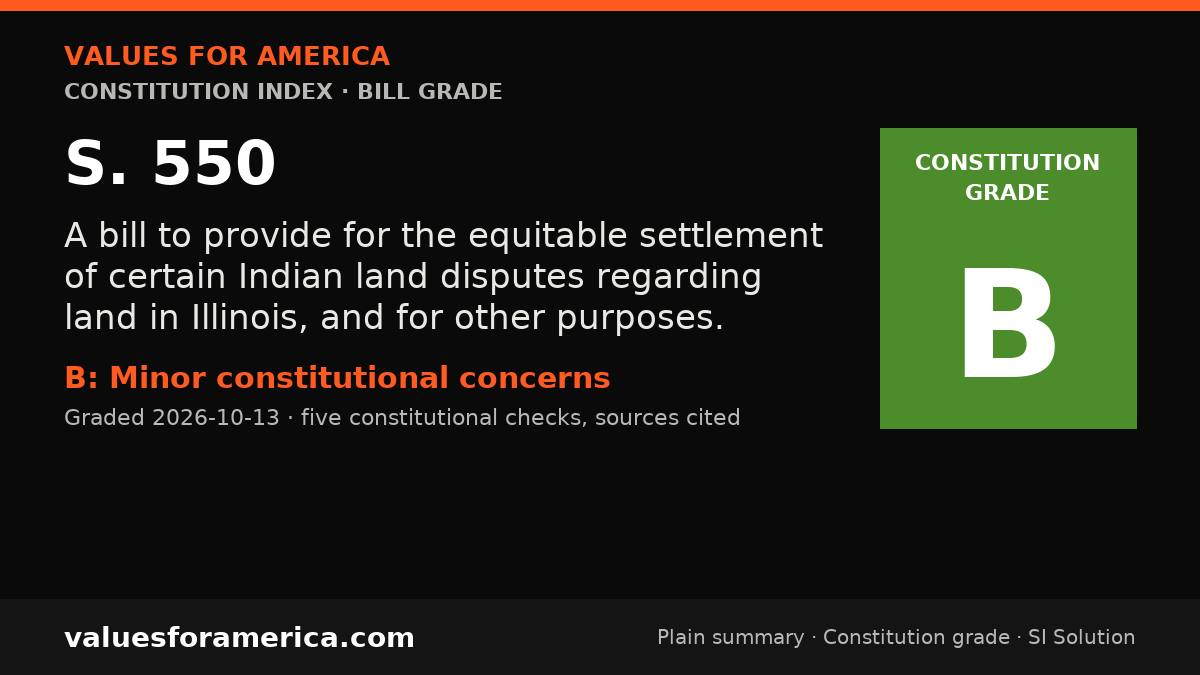
A bill to provide for the equitable settlement of certain Indian land disputes regarding land in Illinois, and for other purposes.
Cosponsors: 1 (1 D, 0 R) · per Congress.gov, 2026-10-17
Introduced: 2025-02-12
Latest action (2026-09-25): Became Public Law No: 119-114.
What S. 550 does, in plain terms
This bill confers jurisdiction to the U.S. Court of Federal Claims for the Miami Tribe of Oklahoma's land claim arising under the Treaty of Grouseland. The court must render judgement without regard to the statute of limitations or any delay-based defense. This jurisdiction expires unless such a claim is filed within one year. All other claims, including any future claims, of the tribe to land in Illinois are extinguished.
Official summary by the Congressional Research Service, via Congress.gov.
Constitution Index
“VFA Constitution grade”
Minor constitutional concerns
Graded 2026-10-13
SI-generated grade · five published checks · not individually reviewed by a person · methodology
This bill is a narrowly tailored exercise of Congress's plenary authority over Indian affairs, granting a specific tribal land claim jurisdiction in the U.S. Court of Federal Claims and extinguishing other claims. It does not infringe individual rights, respects the special trust relationship, and does not consolidate power beyond the federal level. The only minor tension is the waiver of the statute of limitations and delay-based defenses, which is a procedural adjustment within Congress's authority over its own courts and Indian policy.
-
✓ Passes · Enumerated powers
Congress has explicit constitutional authority over Indian affairs under Article I, Section 8, Clause 3 (the Indian Commerce Clause), which grants Congress power 'to regulate Commerce with the Indian Tribes.' This bill directly addresses a tribal land claim and the extinguishment of tribal claims, squarely within that authority. Additionally, Congress has broad authority to define the jurisdiction… -
✓ Passes · Bill of Rights
The bill does not infringe any of the first ten amendments. It does not restrict speech, religion, assembly, press, petition, arms, quartering, search and seizure, self-incrimination, due process, takings, trial rights, jury rights, cruel and unusual punishment, or unenumerated rights. The extinguishment of tribal land claims is a property interest, but the bill provides a remedy (jurisdiction to … -
✓ Passes · Individual sovereignty
The bill does not restrict the personal sovereignty of individuals. It affects the Miami Tribe of Oklahoma's collective land claims, not the rights of individual citizens to their person, property, speech, labor, or belief. The bill provides a forum for the tribe to pursue its claim, and extinguishes other claims, which is a legislative determination of the scope of tribal property rights. The bur… -
✓ Passes · Decentralization
This bill concerns a dispute between a tribe and the federal government over land ceded by treaty. Such disputes inherently require federal resolution because treaties are made under federal authority (Article II, Section 2, Clause 2) and the federal government has exclusive authority over Indian affairs. An individual, family, local community, or state could not resolve a treaty-based land claim … -
✓ Passes · Due process and takings
The bill provides a procedural remedy by conferring jurisdiction on the U.S. Court of Federal Claims, which is a court designed to hear claims against the United States. The waiver of the statute of limitations and delay-based defenses is a procedural rule that does not deprive the tribe of due process; rather, it ensures the claim can be heard on the merits. The extinguishment of other claims is …
Sources: Congress.gov: S 550 summary
Report an error in this grade
What should pass
“VFA SI Solution”
No solution yet
A sourced SI draft appears here once it passes automated checks (Constitution citation, source verification, independent SI critic). How publication works.
Related on VFA

For journalists and bloggers
“Embed this grade”
Free to use with the link back. The badge and card update when the grade changes. Embed terms →
