S. 5424 explained · 119th Congress · Pending in Congress
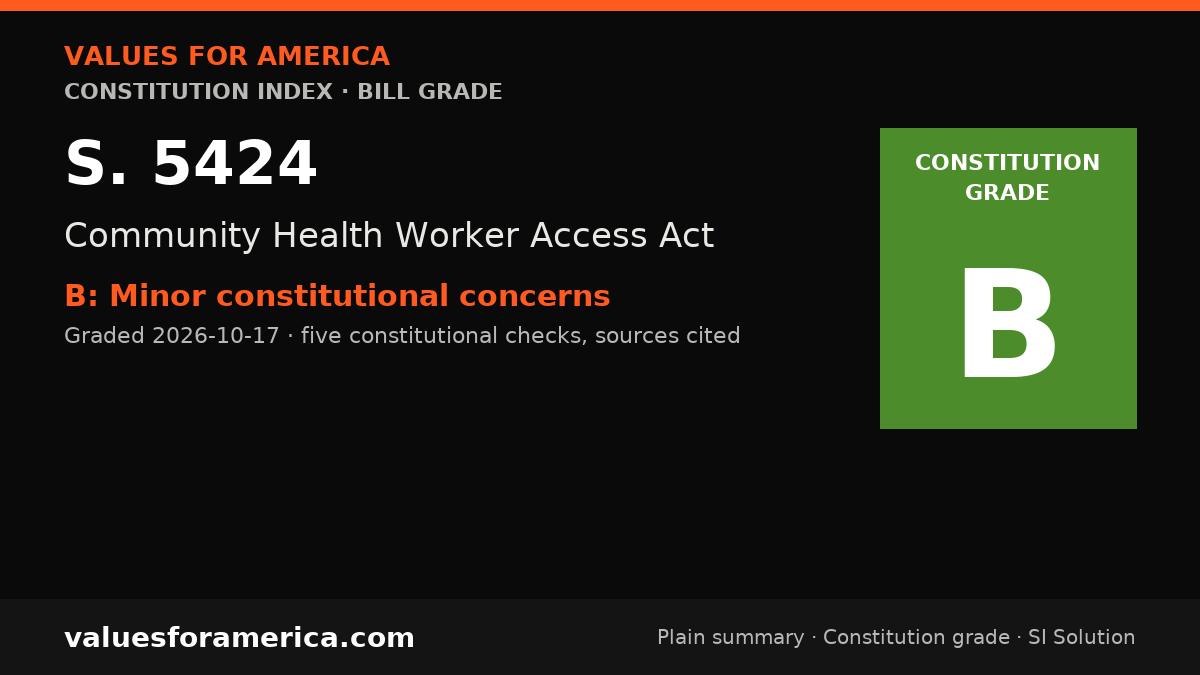
Community Health Worker Access Act
Cosponsors: none · per Congress.gov, 2026-10-14
Introduced: 2026-09-17
Latest action (2026-09-17): Read twice and referred to the Committee on Finance.
What S. 5424 does, in plain terms
Community Health Worker Access Act This bill provides for coverage of community health services under Medicare. Community health services are services provided by a community health agency in accordance with an individual needs assessment, including preventive services (e.g., screenings) and services to address social determinants of health (e.g., educational home visits). Community health agencies include nonprofits, federally qualified health centers, and other organizations that employ health workers (in accordance with certain labor standards) who have lived experience in the communities served. The bill also allows state Medicaid programs to cover these services and provides for an increased Medicaid federal matching rate, also known as the Federal Medical Assistance Percentage (FMAP), for these services.
Official summary by the Congressional Research Service, via Congress.gov.
Constitution Index
“VFA Constitution grade”
Minor constitutional concerns
Graded 2026-10-17
SI-generated grade · five published checks · not individually reviewed by a person · methodology
The Community Health Worker Access Act is a federal spending bill that expands Medicare and Medicaid coverage for community health services. It operates within Congress's enumerated power to spend for the general welfare and to provide for the common defense and general welfare, and it does not infringe on individual rights. The main constitutional concern is the increased FMAP, which may incentivize states to expand their Medicaid programs, potentially consolidating decision-making at the federal level. However, the bill leaves significant discretion to states and individuals, so the decentralization issue is minor and fixable.
-
✓ Passes · Enumerated powers
Congress has the power to tax and spend for the general welfare under Article I, Section 8, Clause 1. This bill authorizes federal spending on community health services through Medicare and Medicaid, which is a valid exercise of the spending power. The bill does not regulate private conduct directly but conditions federal funds on state and provider participation, which is consistent with the Spen… -
✓ Passes · Bill of Rights
The bill does not implicate any of the first ten amendments. It does not restrict speech, religion, assembly, press, petition, arms, quartering, search and seizure, self-incrimination, due process, trial rights, jury rights, cruel and unusual punishment, or unenumerated rights. It is a voluntary program that expands access to health services, not a restriction on individual liberties. -
✓ Passes · Individual sovereignty
The bill does not restrict individual freedom. It provides additional coverage options for Medicare and Medicaid beneficiaries, and it does not compel anyone to participate. Individuals retain the freedom to choose their health care providers and services. The bill's requirements for community health agencies to employ workers with lived experience and meet labor standards are conditions on federa… -
✗ Concern · Decentralization
The bill fails the decentralization test because it consolidates decision-making at the federal level by expanding federal programs (Medicare and Medicaid) and offering an increased FMAP to incentivize state adoption. While individuals and states can choose to participate, the federal government is setting the terms and providing financial incentives that may lead to a more uniform, federally-driv… -
✓ Passes · Due process and takings
The bill does not deprive anyone of life, liberty, or property without due process. It does not take private property for public use without just compensation. The bill establishes eligibility criteria and procedural requirements for providers, but these are not arbitrary and do not violate the Fifth Amendment's Due Process or Takings Clauses.
Sources: Congress.gov: S 5424 summary
Report an error in this grade
What should pass
“VFA SI Solution”
No solution yet
A sourced SI draft appears here once it passes automated checks (Constitution citation, source verification, independent SI critic). How publication works.
Related on VFA

For journalists and bloggers
“Embed this grade”
Free to use with the link back. The badge and card update when the grade changes. Embed terms →
