S. 5319 explained · 119th Congress · Pending in Congress
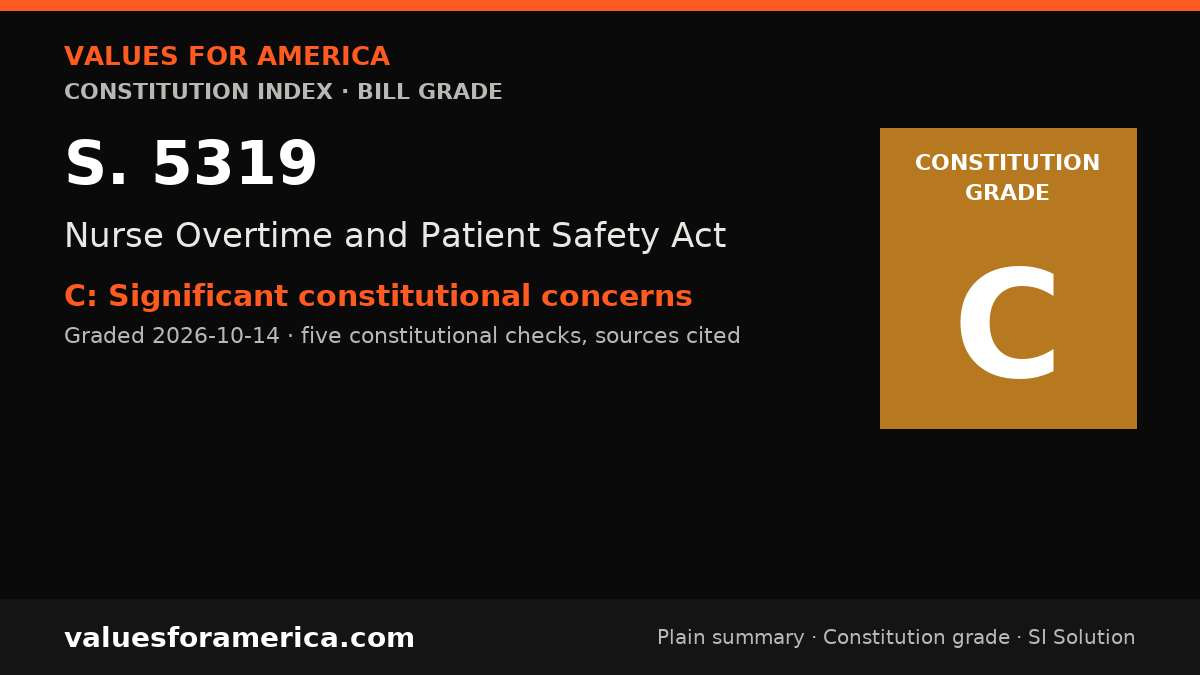
Nurse Overtime and Patient Safety Act
Cosponsors: 3 (3 D, 0 R) · per Congress.gov, 2026-10-14
Introduced: 2026-08-06
Latest action (2026-08-06): Read twice and referred to the Committee on Finance.
What S. 5319 does, in plain terms
Nurse Overtime and Patient Safety Act This bill requires certain providers, as a condition of Medicare participation, to limit mandatory overtime for nurses. Specifically, the bill prohibits hospitals, ambulatory surgical centers, home health agencies, rural health clinics, federally qualified health centers, and other specified providers from requiring nurses to work (1) more than a previously scheduled shift, 48 hours in a workweek, or 12 consecutive hours in a 24-hour period; or (2) during the 10 hours immediately following the 12th hour worked in a shift during a 24-hour period. Qualifying work hours include time spent in training, on call, and on standby. The bill's provisions do not apply during declared emergencies or disasters, subject to specified conditions, and do not preclude voluntary overtime. The bill also establishes (1) certain protections for nurses who file complaints against providers, (2) documentation and notice requirements for providers, and (3) potential civil penalties for violations.
Official summary by the Congressional Research Service, via Congress.gov.
Constitution Index
“VFA Constitution grade”
Significant constitutional concerns
Graded 2026-10-14
SI-generated grade · five published checks · not individually reviewed by a person · methodology
The bill uses the federal spending power to impose labor regulations on healthcare providers as a condition of Medicare participation. While this is a recognized use of federal power, it significantly intrudes into areas traditionally reserved to the states and to private contracting, and it imposes detailed mandates that go beyond the core purpose of Medicare. The bill's protections for whistleblowers and its penalty provisions raise due process concerns. Overall, the bill is constitutionally problematic but not a direct violation of the Bill of Rights.
-
✓ Passes · Enumerated powers
The federal government has the power to attach conditions to the receipt of federal funds, including Medicare, under the Spending Clause (Article I, Section 8, Clause 1) and the Necessary and Proper Clause (Article I, Section 8, Clause 18). Requiring providers to limit mandatory overtime as a condition of Medicare participation is a valid exercise of the spending power, as long as the conditions a… -
✓ Passes · Bill of Rights
The bill does not directly infringe on the rights protected by the Bill of Rights. It does not restrict speech, religion, assembly, press, petition, or the right to keep and bear arms. It does not involve searches or seizures, self-incrimination, or cruel and unusual punishment. The bill's protections for nurses who file complaints actually support the right to petition the government for redress … -
✗ Concern · Individual sovereignty
The bill restricts the freedom of nurses and employers to voluntarily agree to work schedules that exceed the bill's limits. While the bill allows voluntary overtime, it prohibits mandatory overtime beyond specified hours, which interferes with the freedom of contract and the right of individuals to negotiate their own labor terms. The government must show a compelling interest to justify such res… -
✗ Concern · Decentralization
The bill fails the decentralization test because it consolidates decision-making at the federal level. While an individual or family could not handle this issue, and local communities and states could potentially regulate nurse overtime, the federal government is imposing a one-size-fits-all rule on all Medicare providers nationwide. States have traditionally regulated healthcare labor practices, … -
✗ Concern · Due process and takings
The bill establishes civil penalties for violations and provides protections for nurses who file complaints, but it does not specify the procedures for imposing penalties or for adjudicating complaints. This raises due process concerns under the Fifth Amendment, as providers may be subject to penalties without adequate notice or a fair hearing. The bill also imposes documentation and notice requir…
Sources: Congress.gov: S 5319 summary
Report an error in this grade
What should pass
“VFA SI Solution”
No solution yet
A sourced SI draft appears here once it passes automated checks (Constitution citation, source verification, independent SI critic). How publication works.
Related on VFA

For journalists and bloggers
“Embed this grade”
Free to use with the link back. The badge and card update when the grade changes. Embed terms →
