S. 5318 explained · 119th Congress · Pending in Congress
Summer Meals and Learning Act of 2026
Cosponsors: 4 (4 D, 0 R) · per Congress.gov, 2026-10-14
Introduced: 2026-08-06
Latest action (2026-08-06): Read twice and referred to the Committee on Health, Education, Labor, and Pensions.
What S. 5318 does, in plain terms
Summer Meals and Learning Act of 2026 This bill establishes a grant program to support summer early reading programs held at schools with a summer lunch site. Specifically, the Department of Education must use funds provided for the program to award competitive grants to state library administrative agencies to enable them to award subgrants to eligible local educational agencies for summer early reading programs held at schools with a summer lunch site. The program is open to local educational agencies that include schools where at least 50% of the students in prekindergarten through grade 3 are (1) reading below grade level at grade 3, or (2) at risk of reading below grade level at grade 3.
Official summary by the Congressional Research Service, via Congress.gov.
Constitution Index
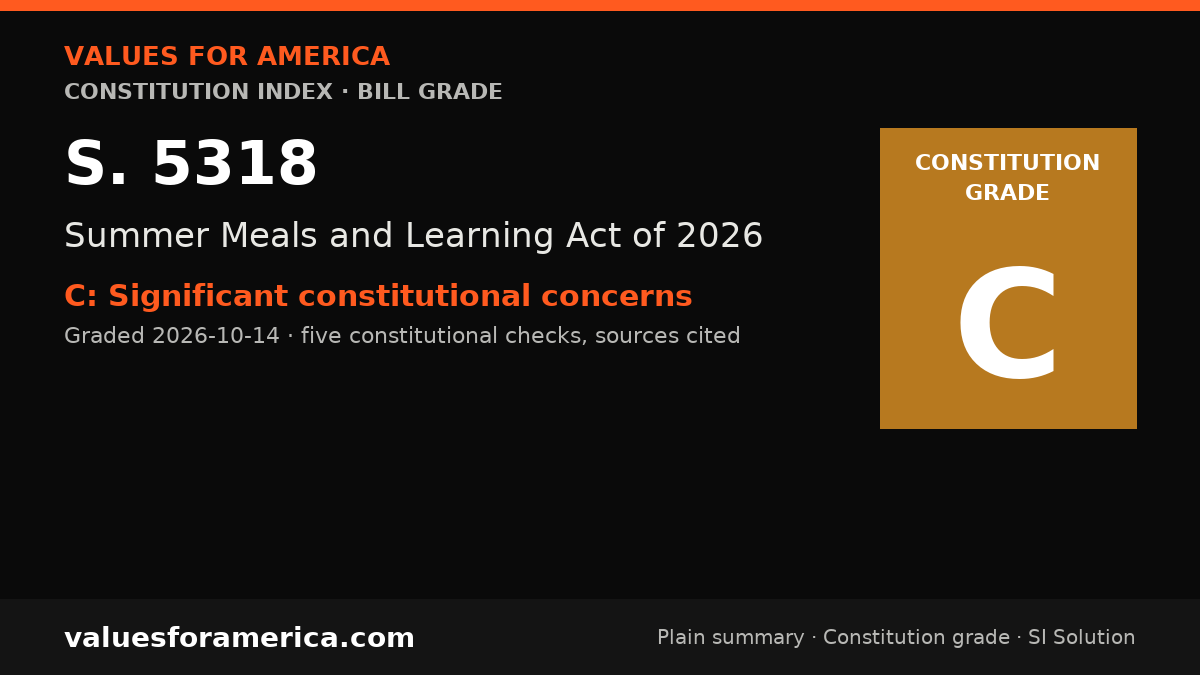
“VFA Constitution grade”
Significant constitutional concerns
Graded 2026-10-14
SI-generated grade · five published checks · not individually reviewed by a person · methodology
The Summer Meals and Learning Act of 2026 raises significant constitutional concerns. While the federal government has broad spending power under Article I, Section 8, Clause 1, the bill's grant program conditions funding on state and local compliance, effectively directing state and local educational priorities. This overreach into education—a power reserved to the states under the Tenth Amendment—combined with the lack of a clear enumerated power beyond general welfare, makes the bill constitutionally problematic. The bill does not directly infringe on individual rights, but it consolidates decision-making at the federal level, failing the decentralization test. The program's structure also raises due process concerns by potentially withholding benefits without adequate procedural safeguards.
-
✗ Concern · Enumerated powers
The federal government's enumerated powers do not include education. While Article I, Section 8, Clause 1 grants Congress the power to spend for the general welfare, the Supreme Court has held that spending must be in pursuit of the general welfare and not prohibited by other provisions. Here, the bill uses federal funds to incentivize states to adopt specific early reading programs, effectively d… -
✓ Passes · Bill of Rights
The bill does not directly infringe on any of the first ten amendments. It does not restrict speech, religion, assembly, press, petition, arms, quartering, search and seizure, self-incrimination, due process, takings, fair trial, jury, cruel and unusual punishment, or unenumerated rights. The program is voluntary for states and local educational agencies, and it does not impose any direct restrict… -
✓ Passes · Individual sovereignty
The bill does not restrict what individuals can do with their own person, property, speech, labor, or belief. It establishes a grant program that states and localities may choose to participate in. There is no compelling constitutional justification required because there is no restriction on individual freedom. The program is purely voluntary at the state and local level, and individuals are not … -
✗ Concern · Decentralization
The bill fails the decentralization test. (1) An individual or family could not handle this alone, as it involves systemic educational programs. (2) A local community or county could handle this without state involvement, as they already operate schools and lunch programs. (3) A state could handle this without federal involvement, as education is a state responsibility. (4) The bill consolidates d… -
✗ Concern · Due process and takings
The bill does not take property, but it raises due process concerns. The grant program conditions federal funds on state and local compliance with federal requirements. If a state or local agency fails to meet the conditions, they could lose funding without a clear hearing or procedural safeguards. This could be seen as arbitrary government action, violating substantive due process. Additionally, …
Sources: Congress.gov: S 5318 summary
Report an error in this grade
What should pass
“VFA SI Solution”
No solution yet
A sourced SI draft appears here once it passes automated checks (Constitution citation, source verification, independent SI critic). How publication works.
Related on VFA

For journalists and bloggers
“Embed this grade”
Free to use with the link back. The badge and card update when the grade changes. Embed terms →
