S. 5317 explained · 119th Congress · Pending in Congress
INSPIRES Act
Cosponsors: 1 (1 D, 0 R) · per Congress.gov, 2026-10-14
Introduced: 2026-08-06
Latest action (2026-08-06): Read twice and referred to the Committee on Health, Education, Labor, and Pensions.
What S. 5317 does, in plain terms
Inspiring New STEM Professionals by Investing in Renovation of Education Spaces Act or the INSPIRES Act This bill directs the Department of Education to establish grant programs (1) for the modernization, renovation, or repair of career- and technical-education facilities; and (2) to enable secondary schools that are located in rural areas or that serve Native American students to improve facilities that provide science, technology, engineering, and mathematics (STEM) education and to support high-speed internet in STEM facilities.
Official summary by the Congressional Research Service, via Congress.gov.
Constitution Index
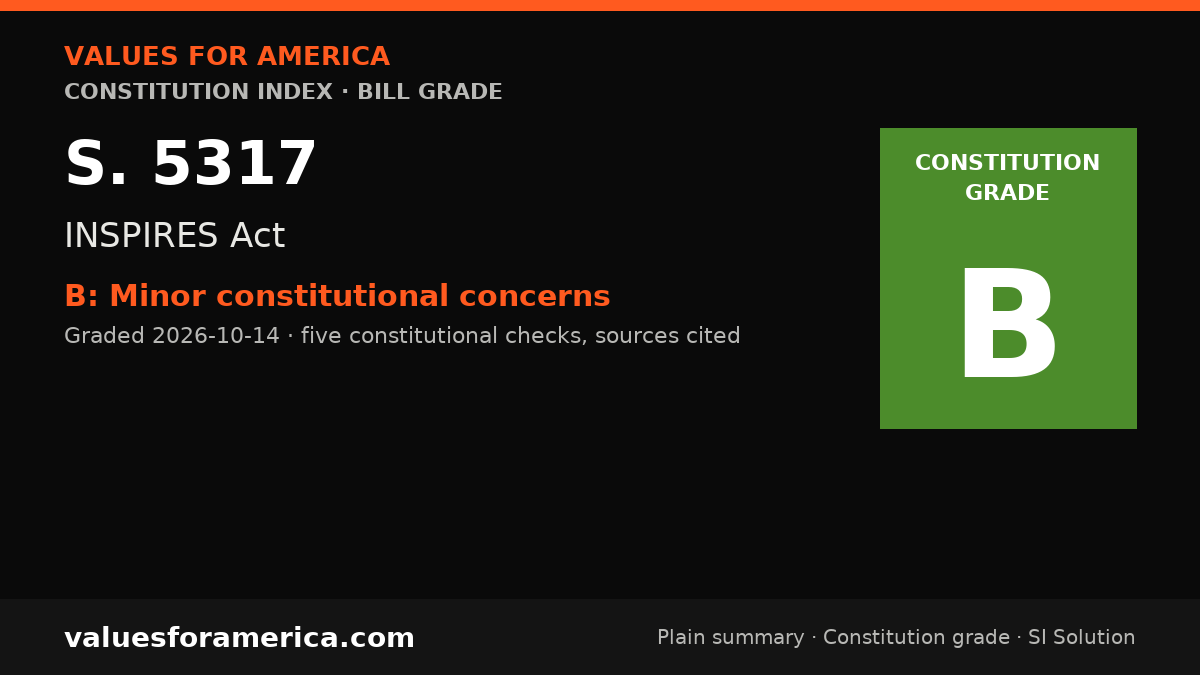
“VFA Constitution grade”
Minor constitutional concerns
Graded 2026-10-14
SI-generated grade · five published checks · not individually reviewed by a person · methodology
The INSPIRES Act is a federal grant program for education facilities, which falls under the spending power and is generally constitutional. However, it raises minor concerns about federal involvement in areas traditionally reserved to states and localities, and the lack of explicit due process protections for grant recipients. The bill does not infringe on individual rights and does not consolidate power beyond what is necessary for a federal spending program.
-
✓ Passes · Enumerated powers
The bill authorizes the Department of Education to establish grant programs, which is an exercise of Congress's spending power under Article I, Section 8, Clause 1. While education is not explicitly enumerated, the spending power allows Congress to attach conditions to federal funds, and the bill's purpose—improving STEM and career-technical education facilities—is a permissible use of federal spe… -
✓ Passes · Bill of Rights
The bill does not implicate any of the first ten amendments. It does not restrict speech, religion, assembly, press, petition, arms, quartering, search and seizure, self-incrimination, due process, takings, fair trial, jury, cruel and unusual punishment, or unenumerated rights. The grant programs are voluntary and do not coerce or penalize individuals or states. -
✓ Passes · Individual sovereignty
The bill does not restrict individual liberty. It provides federal funds to schools for facility improvements and internet access, which enhances educational opportunities rather than restricting personal freedom. There is no burden on individuals to justify any action; the government is not compelling or prohibiting any individual behavior. -
✗ Concern · Decentralization
The bill fails the decentralization test because it involves federal funding for local school facilities, which could be handled at the state or local level. However, the federal role is limited to providing grants, and the bill does not mandate or preempt state action. The consolidation is upward but minimal, as it does not take over decision-making but rather supports local initiatives. The bill… -
✓ Passes · Due process and takings
The bill does not take property or deprive individuals of life, liberty, or property without due process. It establishes grant programs, which are voluntary and do not impose penalties or obligations. There is no indication of arbitrary government action or lack of fair notice. The bill does not implicate the Takings Clause of the Fifth Amendment.
Sources: Congress.gov: S 5317 summary
Report an error in this grade
What should pass
“VFA SI Solution”
No solution yet
A sourced SI draft appears here once it passes automated checks (Constitution citation, source verification, independent SI critic). How publication works.
Related on VFA

For journalists and bloggers
“Embed this grade”
Free to use with the link back. The badge and card update when the grade changes. Embed terms →
