S. 5271 explained · 119th Congress · Pending in Congress
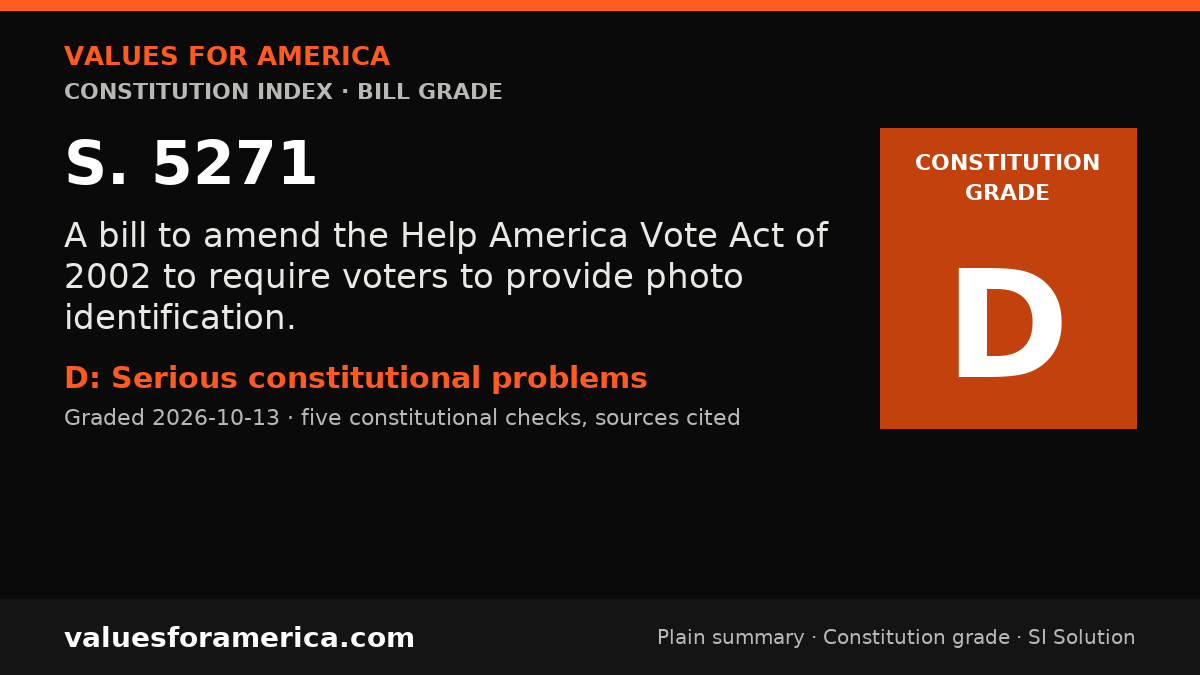
A bill to amend the Help America Vote Act of 2002 to require voters to provide photo identification.
Cosponsors: 2 (0 D, 2 R) · per Congress.gov, 2026-10-14
Introduced: 2026-08-05
Latest action (2026-08-08): Cloture on the motion to proceed to the measure not invoked in Senate by Yea-Nay Vote. 52 - 46. Record Vote Number: 231.
What S. 5271 does, in plain terms
This bill establishes certain photo identification requirements for voting in federal elections. Specifically, the bill prohibits a state or local election official from providing a ballot for a federal election to an individual who does not present valid physical photo identification. Next, the bill outlines the availability of provisional ballots and the requirements for counting those ballots. An individual who does not present a valid photo identification must be permitted to cast a provisional ballot. However, an election official may not determine that the individual is eligible under state law to vote in the election unless, not later than three days after casting the provisional ballot, the individual presents (1) the identification required, or (2) an affidavit attesting that the individual does not possess the identification because of a religious objection to being photographed. An election official may not allow for voting methods other than in-person voting unless the individual submits with the ballot (1) a copy of their photo identification, or (2) the last four digits of their Social Security number with an affidavit attesting that the individual is unable to obtain a copy of a valid photo identification after making reasonable efforts to obtain a copy. This prohibition shall not apply to overseas military voters and certain disabled or elderly voters. States must, to the extent practicable, ensure public access to digital imaging devices for individuals to make a free copy of their valid photo identification. These requirements take effect one day after the bill's enactment.
Official summary by the Congressional Research Service, via Congress.gov.
Constitution Index
“VFA Constitution grade”
Serious constitutional problems
Graded 2026-10-13
SI-generated grade · five published checks · not individually reviewed by a person · methodology
This bill imposes a photo identification requirement for voting in federal elections that creates a significant burden on the fundamental right to vote, particularly for citizens who lack such identification. While states have authority under Article I, Section 4 to regulate the 'Times, Places and Manner' of elections, this requirement is not narrowly tailored to a compelling government interest and imposes an undue restriction on the right to vote, violating the First and Fourteenth Amendments. The bill also raises concerns under the Fourth Amendment by effectively requiring citizens to submit to government identification regimes to exercise a constitutional right. The three-day window to cure a provisional ballot is insufficient for many voters, especially those in rural areas or with limited mobility, and the religious objection exception is too narrow, failing to account for other legitimate reasons for lacking photo ID. The bill fails the decentralization test by imposing a uniform federal mandate that overrides state flexibility in election administration.
-
✗ Concern · Enumerated powers
The bill relies on Congress's power under Article I, Section 4, Clause 1 to regulate the 'Times, Places and Manner of holding Elections for Senators and Representatives.' However, this power is not unlimited; it must be exercised in a manner consistent with other constitutional provisions, including the Bill of Rights. The Supreme Court has held that Congress may not use its election power to abri… -
✗ Concern · Bill of Rights
The bill infringes the First Amendment right to vote, which the Supreme Court has recognized as a fundamental right protected by the First and Fourteenth Amendments. See Burdick v. Takushi, 504 U.S. 428 (1992). The photo ID requirement imposes a severe burden on the right to vote, particularly for minority, low-income, elderly, and disabled voters who are less likely to possess such identification… -
✗ Concern · Individual sovereignty
The bill restricts an individual's sovereign right to vote without a compelling constitutional justification. The government bears the burden to show that the restriction is necessary to achieve a compelling interest, such as preventing voter fraud. However, the evidence of widespread voter impersonation fraud is virtually nonexistent. See Crawford v. Marion County Election Board, 553 U.S. 181 (20… -
✗ Concern · Decentralization
The bill fails the decentralization test. (1) An individual cannot handle this requirement on their own if they lack the resources or ability to obtain photo ID. (2) Local communities could handle voter identification requirements without state or federal involvement, as many localities already do. (3) States can handle voter identification requirements without federal involvement, as many states … -
✗ Concern · Due process and takings
The bill violates procedural due process under the Fifth Amendment by imposing a three-day deadline to cure a provisional ballot without providing adequate notice or a meaningful opportunity to be heard. Many voters may not learn of the deficiency in time to comply, especially if they are traveling or have limited access to mail or the internet. The bill also violates substantive due process by ar…
Sources: Congress.gov: S 5271 summary
Report an error in this grade
The Framers
“Founders’ Verdict”
Confidence 0.75
Archived SI output (machine-generated)No editorial review recorded. This historical SI verdict was machine-generated by software and predates the review desk; check it against the official bill text.
Synthesis
The bill is constitutional only if it includes reasonable accommodations to prevent undue burdens on voters, such as free access to identification and alternative verification methods, ensuring it does not disenfranchise citizens or exceed Congress's enumerated power under Article I, Section 4.
The Constitution vests in the states the power to prescribe the times, places, and manner of holding elections for Senators and Representatives, subject to alteration by Congress (Article I, Section 4, Clause 1). This bill, amending the Help America Vote Act, is a proper exercise of Congress's authority to regulate federal elections to ensure uniformity and integrity. Requiring photo identification is a reasonable measure to prevent fraud and preserve public confidence in the electoral process, as the federal government has an interest in the legitimacy of elections for its own officers. The p…
The Constitution does not delegate to the Congress the power to impose voter identification requirements upon the states. Article I, Section 4 grants Congress authority to alter the times, places, and manner of elections, but this is a limited power meant to ensure uniformity in federal elections, not to impose burdens on the right of suffrage. The Tenth Amendment expressly reserves to the states or to the people all powers not delegated to the United States. The regulation of voter qualifications and the manner of voting are among those reserved powers. Moreover, the right to vote is a fundam…
The Constitution expressly grants Congress the authority to regulate the 'Manner' of holding elections for Senators and Representatives, subject to alteration by Congress. Requiring photo identification is a regulation of the manner of voting, aimed at preserving the integrity and security of federal elections. This power is enumerated and proper, and does not conflict with the states' primary role in prescribing election regulations, as Congress may 'make or alter' such rules. The requirement does not impose a new qualification for electors (such as property or religious tests), but rather a …
The Constitution vests in the States the power to prescribe the times, places, and manner of holding elections for Senators and Representatives, subject only to alteration by Congress (Article I, Section 4, Clause 1). Congress may, under this authority, enact laws to ensure the integrity of federal elections, including requiring photo identification, provided such measures are appropriate and plainly adapted to that legitimate end, as established in McCulloch v. Maryland (1819). However, the Constitution also reserves to the people the right to vote, and any federal restriction must not unduly…
Report an error in this Founders' Verdict
What should pass
“VFA SI Solution”
Archived SI output (machine-generated) · No editorial review recorded
This historical draft has no editorial review time on record. Check its claims against the original bill and current law.
Secure and Accessible Federal Elections Act of 2025
Generated by VFA SI Solutions
To require voters to present photo identification when voting in federal elections, in order to prevent voter impersonation fraud and increase public confidence in election integrity.
Bipartisan rationale: Democratic priorities: free IDs and alternative verification protect voting rights and prevent disenfranchisement of low-income, elderly, and minority voters. Republican priorities: photo ID requirement deters voter impersonation fraud and increases public confidence in election integrity.
Report an error in this Solution
Citizen Consensus
“Do you support this VFA SI Solution?”
One vote per verified account; you can change it any time. Only verified accounts count, results publish once 30 verified people have voted, and state and district results count only people who attested a home ZIP code. How this works.
Email verification is not switched on yet, so no vote counts toward results yet. Votes cast now are saved and count once the voter verifies their email address.
Sign in or create a free account to vote.
Add a short reason (optional)
/280 · no links or contact details · reasons are reviewed before anyone sees them, and many never are shown.
Your vote is saved but held out of published results by an automated integrity check (for example, several accounts voting from one browser).
Your vote is saved. It will count once you verify your email address. Verify on your account page.
Your vote counts nationally. Add your home ZIP code to count in your state and district too.
Your vote counts nationally and in .
Reason saved privately; it is shown only if it passes review.
Verified participants nationwide · n =
Self-selected participants, not a random sample; ± is the 95% sampling margin.
Not enough verified votes yet. Results publish at verified votes.
A sudden surge of votes on this item was flagged and is under review; votes from new accounts in that surge are held out until it is resolved.
Related on VFA

For journalists and bloggers
“Embed this grade”
Free to use with the link back. The badge and card update when the grade changes. Embed terms →
