S. 5254 explained · 119th Congress · Pending in Congress
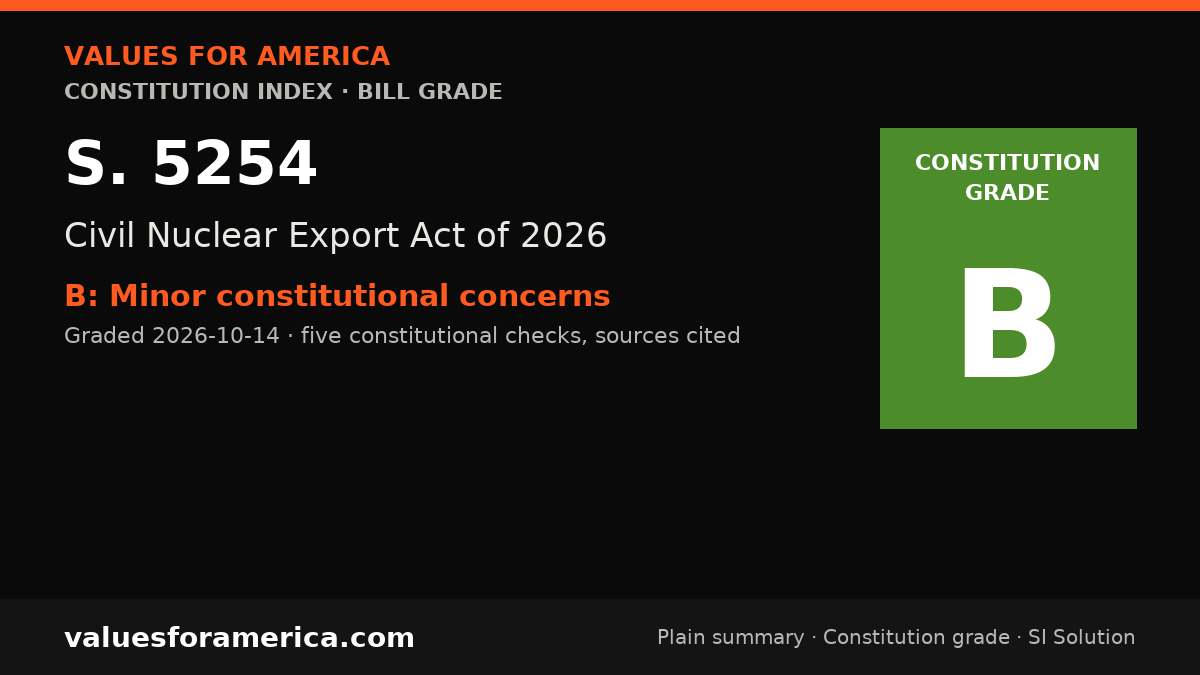
Civil Nuclear Export Act of 2026
Cosponsors: 1 (1 D, 0 R) · per Congress.gov, 2026-10-14
Introduced: 2026-08-05
Latest action (2026-08-05): Read twice and referred to the Committee on Banking, Housing, and Urban Affairs.
What S. 5254 does, in plain terms
Civil Nuclear Export Act of 2026 This bill provides the Export-Import Bank with certain authorities to finance civil nuclear energy exports. Specifically, the bill allows the Export-Import Bank to provide financing for the purchase of liquid metal fast breeder nuclear reactors and nuclear fuel reprocessing facilities if the purchase is otherwise permitted by law. Additionally, the bill expands the China and Transformational Exports Program (CTEP) by making civil nuclear energy eligible for financing under the program. Currently, the bank may extend loans, guarantees, and insurance to advance the comparative leadership of the United States with respect to China in specified export areas (e.g., artificial intelligence, biotechnology, and wireless communications equipment). This bill expands those areas to include civil nuclear energy technologies, materials, services, and related infrastructure and goods. The bill also revises the financial limitation on the outstanding aggregate amount of all of the bank's loans, guarantees, and insurance. In particular, the bill exempts those amounts attributed by the bank to CTEP, as long as that financing does not exceed a specified amount. The bill also increases from 2% to 4% the bank's default rate cap. Further, the bill allows the bank to exclude financing under CTEP from this default rate, subject to approval of the bank's board of directors.
Official summary by the Congressional Research Service, via Congress.gov.
Constitution Index
“VFA Constitution grade”
Minor constitutional concerns
Graded 2026-10-14
SI-generated grade · five published checks · not individually reviewed by a person · methodology
The bill operates within Congress's enumerated power to regulate foreign commerce and to create and fund federal agencies, and it does not infringe on individual rights. The main constitutional concerns are the expansion of federal financing into areas that could be handled by private markets and the upward consolidation of decision-making, but these are within the scope of federal authority over foreign trade and finance. The bill is mostly sound, with minor tensions regarding the appropriate scope of federal involvement.
-
✓ Passes · Enumerated powers
Congress has the power to regulate commerce with foreign nations under Article I, Section 8, Clause 3. Financing exports of civil nuclear technology is a form of foreign commerce regulation. Additionally, the Export-Import Bank is a federal agency created under Congress's spending power (Article I, Section 8, Clause 1) and its necessary and proper authority (Article I, Section 8, Clause 18). The b… -
✓ Passes · Bill of Rights
The bill does not implicate any of the first ten amendments. It does not restrict speech, religion, assembly, press, petition, arms, quartering, search and seizure, self-incrimination, due process, takings, trial rights, or cruel and unusual punishment. It is a commercial financing measure that does not affect individual liberties. -
✓ Passes · Individual sovereignty
The bill does not restrict individual action. It provides government financing for certain exports, which is a voluntary program. It does not compel any individual to engage in any transaction, nor does it restrict what individuals can do with their property, labor, or speech. The burden of justification for any restriction is not triggered because there is no restriction. -
✗ Concern · Decentralization
The bill fails the decentralization test because it consolidates decision-making at the federal level for financing civil nuclear exports, which could be handled by private markets or individual companies without government involvement. However, foreign trade is an area where the Constitution explicitly grants the federal government authority, and the bill does not violate the Tenth Amendment beca… -
✓ Passes · Due process and takings
The bill does not bypass due process or take property without just compensation. It does not affect any individual's property rights. The changes to the Export-Import Bank's financing limits and default rate caps are administrative and do not implicate procedural or substantive due process concerns.
Sources: Congress.gov: S 5254 summary
Report an error in this grade
What should pass
“VFA SI Solution”
Archived SI output (machine-generated) · No editorial review recorded
This historical draft has no editorial review time on record. Check its claims against the original bill and current law.
Civil Nuclear Export Competitiveness and Safeguards Act of 2025
Generated by VFA SI Solutions
The bill seeks to remove or modify the current prohibition on the Export-Import Bank financing civil nuclear energy projects abroad, allowing U.S. companies to compete in the global nuclear energy market.
Bipartisan rationale: This bill honors Democratic priorities of nonproliferation and environmental safety by limiting financing to countries with strong nonproliferation commitments and requiring advanced, safer reactor designs. It honors Republican priorities of supporting U.S. exports, energy dominance, and economic growth by enabling American nuclear companies to compete globally without increasing the deficit.
Article I, Section 8, Clause 3 Article II, Section 2, Clause 2
Report an error in this Solution
Citizen Consensus
“Do you support this VFA SI Solution?”
One vote per verified account; you can change it any time. Only verified accounts count, results publish once 30 verified people have voted, and state and district results count only people who attested a home ZIP code. How this works.
Email verification is not switched on yet, so no vote counts toward results yet. Votes cast now are saved and count once the voter verifies their email address.
Sign in or create a free account to vote.
Add a short reason (optional)
/280 · no links or contact details · reasons are reviewed before anyone sees them, and many never are shown.
Your vote is saved but held out of published results by an automated integrity check (for example, several accounts voting from one browser).
Your vote is saved. It will count once you verify your email address. Verify on your account page.
Your vote counts nationally. Add your home ZIP code to count in your state and district too.
Your vote counts nationally and in .
Reason saved privately; it is shown only if it passes review.
Verified participants nationwide · n =
Self-selected participants, not a random sample; ± is the 95% sampling margin.
Not enough verified votes yet. Results publish at verified votes.
A sudden surge of votes on this item was flagged and is under review; votes from new accounts in that surge are held out until it is resolved.
Related on VFA

For journalists and bloggers
“Embed this grade”
Free to use with the link back. The badge and card update when the grade changes. Embed terms →
