S. 5218 explained · 119th Congress · Pending in Congress
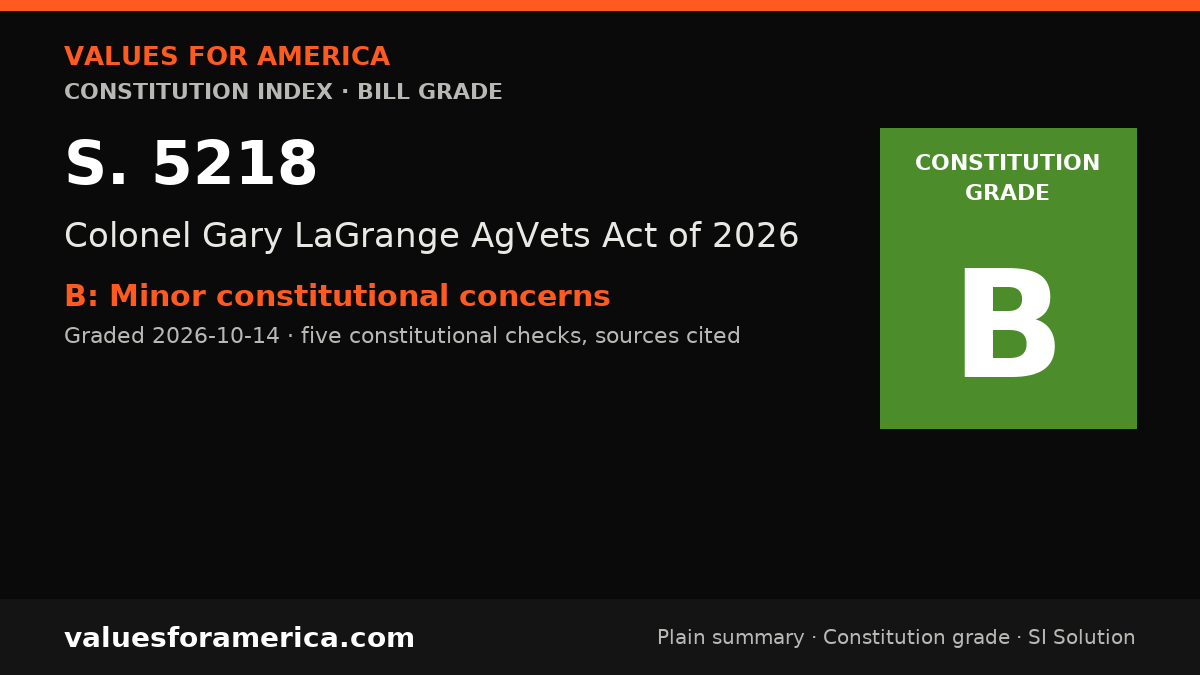
Colonel Gary LaGrange AgVets Act of 2026
Cosponsors: none · per Congress.gov, 2026-10-14
Introduced: 2026-08-03
Latest action (2026-08-03): Read twice and referred to the Committee on Agriculture, Nutrition, and Forestry.
What S. 5218 does, in plain terms
Colonel Gary LaGrange AgVets Act of 2026 This bill directs the Department of Agriculture to provide competitive grants to eligible entities for the purpose of establishing and enhancing farming and ranching opportunities for veterans through education and training services. Entities eligible for the grants include cooperative extension services, land-grant colleges and universities, non-land-grant colleges of agriculture, state departments of agriculture, and nonprofit organizations.
Official summary by the Congressional Research Service, via Congress.gov.
Constitution Index
“VFA Constitution grade”
Minor constitutional concerns
Graded 2026-10-14
SI-generated grade · five published checks · not individually reviewed by a person · methodology
The bill is a federal spending measure that provides grants to support agricultural education and training for veterans. It falls within Congress's spending power and is consistent with the constitutional framework, though it involves federal involvement in an area traditionally managed by states and localities, which creates minor tension with principles of decentralization.
-
✓ Passes · Enumerated powers
Congress has the power to spend for the general welfare under Article I, Section 8, Clause 1. Providing grants to support agricultural education and training for veterans is a permissible exercise of the spending power, as it is directed toward a national purpose (supporting veterans and agriculture) and does not compel states or individuals to participate. -
✓ Passes · Bill of Rights
The bill does not infringe on any rights protected by the Bill of Rights. It imposes no restrictions on speech, religion, assembly, press, petition, arms, quartering, search and seizure, self-incrimination, due process, takings, trial by jury, or cruel and unusual punishment. It is a voluntary grant program that does not coerce or penalize any individual or entity. -
✓ Passes · Individual sovereignty
The bill does not restrict individual freedom. It provides voluntary grants to eligible entities for educational and training services, which expands opportunities for veterans rather than limiting them. There is no burden on individual sovereignty; the program is optional and does not mandate participation. -
✗ Concern · Decentralization
The bill fails the decentralization test because it consolidates decision-making at the federal level for agricultural education and training, which could be handled by states, localities, or even individuals and families. While the grants are distributed to state and local entities, the federal government sets the criteria and directs the funding, which is a higher level of involvement than the m… -
✓ Passes · Due process and takings
The bill does not bypass due process or take property without just compensation. It is a grant program that does not affect property rights or impose penalties. There are no procedural or substantive due process concerns, as the program is voluntary and does not deprive anyone of life, liberty, or property.
Sources: Congress.gov: S 5218 summary
Report an error in this grade
What should pass
“VFA SI Solution”
No solution yet
A sourced SI draft appears here once it passes automated checks (Constitution citation, source verification, independent SI critic). How publication works.
Related on VFA

For journalists and bloggers
“Embed this grade”
Free to use with the link back. The badge and card update when the grade changes. Embed terms →
