S. 5200 explained · 119th Congress · Pending in Congress
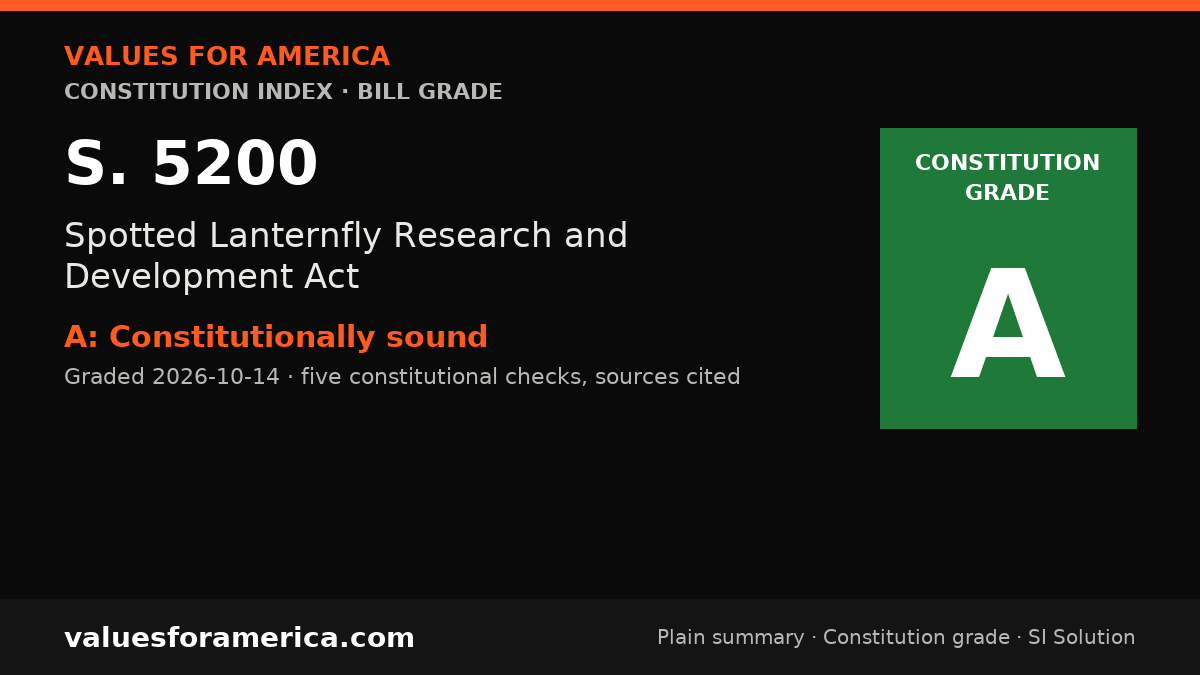
Spotted Lanternfly Research and Development Act
Cosponsors: 5 (4 D, 1 R) · per Congress.gov, 2026-10-14
Introduced: 2026-07-30
Latest action (2026-07-30): Read twice and referred to the Committee on Agriculture, Nutrition, and Forestry.
What S. 5200 does, in plain terms
Spotted Lanternfly Research and Development Act This bill includes combatting the spotted lanternfly (Lycorma delicatula) as a Department of Agriculture (USDA) high-priority research and extension area and reauthorizes other USDA research and extension initiatives. The bill specifically allows grants for developing and disseminating research-based tools and treatments to combat the spotted lanternfly, which is an invasive species native to Asia that feeds on a wide range of crops and plants (e.g., grapes, apples, hops, walnuts, and hardwood trees). Further, the bill reauthorizes USDA grants to support competitive specialized research and extension activities, including high-priority areas, through FY2028. The bill also specifically reauthorizes through FY2028 the Pulse Crop Health Initiative; the Comprehensive Food Safety Training Network; pollinator protection research and extension grants; increased USDA capacity and infrastructure to address and conduct research on colony collapse disorder and other pollinator issues; and a USDA-conducted nationwide honey bee pest, pathogen, health, and population status surveillance program.
Official summary by the Congressional Research Service, via Congress.gov.
Constitution Index
“VFA Constitution grade”
Constitutionally sound
Graded 2026-10-14
SI-generated grade · five published checks · not individually reviewed by a person · methodology
The Spotted Lanternfly Research and Development Act is a constitutional exercise of Congress's enumerated power to provide for the general welfare and regulate interstate commerce. It authorizes agricultural research and extension programs, which fall squarely within federal authority. The bill does not infringe on any constitutional rights, respects individual sovereignty by funding voluntary research and extension activities, and appropriately delegates implementation to the states and localities through USDA programs. It does not consolidate decision-making beyond the necessary federal role in coordinating national agricultural research. The bill also provides clear statutory authorization and does not implicate due process or takings concerns.
-
✓ Passes · Enumerated powers
Congress has authority under Article I, Section 8, Clause 1 (the General Welfare Clause) and Article I, Section 8, Clause 3 (the Commerce Clause) to fund agricultural research and extension programs. The spotted lanternfly is an invasive species that affects interstate agriculture and commerce, and the bill's provisions for research, grants, and surveillance are directly related to protecting the … -
✓ Passes · Bill of Rights
The bill does not restrict speech, religion, assembly, press, petition, the right to bear arms, or any other right protected by the Bill of Rights. It authorizes grants and research activities, which are voluntary and do not impose mandates on individuals or states. There is no search, seizure, or criminal penalty involved. The surveillance program for honey bee health is a data collection effort,… -
✓ Passes · Individual sovereignty
The bill does not restrict individual liberty. It provides funding for research and extension activities, which individuals and businesses may voluntarily participate in. There is no compelled action, no restriction on property use, and no burden on personal autonomy. The government is not restricting what a person can do with their own person, property, speech, labor, or belief; it is merely faci… -
✓ Passes · Decentralization
The bill passes all four questions. (1) Individuals and families could not effectively combat a nationwide invasive species on their own, so federal involvement is justified. (2) Local communities and counties lack the resources and coordination to address a multi-state agricultural threat. (3) States could not alone handle the interstate nature of the invasive species and the need for a coordinat… -
✓ Passes · Due process and takings
The bill does not deprive any person of life, liberty, or property without due process. It does not impose penalties or take property. It authorizes grants and research, which are voluntary and do not require adjudication or hearings. There is no arbitrary government action; the bill provides clear statutory authority for USDA programs. No takings clause issue arises.
Sources: Congress.gov: S 5200 summary
Report an error in this grade
The Framers
“Founders’ Verdict”
Confidence 0.75
Archived SI output (machine-generated)No editorial review recorded. This historical SI verdict was machine-generated by software and predates the review desk; check it against the official bill text.
Synthesis
The majority found the bill constitutional as a valid exercise of Congress's enumerated powers under Article I, Section 8, Clauses 1, 3, and 18. Agricultural pest control research directly affects interstate commerce and the general welfare, and the bill's spending and regulatory measures are necessary and proper. Federalist No. 23, 41, and 45 support a broad reading of federal authority for national interests, and the Tenth Amendment does not bar cooperative research that does not mandate state action.
The proposed legislation falls squarely within the enumerated powers of Congress. Article I, Section 8, Clause 1 grants Congress the power to 'provide for the common Defence and general Welfare of the United States,' and appropriating funds for agricultural research and pest control is a clear exercise of that power. Additionally, Article I, Section 8, Clause 3 empowers Congress to regulate commerce among the several states. The spotted lanternfly is a known invasive species that threatens crops and trade across state lines, making its control a matter of interstate commerce. Federalist No. 23…
The Constitution grants the federal government only limited, enumerated powers. While Congress may regulate interstate commerce and provide for the general welfare, the general welfare clause is not an independent source of authority. The spotted lanternfly control research, though perhaps beneficial, is a matter of local agriculture and pest management, properly reserved to the states under the Tenth Amendment. The bill does not demonstrate a direct and necessary connection to an enumerated power such as interstate commerce, and thus exceeds the proper bounds of federal authority.
This bill, by amending the Food, Agriculture, Conservation, and Trade Act to prioritize research on spotted lanternfly control, falls squarely within the enumerated powers of Congress. The regulation of agricultural pests and the support of agricultural research directly affect interstate commerce, as such pests can devastate crops and timber across state lines. The Constitution grants Congress the power to regulate commerce among the several states (Article I, Section 8, Clause 3), and the necessary and proper clause (Article I, Section 8, Clause 18) permits Congress to enact legislation that…
This bill is a proper exercise of the legislative power vested in Congress. The regulation of agricultural pests, including the spotted lanternfly, directly affects interstate commerce and the general welfare. Congress may appropriate funds and direct research initiatives to protect the nation's agricultural resources, as such measures are necessary and proper to execute its enumerated powers. The amendment to an existing agricultural act falls within the scope of Congress's authority under the Commerce Clause and the Spending Clause, and is consistent with the principles of federalism and enu…
Report an error in this Founders' Verdict
What should pass
“VFA SI Solution”
Archived SI output (machine-generated) · No editorial review recorded
This historical draft has no editorial review time on record. Check its claims against the original bill and current law.
Spotted Lanternfly Control Research and Extension Grant Act of 2025
Generated by VFA SI Solutions
To prioritize federal research and extension efforts specifically for controlling the spotted lanternfly, an invasive pest that threatens agricultural crops and interstate commerce.
Bipartisan rationale: Honors Democratic priorities: targeted federal investment in environmental protection and agricultural sustainability, with emphasis on science-based solutions and public education. Honors Republican priorities: limited federal role through state-led grants, cost-sharing requirement, strict funding cap, sunset provision, and oversight to prevent waste.
Article I, Section 8, Clause 1 Article I, Section 8, Clause 3
Report an error in this Solution
Citizen Consensus
“Do you support this VFA SI Solution?”
One vote per verified account; you can change it any time. Only verified accounts count, results publish once 30 verified people have voted, and state and district results count only people who attested a home ZIP code. How this works.
Email verification is not switched on yet, so no vote counts toward results yet. Votes cast now are saved and count once the voter verifies their email address.
Sign in or create a free account to vote.
Add a short reason (optional)
/280 · no links or contact details · reasons are reviewed before anyone sees them, and many never are shown.
Your vote is saved but held out of published results by an automated integrity check (for example, several accounts voting from one browser).
Your vote is saved. It will count once you verify your email address. Verify on your account page.
Your vote counts nationally. Add your home ZIP code to count in your state and district too.
Your vote counts nationally and in .
Reason saved privately; it is shown only if it passes review.
Verified participants nationwide · n =
Self-selected participants, not a random sample; ± is the 95% sampling margin.
Not enough verified votes yet. Results publish at verified votes.
A sudden surge of votes on this item was flagged and is under review; votes from new accounts in that surge are held out until it is resolved.
Related on VFA

For journalists and bloggers
“Embed this grade”
Free to use with the link back. The badge and card update when the grade changes. Embed terms →
