S. 5189 explained · 119th Congress · Pending in Congress
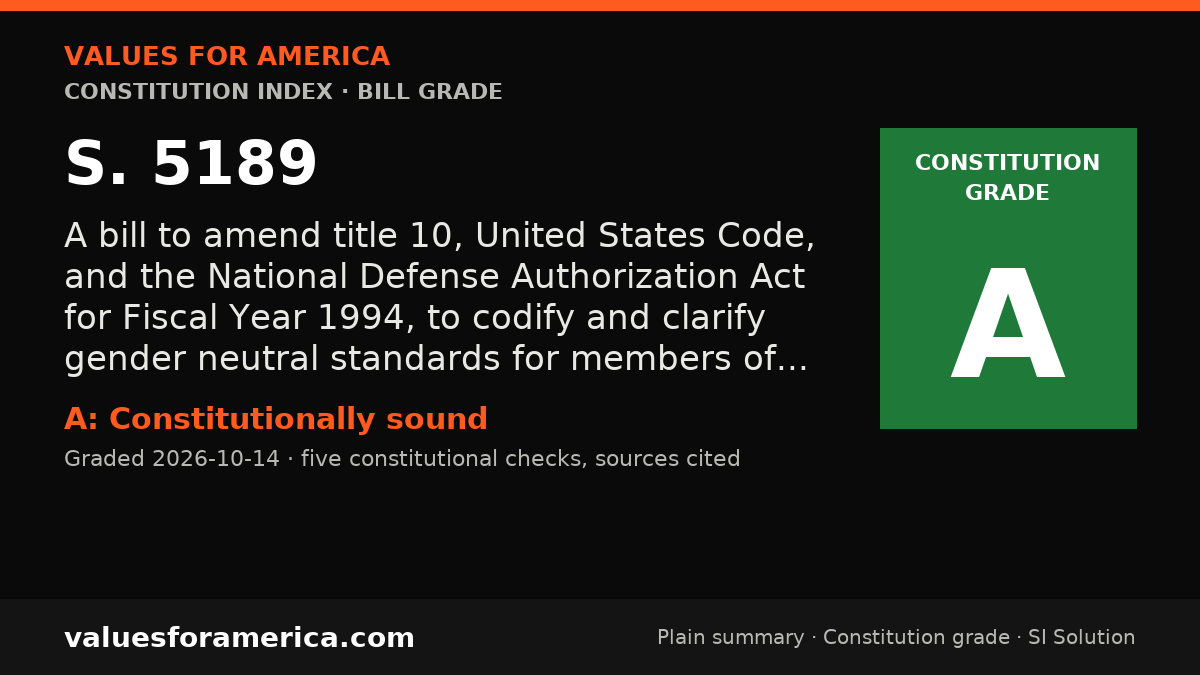
A bill to amend title 10, United States Code, and the National Defense Authorization Act for Fiscal Year 1994, to codify and clarify gender neutral standards for members of certain Armed Forces, and for other purposes.
Cosponsors: 24 (24 D, 0 R) · per Congress.gov, 2026-10-14
Introduced: 2026-07-30
Latest action (2026-07-30): Read twice and referred to the Committee on Armed Services.
What S. 5189 does, in plain terms
This bill prohibits the Department of Defense (DOD) from excluding an individual from military positions or assignments based on gender. It also limits changes to DOD occupational performance standards that address gender neutrality. First, the bill prohibits the exclusion of members of the Armed Forces from an occupational specialty, career field, or assignment on the basis of gender. Next, it prohibits DOD from changing an occupational performance standard to increase or decrease the number of individuals in a career field on the basis of gender. (Currently, this prohibition only applies to increasing or decreasing the number of women.) DOD must also apply occupational standards related to technical, tactical, cognitive, or physical abilities on a gender-neutral basis for positions that require such standards and must determine any such standards after a rigorous scientific process. In situations where DOD establishes or revises a physical requirement for a military position, a member serving satisfactorily in such a position must be provided at least 18 months to meet the new standard. Finally, DOD must notify Congress of any proposed changes to the gender-neutral occupational standards for a military position that may result in at least a 10% change in the number of members of any gender who are assigned to or enter that position. (Currently, such notice is required only with respect to a change in the number of female members.) DOD must provide the congressional defense committees with a report on the proposed change, estimated costs, and justification for the change.
Official summary by the Congressional Research Service, via Congress.gov.
Constitution Index
“VFA Constitution grade”
Constitutionally sound
Graded 2026-10-14
SI-generated grade · five published checks · not individually reviewed by a person · methodology
This bill is fully constitutional. It operates within Congress's enumerated power to regulate the Armed Forces, does not infringe any Bill of Rights protections, respects individual sovereignty by removing gender-based barriers to service, passes all four decentralization questions (military standards are inherently federal), and does not violate due process or takings protections.
-
✓ Passes · Enumerated powers
Congress has explicit constitutional authority under Article I, Section 8, Clause 12 to raise and support Armies, and under Clause 14 to make rules for the government and regulation of the land and naval forces. This bill directly governs military occupational standards and personnel assignments, which falls squarely within that enumerated power. -
✓ Passes · Bill of Rights
The bill does not restrict speech, religion, press, assembly, petition, arms, quartering, search and seizure, self-incrimination, due process, takings, trial rights, jury rights, or cruel and unusual punishment. It imposes no criminal penalties or searches. It does not infringe any of the first ten amendments. -
✓ Passes · Individual sovereignty
The bill expands individual freedom by prohibiting the government from excluding individuals from military positions based on gender. It does not restrict what any person may do with their own person, property, speech, labor, or belief. The requirement that occupational standards be gender-neutral and scientifically determined actually protects individuals from arbitrary government discrimination. -
✓ Passes · Decentralization
Military occupational standards are inherently a federal function under Article I, Section 8. An individual cannot set military standards for the entire force. Local communities cannot set uniform national standards. States cannot regulate the federal armed forces. This action does not consolidate decision-making upward because the military is already constitutionally a federal responsibility. The… -
✓ Passes · Due process and takings
The bill provides procedural due process by requiring a rigorous scientific process for establishing standards, giving members at least 18 months to meet new physical requirements, and requiring congressional notification and justification for changes. It does not take private property without just compensation. It does not bypass any fair hearing or notice requirements.
Sources: Congress.gov: S 5189 summary
Report an error in this grade
What should pass
“VFA SI Solution”
No solution yet
A sourced SI draft appears here once it passes automated checks (Constitution citation, source verification, independent SI critic). How publication works.
Related on VFA

For journalists and bloggers
“Embed this grade”
Free to use with the link back. The badge and card update when the grade changes. Embed terms →
