S. 5185 explained · 119th Congress · Pending in Congress
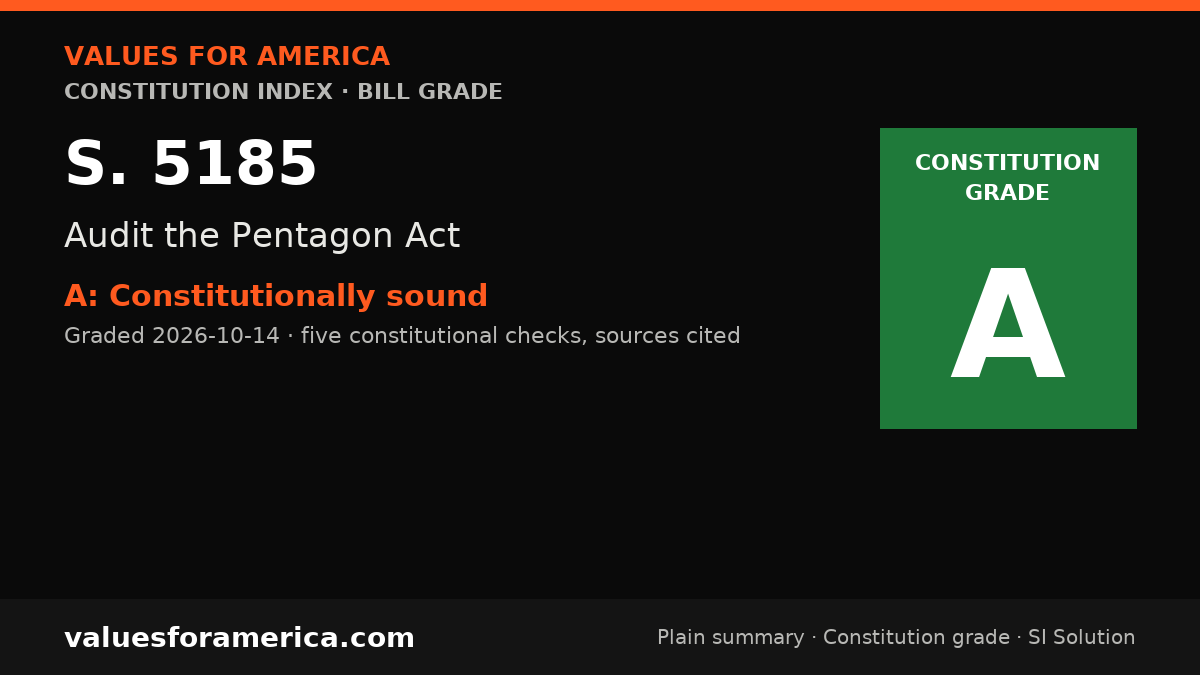
Audit the Pentagon Act
Cosponsors: 13 (10 D, 3 R) · per Congress.gov, 2026-10-14
Introduced: 2026-07-30
Latest action (2026-07-30): Read twice and referred to the Committee on Armed Services.
What S. 5185 does, in plain terms
Audit the Pentagon Act This bill requires the Department of Defense (DOD) to reduce spending for any department, agency, or other DOD element that DOD determines has not achieved an unqualified opinion on its full financial statements for the calendar year ending during that fiscal year. (An unqualified opinion or clean audit means an auditor has determined the financial statements are presented fairly and provide a true view of an entity’s financial position.) Specifically, the amount available to such department, agency, or element for the fiscal year when the determination is made must be reduced by 2%. Amounts unavailable to such department, agency, or element must be applied on a pro rata basis against each program, project, and activity. DOD must deposit such unavailable amounts in the general fund of the Department of the Treasury for purposes of deficit reduction.
Official summary by the Congressional Research Service, via Congress.gov.
Constitution Index
“VFA Constitution grade”
Constitutionally sound
Graded 2026-10-14
SI-generated grade · five published checks · not individually reviewed by a person · methodology
The Audit the Pentagon Act is fully constitutional. It operates squarely within Congress's enumerated power to raise and support Armies and to make rules for the regulation of the land and naval forces. The bill imposes a fiscal condition on Department of Defense appropriations—reducing funding for components that fail to obtain a clean audit—and redirects the savings to deficit reduction. It does not restrict any individual right, does not take private property, does not bypass due process, and does not consolidate power upward beyond what the Constitution already vests in Congress over military appropriations. The bill passes all five constitutional checks with no violations.
-
✓ Passes · Enumerated powers
Congress has express constitutional authority over military funding under Article I, Section 8, Clause 12 (power to raise and support Armies) and Clause 14 (power to make rules for the regulation of the land and naval forces). Requiring the Department of Defense to reduce spending for components that fail to achieve a clean audit is a direct exercise of Congress's power to condition appropriations… -
✓ Passes · Bill of Rights
The bill imposes no restriction on speech, religion, assembly, press, petition, arms, quartering, search and seizure, self-incrimination, due process, fair trial, jury, cruel and unusual punishment, or any other right protected by the first ten amendments. It is a fiscal management measure directed at government agencies, not at individuals. No Bill of Rights provision is implicated. -
✓ Passes · Individual sovereignty
The bill does not restrict what any individual may do with their own person, property, speech, labor, or belief. It imposes conditions only on federal agencies and their internal budgeting. Individual sovereignty is untouched. -
✓ Passes · Decentralization
The bill addresses federal military spending, which is a matter constitutionally assigned to the federal government. An individual or family cannot handle Pentagon auditing (Question 1: no). A local community or county cannot handle it (Question 2: no). A state cannot handle it (Question 3: no). The bill does not consolidate decision-making upward beyond the minimum necessary; Congress already has… -
✓ Passes · Due process and takings
The bill does not take private property, does not bypass procedural due process, and does not impose arbitrary government action. It applies a clear, non-arbitrary standard (failure to obtain an unqualified audit opinion) and a fixed reduction (2%). The affected entities are federal agencies, not persons, and the Fifth Amendment's Due Process and Takings Clauses protect individuals, not government…
Sources: Congress.gov: S 5185 summary
Report an error in this grade
What should pass
“VFA SI Solution”
No solution yet
A sourced SI draft appears here once it passes automated checks (Constitution citation, source verification, independent SI critic). How publication works.
Related on VFA

For journalists and bloggers
“Embed this grade”
Free to use with the link back. The badge and card update when the grade changes. Embed terms →
