S. 5089 explained · 119th Congress · Pending in Congress
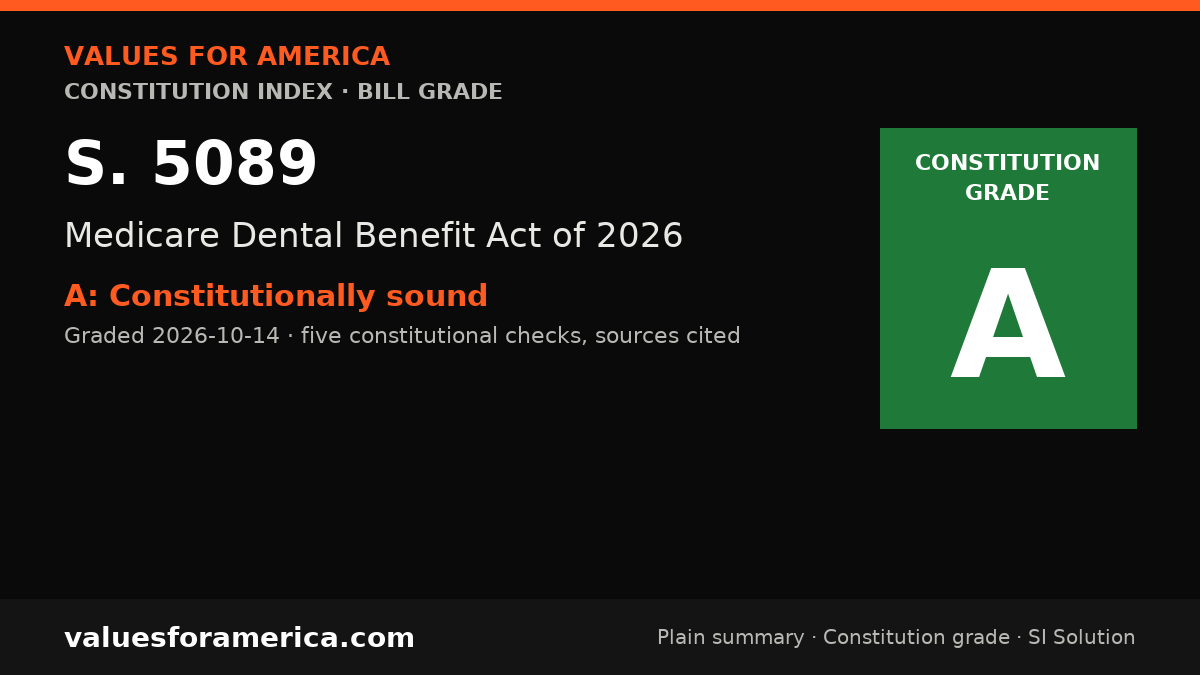
Medicare Dental Benefit Act of 2026
Cosponsors: 2 (2 D, 0 R) · per Congress.gov, 2026-10-15
Introduced: 2026-07-22
Latest action (2026-07-22): Read twice and referred to the Committee on Finance.
What S. 5089 does, in plain terms
Medicare Dental Benefit Act of 2026 This bill provides for Medicare coverage of dental and oral health services, including routine diagnostic and preventive services, basic and major dental services, and emergency care; dental prostheses are also covered. Currently, such services are excluded from Medicare coverage.
Official summary by the Congressional Research Service, via Congress.gov.
Constitution Index
“VFA Constitution grade”
Constitutionally sound
Graded 2026-10-14
SI-generated grade · five published checks · not individually reviewed by a person · methodology
The Medicare Dental Benefit Act of 2026 is constitutional. It falls within Congress's enumerated power under the Taxing and Spending Clause to provide for the general welfare through the Medicare program, does not infringe any Bill of Rights protections, respects individual sovereignty by expanding voluntary access to healthcare, passes all decentralization tests as it operates within an existing federal program, and does not violate due process or takings principles.
-
✓ Passes · Enumerated powers
Congress has authority under Article I, Section 8, Clause 1 (the Taxing and Spending Clause) to 'provide for the common Defence and general Welfare of the United States.' Medicare is a federal spending program established under this power, and expanding covered services (dental care) is a permissible exercise of Congress's spending power. The bill does not regulate private conduct but merely expan… -
✓ Passes · Bill of Rights
The bill does not restrict speech, religion, assembly, press, petition, arms, quartering, search and seizure, self-incrimination, due process, fair trial, jury, cruel and unusual punishment, or any other enumerated right. It expands access to healthcare services, which does not implicate any provision of the first ten amendments. -
✓ Passes · Individual sovereignty
The bill imposes no restriction on individual liberty. It does not compel anyone to purchase dental insurance or receive dental care. It merely authorizes Medicare to cover dental services for eligible beneficiaries. Individuals remain free to choose their own healthcare providers and treatments. No person's property, speech, labor, or belief is restricted. -
✓ Passes · Decentralization
The bill operates within an existing federal program (Medicare) that has been constitutionally established for decades. While dental care could theoretically be handled by individuals or states, the federal government already administers Medicare for seniors and disabled persons, and adding dental coverage is a logical extension of that program. The Tenth Amendment reserves powers not delegated to… -
✓ Passes · Due process and takings
The bill does not deprive any person of life, liberty, or property without due process. It does not take private property for public use without just compensation. It creates a voluntary benefit program with no punitive or confiscatory elements. Procedural and substantive due process are not implicated.
Sources: Congress.gov: S 5089 summary
Report an error in this grade
What should pass
“VFA SI Solution”
No solution yet
A sourced SI draft appears here once it passes automated checks (Constitution citation, source verification, independent SI critic). How publication works.
Related on VFA

For journalists and bloggers
“Embed this grade”
Free to use with the link back. The badge and card update when the grade changes. Embed terms →
