S. 5046 explained · 119th Congress · Pending in Congress
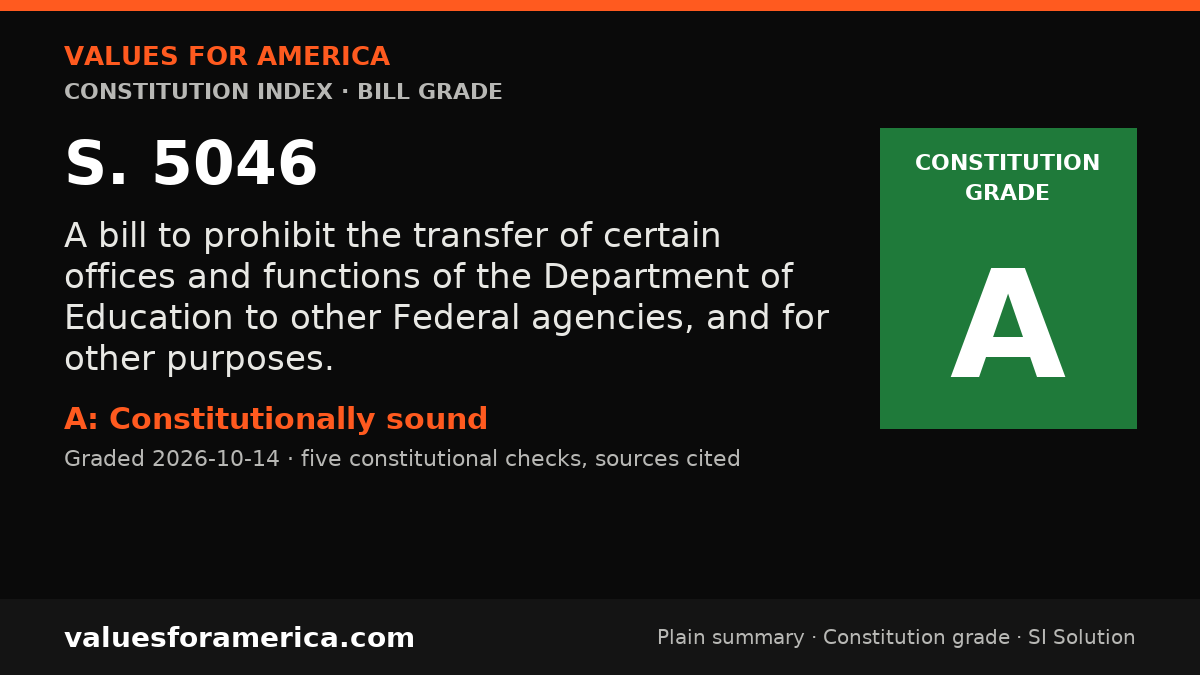
A bill to prohibit the transfer of certain offices and functions of the Department of Education to other Federal agencies, and for other purposes.
Cosponsors: 6 (4 D, 2 R) · per Congress.gov, 2026-10-14
Introduced: 2026-07-21
Latest action (2026-08-04): Placed on Senate Legislative Calendar under General Orders. Calendar No. 541.
What S. 5046 does, in plain terms
This bill prohibits the Department of Education (ED) from transferring specified offices and functions to other federal agencies. Specifically, the bill prohibits ED from entering into or carrying out interagency agreements related to the following four offices: the Office of Special Education and Rehabilitative Services, the Office of Postsecondary Education, the Office of Indian Education, and the Office of Elementary and Secondary Education. This prohibition applies to the transfer of functions such as administering or operating programs, making grants, carrying out technical assistance, enforcing rights and requirements (e.g., data collection requirements), conducting administrative and oversight functions, and monitoring grantees. Additionally, ED may not transfer a function or program of one of the four offices to another ED office and then subsequently enter into an interagency agreement related to the function or program. The bill does not apply to agreements in effect on February 1, 2025, or renewals with substantially similar terms. ED must, within 14 days of the bill's enactment and on a quarterly basis, provide to Congress (and publish on its website) a report and cost analysis for each interagency agreement entered into on or after February 1, 2025. ED may not use specified FY2026 or FY2027 funds for travel expenses unless ED provides this required information. (As of July 30, 2026, ED has entered into 14 interagency agreements to transfer functions of ED to other federal agencies, including the ED offices listed in the bill.)
Official summary by the Congressional Research Service, via Congress.gov.
Constitution Index
“VFA Constitution grade”
Constitutionally sound
Graded 2026-10-14
SI-generated grade · five published checks · not individually reviewed by a person · methodology
This bill is a straightforward exercise of Congress's legislative authority to define the structure and functions of a federal agency. It does not expand federal power, restrict individual rights, or consolidate decision-making; rather, it preserves the existing statutory framework of the Department of Education and imposes transparency and reporting requirements. It passes all five constitutional checks.
-
✓ Passes · Enumerated powers
Congress has broad authority to organize and define the functions of executive departments under Article I, Section 8, Clause 18 (the Necessary and Proper Clause), and its spending power under Article I, Section 8, Clause 1. The bill merely prohibits the Department of Education from transferring certain offices and functions to other agencies, which is a permissible exercise of Congress's power to… -
✓ Passes · Bill of Rights
The bill does not implicate any of the first ten amendments. It does not restrict speech, religion, assembly, press, petition, arms, quartering, search and seizure, self-incrimination, due process, takings, trial rights, or cruel and unusual punishment. It is a purely administrative measure concerning agency organization and reporting. -
✓ Passes · Individual sovereignty
The bill does not restrict what individuals can do with their person, property, speech, labor, or belief. It imposes no obligations on private citizens and does not affect individual liberty. The reporting requirements apply only to the Department of Education and its interactions with Congress, not to individuals. -
✓ Passes · Decentralization
The bill does not consolidate decision-making at a higher level of government; it actually prevents the consolidation of functions within the federal executive branch by prohibiting transfers between agencies. It does not affect the ability of individuals, families, local communities, or states to handle education matters, and it does not shift authority upward. The bill is consistent with the Ten… -
✓ Passes · Due process and takings
The bill does not deprive any person of life, liberty, or property without due process, nor does it take private property for public use without just compensation. It imposes no penalties on individuals and does not affect any vested rights. The reporting and funding restrictions apply only to the Department of Education's internal operations and do not implicate the Fifth Amendment.
Sources: Congress.gov: S 5046 summary
Report an error in this grade
The Framers
“Founders’ Verdict”
Confidence 0.50
Archived SI output (machine-generated)No editorial review recorded. This historical SI verdict was machine-generated by software and predates the review desk; check it against the official bill text.
Synthesis
The bill is constitutional only if it does not impede the President's ability to execute the laws and if the functions of the Department of Education are within Congress's enumerated powers. Otherwise, it may be unconstitutional.
The bill is a constitutional exercise of Congress's power to organize and regulate the structure of the executive departments. Article I, Section 8, Clause 18 grants Congress the authority to make all laws necessary and proper for carrying into execution the powers vested in the government, which includes determining the assignment of functions within the executive branch. Additionally, Article II, Section 2, Clause 1 presumes that the principal officers of executive departments are established by law, and thus Congress may set limitations on the transfer of their offices. The prohibition does…
This bill, by prohibiting the transfer of offices and functions of the Department of Education, implicitly acknowledges the legitimacy of a federal department that exercises powers not delegated to the United States by the Constitution. The Constitution nowhere grants Congress authority over education; such matters are reserved to the States and the people. To maintain or even regulate the functions of a department that exceeds the enumerated powers is to sanction a trespass upon the rights of the States. A strict construction of federal power demands that the Department of Education be disman…
The Constitution does not explicitly enumerate education as a federal power; the Tenth Amendment reserves such matters to the States or the people. However, if the Department of Education's functions are tied to enumerated powers—such as spending for the general welfare (Article I, Section 8, Clause 1) or enforcing the Fourteenth Amendment—then Congress may regulate their transfer. The bill's prohibition on transferring offices must be assessed against whether the underlying functions are constitutionally assigned to the federal government. If the functions exceed enumerated powers, the bill m…
This bill, by prohibiting the transfer of certain offices and functions of the Department of Education to other Federal agencies, raises questions under the Necessary and Proper Clause. Congress possesses the power to organize the executive branch, including the creation and structuring of departments, as an incident to its enumerated powers. However, the Constitution vests the executive power in the President, who must take care that the laws be faithfully executed. If this bill prevents the President from reassigning functions that are essential to the execution of laws passed by Congress, i…
Report an error in this Founders' Verdict
What should pass
“VFA SI Solution”
Archived SI output (machine-generated) · No editorial review recorded
This historical draft has no editorial review time on record. Check its claims against the original bill and current law.
Education Agency Stability and Congressional Oversight Act of 2025
Generated by VFA SI Solutions
To prevent the President from transferring the Department of Education's core functions to other federal agencies without congressional approval, thereby preserving the agency's current structure and mission.
Bipartisan rationale: Honors Democratic priorities: preserves the Department of Education's role in administering federal education programs and protecting civil rights, and ensures that Congress—not the Executive alone—decides major structural changes. Honors Republican priorities: respects the Tenth Amendment by limiting federal overreach to only those functions explicitly authorized by Congress, and prevents executive overreach by requiring a clear legislative check on reorganization. Both parties value stability and predictability in education policy.
Article I, Section 8, Clause 18 Article II, Section 3 Amendment X
Report an error in this Solution
Citizen Consensus
“Do you support this VFA SI Solution?”
One vote per verified account; you can change it any time. Only verified accounts count, results publish once 30 verified people have voted, and state and district results count only people who attested a home ZIP code. How this works.
Email verification is not switched on yet, so no vote counts toward results yet. Votes cast now are saved and count once the voter verifies their email address.
Sign in or create a free account to vote.
Add a short reason (optional)
/280 · no links or contact details · reasons are reviewed before anyone sees them, and many never are shown.
Your vote is saved but held out of published results by an automated integrity check (for example, several accounts voting from one browser).
Your vote is saved. It will count once you verify your email address. Verify on your account page.
Your vote counts nationally. Add your home ZIP code to count in your state and district too.
Your vote counts nationally and in .
Reason saved privately; it is shown only if it passes review.
Verified participants nationwide · n =
Self-selected participants, not a random sample; ± is the 95% sampling margin.
Not enough verified votes yet. Results publish at verified votes.
A sudden surge of votes on this item was flagged and is under review; votes from new accounts in that surge are held out until it is resolved.
Related on VFA

For journalists and bloggers
“Embed this grade”
Free to use with the link back. The badge and card update when the grade changes. Embed terms →
