S. 5 explained · 119th Congress · Became law
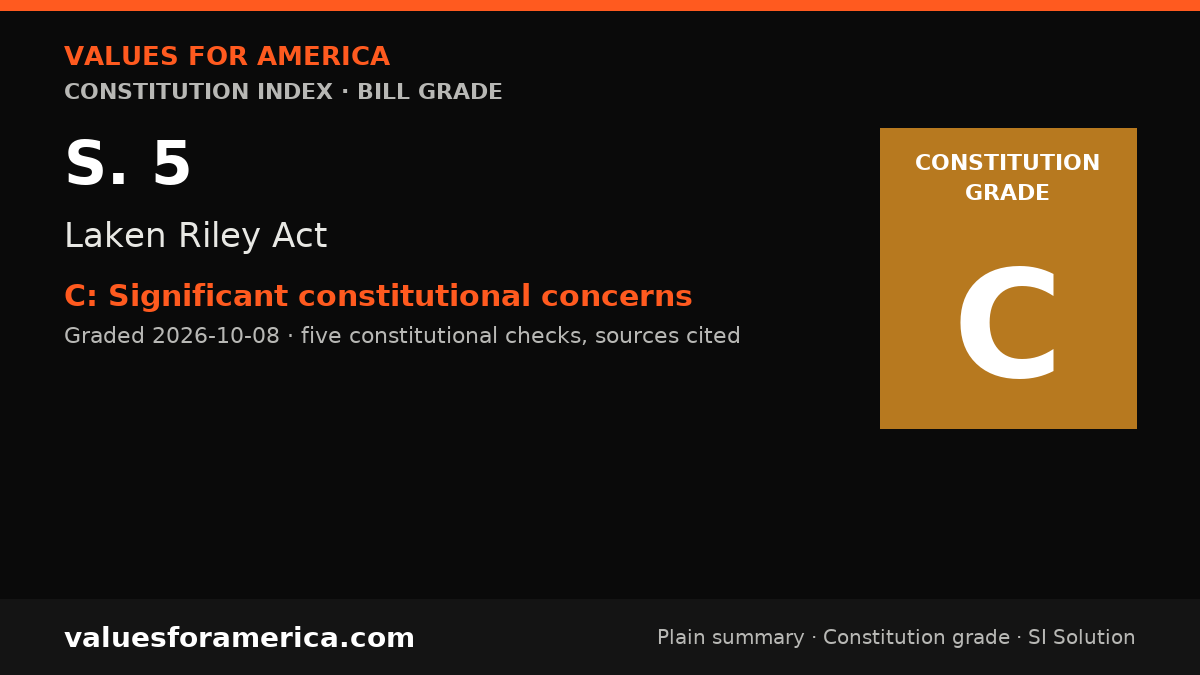
Laken Riley Act
Cosponsors: 53 (2 D, 51 R) · per Congress.gov, 2026-10-12
Introduced: 2025-01-06
Latest action (2025-01-29): Became Public Law No: 119-1.
What S. 5 does, in plain terms
Laken Riley Act This act requires the Department of Homeland Security (DHS) to detain certain non-U.S. nationals (aliens under federal law) who have been arrested for burglary, theft, larceny, shoplifting, assault of a law enforcement officer, or any crime that results in death or serious bodily injury to another person. The act also authorizes states to sue the federal government for decisions or alleged failures related to immigration enforcement. Under this act, DHS must detain an individual who (1) is unlawfully present in the United States or did not possess the necessary documents when applying for admission; and (2) has been charged with, arrested for, convicted of, or admits to having committed acts that constitute the essential elements of the above crimes. The act also authorizes state governments to sue for injunctive relief over certain immigration-related decisions or alleged failures by the federal government if the decision or failure caused the state or its residents harm, including financial harm of more than $100. Specifically, the state government may sue the federal government over a decision to release a non-U.S. national from custody; failure to fulfill requirements relating to inspecting individuals seeking admission into the United States, including requirements related to asylum interviews; failure to fulfill a requirement to stop issuing visas to nationals of a country that unreasonably denies or delays acceptance of nationals of that country; violation of limitations on immigration parole, such as the requirement that parole be granted only on a case-by-case basis; or failure to detain an individual who has been ordered removed from the United States.
Official summary by the Congressional Research Service, via Congress.gov.
Constitution Index
“VFA Constitution grade”
Significant constitutional concerns
Graded 2026-10-08
SI-generated grade · five published checks · not individually reviewed by a person · methodology
Federal detention and removal of noncitizens unlawfully present is within enumerated immigration power and properly federal, but mandatory detention triggered by mere arrest or charge for theft-related offenses permits extended loss of liberty without conviction or individualized hearing, creating significant Fifth and Sixth Amendment due process and individual sovereignty problems requiring a prompt hearing safeguard.
-
✓ Passes · Enumerated powers
Congress has explicit authority over immigration and admission of noncitizens under Article I, Section 8, Clause 4, the power to establish a uniform Rule of Naturalization, reinforced by Article I, Section 8, Clause 18, the Necessary and Proper Clause, to detain and remove noncitizens unlawfully present. Direction to DHS, an executive agency under Article II, Section 3 take-care authority, to deta… -
✗ Concern · Bill of Rights
Mandatory detention based on arrest or charge alone, without conviction, creates tension with the Fifth Amendment Due Process Clause and the Sixth Amendment presumption of innocence and right to fair hearing. While Congress has broad power over removal of noncitizens unlawfully present, detention triggered by mere arrest for shoplifting, theft or burglary risks liberty deprivation without individu… -
✗ Concern · Individual sovereignty
The Act restricts physical liberty by mandating federal detention after arrest or charge for specified property and person offenses, without requiring conviction or individualized justification. The burden is on the government to justify liberty restrictions, and arrest alone does not prove guilt or dangerousness. Mitigating factors: the restriction applies only to persons unlawfully present or la… -
✓ Passes · Decentralization
Immigration admission, exclusion, removal and border control cannot be handled by individuals, families, counties, or single states without fragmentation and foreign-policy conflict. Article I, Section 8, Clause 4 and Article I, Section 8, Clause 3 support uniform federal control. The Act does not consolidate upward beyond the minimum necessary; it preserves federal primacy while authorizing state… -
✗ Concern · Due process and takings
Fifth Amendment Due Process Clause requires fair notice and opportunity to be heard before extended deprivation of physical liberty, and prohibits arbitrary government action. Section requiring DHS to detain a person who has been charged with, arrested for, or admits the essential elements of listed offenses allows prolonged detention on arrest alone, before a neutral determination of probable cau…
Sources: Congress.gov: S 5 summary
Report an error in this grade
What should pass
“VFA SI Solution”
No solution yet
A sourced SI draft appears here once it passes automated checks (Constitution citation, source verification, independent SI critic). How publication works.
Related on VFA

For journalists and bloggers
“Embed this grade”
Free to use with the link back. The badge and card update when the grade changes. Embed terms →
