S. 4974 explained · 119th Congress · Pending in Congress
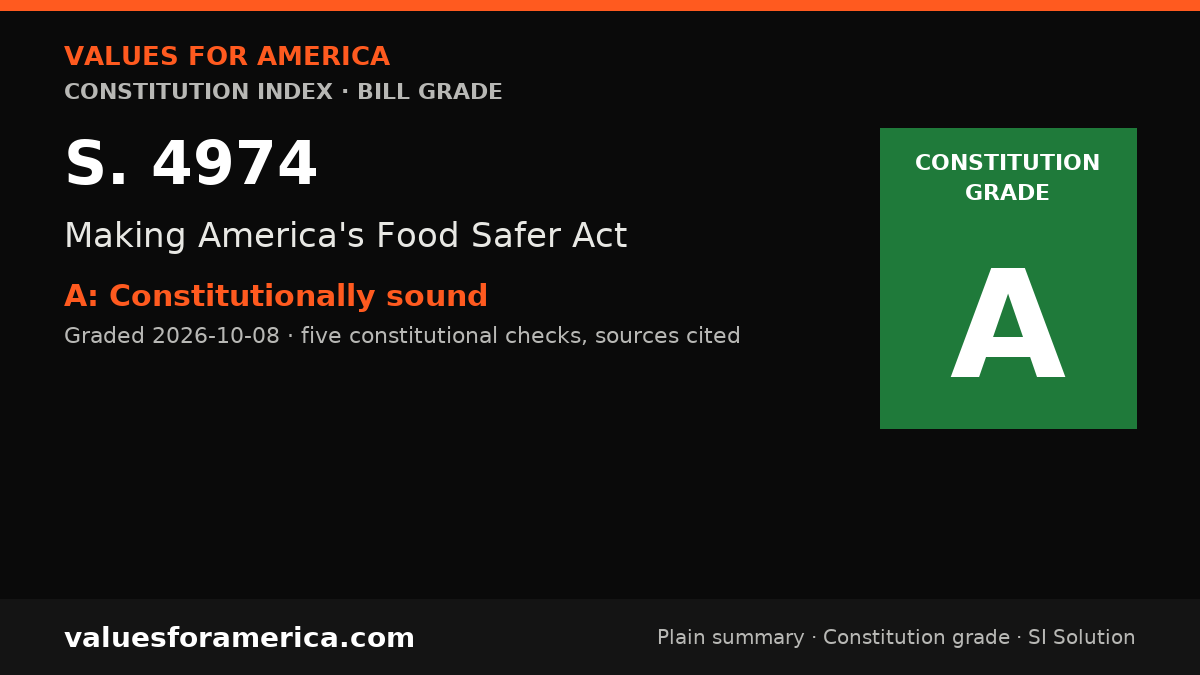
Making America's Food Safer Act
Cosponsors: 2 (1 D, 1 R) · per Congress.gov, 2026-10-14
Introduced: 2026-07-14
Latest action (2026-10-05): Held at the desk.
What S. 4974 does, in plain terms
Making America's Food Safer Act This bill expands the Food and Drug Administration’s (FDA’s) authority to require the destruction of unsafe imported foods, share food safety information, and make use of food facility audit information. Specifically, the bill authorizes the FDA to order the destruction, without the opportunity for export, of any item that (1) is refused import into the United States; (2) violates federal law regulating food, drugs, medical devices, cosmetics, and tobacco products; and (3) presents a significant public health concern. Before issuing a destruction order, the FDA must provide an item’s owner or consignee with appropriate due process, including notice and an opportunity to appear. If an order is issued, the item’s owner or consignee must destroy it within 90 days at their own cost. The bill also generally authorizes the FDA to share unredacted food safety information with state, local, tribal, and territorial authorities, including information related to foodborne illness tracking, recalls and outbreaks, and other topics. During a food safety incident, the FDA may disclose certain commercial information that is otherwise protected from disclosure. Finally, the bill expands the FDA’s third-party audit system to make domestic food facilities eligible for voluntary audits. (Foreign facilities are eligible under current law.) The bill also authorizes the FDA to use audit results and related certifications to analyze risks and prioritize regulatory activities (e.g., inspections) to protect public health. (This information is currently used to determine whether specific food, or food from a specific facility, is eligible for import.)
Official summary by the Congressional Research Service, via Congress.gov.
Constitution Index
“VFA Constitution grade”
Constitutionally sound
Graded 2026-10-08
SI-generated grade · five published checks · not individually reviewed by a person · methodology
Constitutional exercise of foreign commerce power with built-in Fifth Amendment hearing, downward information sharing, and voluntary audits. No rights infringement or unlawful consolidation.
-
✓ Passes · Enumerated powers
Federal authority rests on Article I, Section 8, Clause 3, the Commerce Clause covering commerce with foreign nations, and Clause 18, Necessary and Proper Clause to execute that power. Regulating, refusing, and ordering destruction of unsafe refused imports directly regulates foreign commerce. Sharing food safety data and using voluntary audit results to prioritize inspections are necessary and pr… -
✓ Passes · Bill of Rights
No First through Tenth Amendment right is infringed. No speech, religion, press, assembly, arms, search, trial, or jury restriction. Fourth Amendment: no unreasonable search is authorized; audit use is for risk analysis and voluntary domestic audits require consent. Fifth Amendment Takings concern from destruction orders is cured by express due process: notice and opportunity to appear before orde… -
✓ Passes · Individual sovereignty
Burden on person, property, speech, labor or belief is narrow and justified. Importers have no sovereign right to sell unsafe violative goods in domestic commerce. Destruction only after finding of legal violation plus significant public health concern, with hearing. Domestic audits are expressly voluntary. Commercial information disclosure is limited to food safety incidents and to public authori… -
✓ Passes · Decentralization
Foreign import exclusion cannot be handled by individuals, localities, or single states without creating conflicting border rules. Tenth Amendment reserves police powers to states, but foreign commerce and border exclusion are necessarily federal. Information-sharing with state, local, tribal and territorial authorities moves knowledge downward, not upward. Voluntary domestic audits do not compel … -
✓ Passes · Due process and takings
Satisfies Fifth Amendment Due Process and Takings Clause. Procedural due process: owner or consignee receives notice and opportunity to appear before destruction order issues. Substantive due process: destruction limited to items that violate federal law and present significant public health concern, a non-arbitrary health standard. No taking without just compensation issue because contraband or u…
Sources: Congress.gov: S 4974 summary
Report an error in this grade
The Framers
“Founders’ Verdict”
Confidence 0.65
Archived SI output (machine-generated)No editorial review recorded. This historical SI verdict was machine-generated by software and predates the review desk; check it against the official bill text.
Synthesis
The Founders are divided, with a conditional majority emerging. Hamilton and Marshall support the bill as a clear exercise of Congress's commerce power, citing Article I, Section 8, Clauses 3 and 18, and precedents like Gibbons v. Ogden. Madison conditions approval on the bill's strict limitation to interstate commerce, warning against encroachment on state police powers under the Tenth Amendment. Jefferson dissents, arguing food safety is a reserved state power and the bill exceeds enumerated federal authority. Thus, the bill is constitutional only if it does not regulate purely intrastate matters or undermine the federal-state balance.
The proposed amendment to the Federal Food, Drug, and Cosmetic Act falls squarely within Congress's power to regulate interstate commerce. Food safety directly affects goods moving across state lines, and the necessary and proper clause empowers Congress to enact laws that are essential to executing its enumerated powers. The Federalist Papers affirm that the general government must possess adequate authority to secure the common interests of the Union, including the regulation of commerce and the prevention of harmful practices that could disrupt the national market.
The Constitution grants the federal government only enumerated powers, and the Tenth Amendment reserves all other powers to the states or the people. The Federal Food, Drug, and Cosmetic Act, and any amendment thereto, exceeds the limited authority of Congress under Article I, Section 8, as it regulates an area—food safety—that is not among those enumerated powers. The general welfare clause does not authorize such broad police powers, which belong to the states. Moreover, the First Amendment protects the free exchange of food and agricultural products among the states, and this bill would imp…
The proposed amendment to the Federal Food, Drug, and Cosmetic Act must be examined to determine whether it falls within the enumerated powers of Congress. Under the Constitution, Congress may regulate interstate commerce (Article I, Section 8, Clause 3) and may enact laws necessary and proper for executing that power (Article I, Section 8, Clause 18). However, the Tenth Amendment reserves to the states all powers not delegated to the United States. If the bill's provisions extend to purely intrastate food safety matters that do not substantially affect interstate commerce, it would exceed the…
This bill to amend the Federal Food, Drug, and Cosmetic Act concerning food safety falls within the constitutional authority of Congress under the Commerce Clause. The regulation of food safety is a matter of interstate commerce, as food articles are frequently transported across state lines and their purity and labeling affect the national market. In Gibbons v. Ogden, this Court held that the power to regulate commerce among the states is plenary and extends to all commercial intercourse. Moreover, the Necessary and Proper Clause empowers Congress to enact laws that are appropriate and plainl…
Report an error in this Founders' Verdict
What should pass
“VFA SI Solution”
No solution yet
A sourced SI draft appears here once it passes automated checks (Constitution citation, source verification, independent SI critic). How publication works.
Related on VFA

For journalists and bloggers
“Embed this grade”
Free to use with the link back. The badge and card update when the grade changes. Embed terms →
