S. 4785 explained · 119th Congress · Pending in Congress
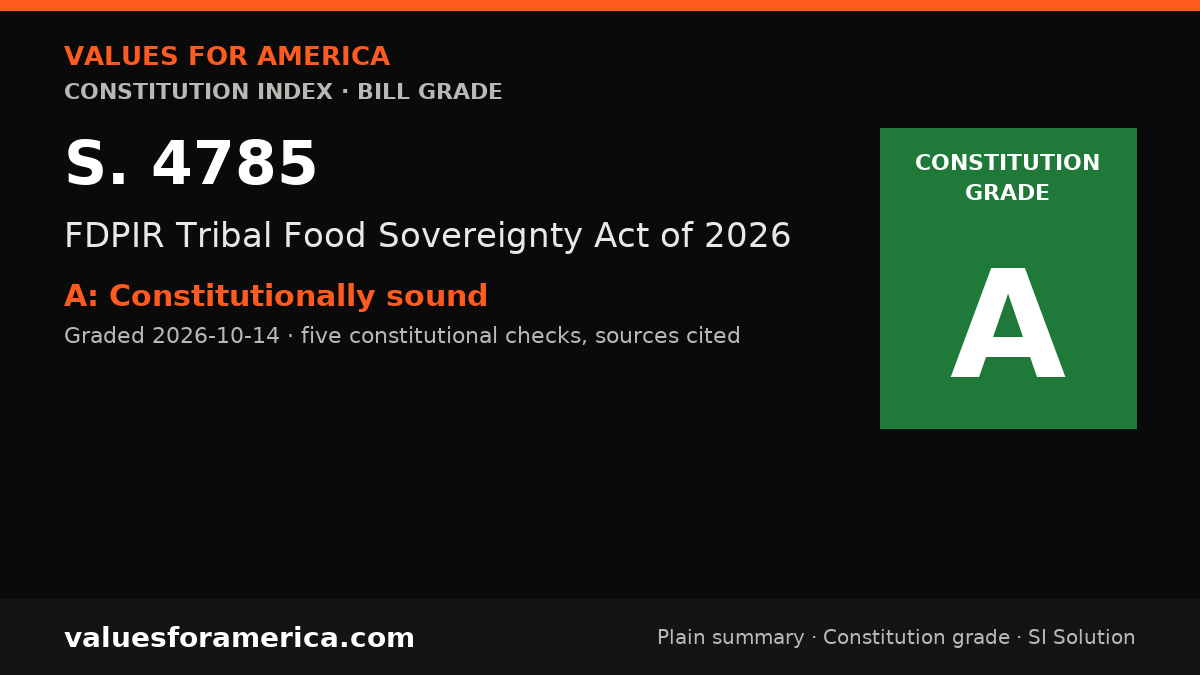
FDPIR Tribal Food Sovereignty Act of 2026
Cosponsors: 1 (0 D, 1 R) · per Congress.gov, 2026-10-14
Introduced: 2026-06-15
Latest action (2026-06-15): Read twice and referred to the Committee on Indian Affairs.
What S. 4785 does, in plain terms
FDPIR Tribal Food Sovereignty Act of 2026 This bill expands and makes permanent a pilot program through which the Department of Agriculture must enter into self-determination contracts with tribal organizations, upon the request of an Indian tribe, to carry out the Food Distribution Program on Indian Reservations (FDPIR). (FDPIR provides, in lieu of benefits under the Supplemental Nutrition Assistance Program, food commodities to low-income households on Indian reservations and to Native American families residing in Oklahoma or in designated areas near Oklahoma.)
Official summary by the Congressional Research Service, via Congress.gov.
Constitution Index
“VFA Constitution grade”
Constitutionally sound
Graded 2026-10-14
SI-generated grade · five published checks · not individually reviewed by a person · methodology
The bill operates within the federal government's broad authority over Indian affairs and tribal self-determination, does not infringe on individual rights, and appropriately delegates program administration to tribal organizations, which enhances decentralization rather than consolidating power upward.
-
✓ Passes · Enumerated powers
The federal government has explicit constitutional authority over Indian affairs under Article I, Section 8, Clause 3 (the Indian Commerce Clause), which grants Congress the power to regulate commerce with Indian tribes. Additionally, the treaty-making power and the historical trust responsibility support federal action in this area. The bill's expansion of a tribal self-determination program fall… -
✓ Passes · Bill of Rights
The bill does not implicate any of the first ten amendments. It does not restrict speech, religion, assembly, press, petition, arms, quartering, search and seizure, self-incrimination, due process, takings, trial rights, or cruel and unusual punishment. It is a voluntary program that provides food commodities to eligible households, and no rights are infringed. -
✓ Passes · Individual sovereignty
The bill does not restrict individual liberty. It expands the ability of tribal organizations to administer a federal food distribution program, which is a benefit program. Individuals retain their freedom to participate or not, and the program does not impose any new obligations or restrictions on personal conduct, property, or labor. -
✓ Passes · Decentralization
The bill passes all four questions of the decentralization test. (1) An individual or family could not handle the administration of a federal food distribution program on their own, as it requires federal resources and coordination. (2) A local community or county could not handle it without state or federal involvement because it is a federal program tied to treaty and trust obligations. (3) A st… -
✓ Passes · Due process and takings
The bill does not bypass due process or take property without just compensation. It establishes a process for tribal organizations to enter into self-determination contracts with the Department of Agriculture, which includes procedural safeguards. There is no deprivation of life, liberty, or property without due process, and no taking of private property for public use without just compensation.
Sources: Congress.gov: S 4785 summary
Report an error in this grade
The Framers
“Founders’ Verdict”
Confidence 0.85
Archived SI output (machine-generated)No editorial review recorded. This historical SI verdict was machine-generated by software and predates the review desk; check it against the official bill text.
Synthesis
The bill is constitutional as a valid exercise of Congress's plenary power over Indian affairs under the Indian Commerce Clause and Necessary and Proper Clause, respecting tribal sovereignty while retaining necessary federal oversight.
This bill is constitutional as it operates within the framework of the Indian Commerce Clause and the treaty power, which grant the federal government plenary authority over Indian affairs. The Indian Self-Determination and Education Assistance Act is a valid exercise of Congress's power to manage relations with Indian tribes, and extending self-determination contracts to the Secretary of Agriculture for food distribution programs on reservations is a permissible delegation of administrative functions. The Constitution does not prohibit Congress from authorizing such contracts, and the bill re…
This bill rightly devolves federal authority to tribal organizations, honoring the principle of self-government and reducing the reach of the central administration. The Constitution grants Congress power over Indian affairs under Article I, Section 8, Clause 3, but that power must be exercised with restraint and respect for the sovereignty of tribal nations. By allowing the Secretary of Agriculture to contract with tribes for food distribution, the bill aligns with the Tenth Amendment's reservation of powers to the states and the people—here, to the tribal governments as distinct political co…
The proposed transfer of authority from the Secretary of Agriculture to Tribal organizations for food distribution on reservations must comply with Article I, Section 8, Clause 3 (Indian Commerce Clause) and the President's responsibility to take care that the laws be faithfully executed (Article II, Section 3). Additionally, Federalist No. 10 cautions against factions seeking to aggrandize administrative power without clear constitutional warrant. The bill may permissibly delegate administrative functions if it preserves ultimate federal accountability for the lawful execution of the food pro…
This bill is a valid exercise of Congress's plenary power over Indian affairs, grounded in the Indian Commerce Clause and the Necessary and Proper Clause. The Constitution grants Congress authority to regulate commerce with Indian tribes, and the proposed amendment to the Indian Self-Determination and Education Assistance Act is a proper means to effectuate that power by allowing the Secretary of Agriculture to contract with tribal organizations for food distribution. Such delegation respects tribal sovereignty and aligns with the federal trust responsibility, as recognized in early precedents…
Report an error in this Founders' Verdict
What should pass
“VFA SI Solution”
Archived SI output (machine-generated) · No editorial review recorded
This historical draft has no editorial review time on record. Check its claims against the original bill and current law.
Tribal Food Distribution Self-Determination Act of 2025
Generated by VFA SI Solutions
Enable the Secretary of Agriculture to enter into self-determination contracts with tribal organizations to administer the food distribution program on Indian reservations, similar to existing authority already held by the Secretary of the Interior under the Indian Self-Determination and Education Assistance Act.
Bipartisan rationale: Democratic priority: Honoring tribal sovereignty and self-determination by expanding contract authority to include the Department of Agriculture. Republican priority: Fiscal accountability through annual audit requirements, biennial OIG oversight, a sunset provision, a 15% overhead cap, and non-duplication of contracts.
Article I, Section 8, Clause 3 Article I, Section 8, Clause 18 Amendment V
Report an error in this Solution
Citizen Consensus
“Do you support this VFA SI Solution?”
One vote per verified account; you can change it any time. Only verified accounts count, results publish once 30 verified people have voted, and state and district results count only people who attested a home ZIP code. How this works.
Email verification is not switched on yet, so no vote counts toward results yet. Votes cast now are saved and count once the voter verifies their email address.
Sign in or create a free account to vote.
Add a short reason (optional)
/280 · no links or contact details · reasons are reviewed before anyone sees them, and many never are shown.
Your vote is saved but held out of published results by an automated integrity check (for example, several accounts voting from one browser).
Your vote is saved. It will count once you verify your email address. Verify on your account page.
Your vote counts nationally. Add your home ZIP code to count in your state and district too.
Your vote counts nationally and in .
Reason saved privately; it is shown only if it passes review.
Verified participants nationwide · n =
Self-selected participants, not a random sample; ± is the 95% sampling margin.
Not enough verified votes yet. Results publish at verified votes.
A sudden surge of votes on this item was flagged and is under review; votes from new accounts in that surge are held out until it is resolved.
Related on VFA

For journalists and bloggers
“Embed this grade”
Free to use with the link back. The badge and card update when the grade changes. Embed terms →
