S. 4784 explained · 119th Congress · Pending in Congress
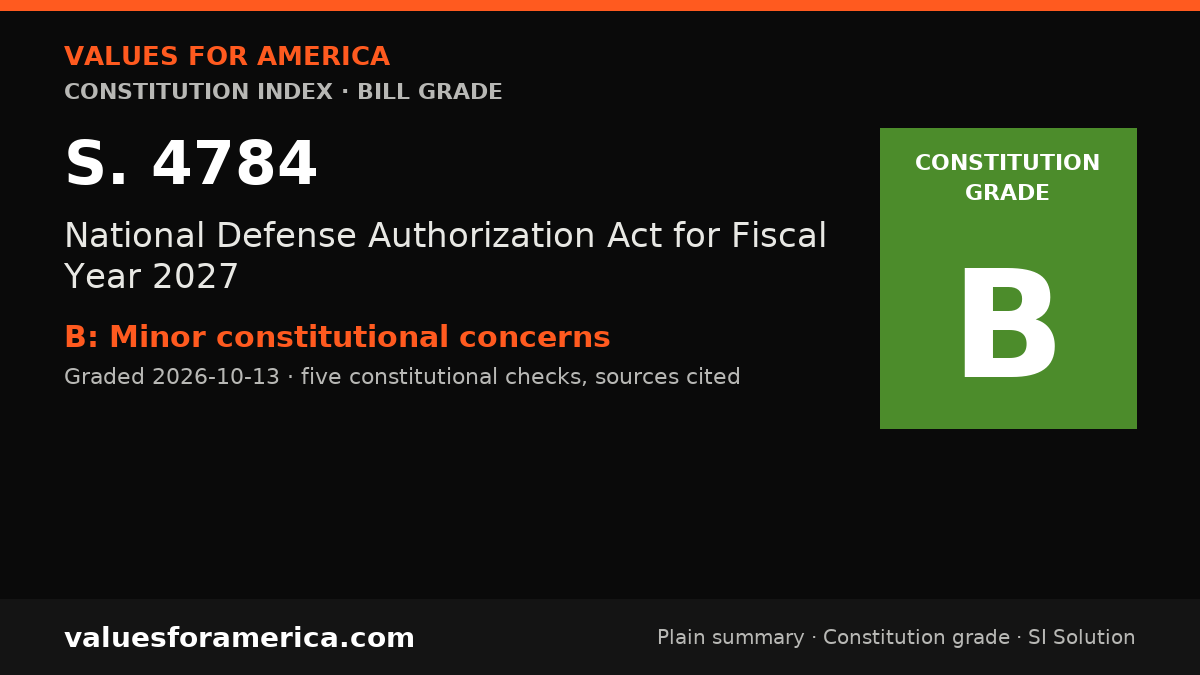
National Defense Authorization Act for Fiscal Year 2027
Cosponsors: none · per Congress.gov, 2026-10-14
Introduced: 2026-06-15
Latest action (2026-07-27): Motion to proceed to consideration of measure made in Senate. (CR S4276)
What S. 4784 does, in plain terms
National Defense Authorization Act for Fiscal Year 2027 This bill sets forth policies and authorities for FY2027 for Department of Defense (DOD) programs, activities, and military construction as well as the national security programs of the Department of Energy (DOE). Among other elements, the bill authorizes the procurement of various items, including aircraft and ships; sets active duty and reserve component personnel strength levels; sets policy regarding various aspects of military health care and military compensation; sets policy regarding DOD acquisitions and acquisition management, including contracting authorities; sets policy for various matters related to DOD interactions with foreign nations, including matters concerning the Middle East, Europe, and the Indo-Pacific; sets policy for various matters related to DOD cyber operations, cyber forces, cybersecurity, and artificial intelligence; requires DOD to review certain materials (including boron carbide, copper foil, and synthetic diamond) to determine actions to maintain access to critical defense industry components and materials, and report to Congress on such matters; authorizes DOD's Office of Strategic Capital to make equity investments in non-federal entities with respect to batteries and critical minerals, materials, and chemicals; authorizes specified military construction projects and extends the authorization of certain projects from previous fiscal years; and authorizes the National Nuclear Security Administration and the Defense Nuclear Facilities Safety Board. For additional information on the National Defense Authorization Act (NDAA) see In Focus IF10516, Defense Primer: Navigating the NDAA, and In Focus IF10515, Defense Primer: The NDAA Process.
Official summary by the Congressional Research Service, via Congress.gov.
Constitution Index
“VFA Constitution grade”
Minor constitutional concerns
Graded 2026-10-13
SI-generated grade · five published checks · not individually reviewed by a person · methodology
The NDAA is a broad exercise of Congress's enumerated powers to raise and support armies, provide and maintain a navy, and make rules for the governance of the armed forces. While most provisions are clearly within these powers, the authorization for the Office of Strategic Capital to make equity investments in non-federal entities raises significant constitutional concerns under the Spending Clause and the Tenth Amendment, as it may exceed the scope of military necessity and intrude on private economic activity. Other provisions, such as those related to cyber operations and artificial intelligence, require careful oversight to ensure they do not infringe on civil liberties, but the bill as a whole is largely consistent with constitutional principles.
-
✓ Passes · Enumerated powers
The NDAA is primarily an exercise of Congress's enumerated powers under Article I, Section 8, Clauses 12-14 to raise and support armies, provide and maintain a navy, and make rules for the governance of the land and naval forces. The provisions for procurement, personnel, military construction, and national security programs of the Department of Energy fall within these powers. However, the author… -
✓ Passes · Bill of Rights
The bill does not explicitly infringe on any of the first ten amendments. However, provisions related to cyber operations and artificial intelligence could potentially implicate the Fourth Amendment's protection against unreasonable searches and seizures if they authorize surveillance or data collection without proper oversight. The bill's language is not specific enough to determine a violation, … -
✓ Passes · Individual sovereignty
The bill primarily affects government operations and military personnel, not the general public's individual sovereignty. It does not restrict personal speech, religion, assembly, or property rights. The equity investment provision could be seen as the government using taxpayer funds to influence private markets, but it does not directly restrict individual freedom. The burden is on the government… -
✗ Concern · Decentralization
The NDAA is a federal action that, by its nature, consolidates decision-making at the federal level for national defense. This is appropriate under the Constitution, as defense is a federal responsibility. However, the equity investment provision in the Office of Strategic Capital is an example of the federal government intervening in areas that could be handled by private markets or state governm… -
✓ Passes · Due process and takings
The bill does not appear to bypass due process or take property without just compensation. It authorizes military construction and procurement, which are subject to existing legal processes. The equity investment provision is a voluntary investment, not a taking. No procedural or substantive due process violations are apparent from the summary.
Sources: Congress.gov: S 4784 summary
Report an error in this grade
The Framers
“Founders’ Verdict”
Confidence 0.75
Archived SI output (machine-generated)No editorial review recorded. This historical SI verdict was machine-generated by software and predates the review desk; check it against the official bill text.
Synthesis
The bill is constitutional in principle provided it respects constitutional limits: appropriations for the army must be limited to two years (Article I, Section 8, Clause 12), it must not encroach upon state authority over the militia unless in federal service (Article I, Section 8, Clause 16), and any 'other purposes' clauses must be narrowly construed to avoid overreach beyond enumerated powers. Additionally, military construction and activities must respect state sovereignty, property rights, and individual liberties protected by the Second and Third Amendments.
The proposed bill, providing for the common defense by authorizing appropriations for military activities, military construction, and prescribing personnel strengths, is clearly within the enumerated powers granted to Congress. The Constitution vests Congress with the power to “provide for the common Defence” and “to raise and support Armies,” as well as “to provide and maintain a Navy.” (Article I, Section 8, Clauses 12-13). Furthermore, Congress is authorized to “make all Laws which shall be necessary and proper for carrying into Execution the foregoing Powers” (Article I, Section 8, Clause …
An army, though necessary in times of war, is a dangerous instrument to the liberties of a free people. The Constitution grants Congress the power to raise and support Armies, but limits appropriations to two years (Article I, Section 8, Clause 12). This bill, if it provides funding for only the single fiscal year 2027 and does not bind future Congresses, may be consistent with the constitutional check against a standing army in peacetime. However, if any provision extends beyond that term or encroaches upon the rights of the individual citizen through unchecked military jurisdiction, it would…
The Constitution vests in Congress the power to raise and support Armies, to provide and maintain a Navy, and to make rules for the governance of the land and naval forces (Article I, Section 8, Clauses 12–14). An annual authorization for military activities, military construction, and personnel strengths falls squarely within these enumerated powers. However, such bills must respect the principle that no appropriation for the support of an army shall be for a longer term than two years (Article I, Section 8, Clause 12). Furthermore, the legislature must guard against the accumulation of unnec…
This bill falls squarely within the enumerated powers of Congress as provided by the Constitution. The authority to raise and support armies, provide and maintain a navy, and make rules for the government and regulation of the land and naval forces is expressly granted to Congress. Furthermore, the requirement that no money be drawn from the Treasury but in consequence of appropriations made by law is satisfied by this authorization. The bill is a proper exercise of legislative power and does not exceed the constitutional limits placed upon the federal government.
Report an error in this Founders' Verdict
What should pass
“VFA SI Solution”
Archived SI output (machine-generated) · No editorial review recorded
This historical draft has no editorial review time on record. Check its claims against the original bill and current law.
Streamlined Defense Authorization and Appropriations Act for Fiscal Year 2027
Generated by VFA SI Solutions
Authorize appropriations for FY2027 for DoD military activities, military construction, DOE defense activities, and set military personnel strengths.
Bipartisan rationale: Honors Democratic priorities by including robust cost-containment, transparency via GAO/CBO audits, and automatic sequestration to control spending. Honors Republican priorities by maintaining strong personnel levels, fully funding defense activities, and avoiding tax increases or debt-limit increases. Both parties can support because the bill reduces waste while ensuring military readiness within existing revenue.
Article I, Section 8, Clause 12 Article I, Section 8, Clause 13 Article I, Section 8, Clause 1 Article I, Section 9, Clause 7
Report an error in this Solution
Citizen Consensus
“Do you support this VFA SI Solution?”
One vote per verified account; you can change it any time. Only verified accounts count, results publish once 30 verified people have voted, and state and district results count only people who attested a home ZIP code. How this works.
Email verification is not switched on yet, so no vote counts toward results yet. Votes cast now are saved and count once the voter verifies their email address.
Sign in or create a free account to vote.
Add a short reason (optional)
/280 · no links or contact details · reasons are reviewed before anyone sees them, and many never are shown.
Your vote is saved but held out of published results by an automated integrity check (for example, several accounts voting from one browser).
Your vote is saved. It will count once you verify your email address. Verify on your account page.
Your vote counts nationally. Add your home ZIP code to count in your state and district too.
Your vote counts nationally and in .
Reason saved privately; it is shown only if it passes review.
Verified participants nationwide · n =
Self-selected participants, not a random sample; ± is the 95% sampling margin.
Not enough verified votes yet. Results publish at verified votes.
A sudden surge of votes on this item was flagged and is under review; votes from new accounts in that surge are held out until it is resolved.
Related on VFA

For journalists and bloggers
“Embed this grade”
Free to use with the link back. The badge and card update when the grade changes. Embed terms →
