S. 4668 explained · 119th Congress · Pending in Congress
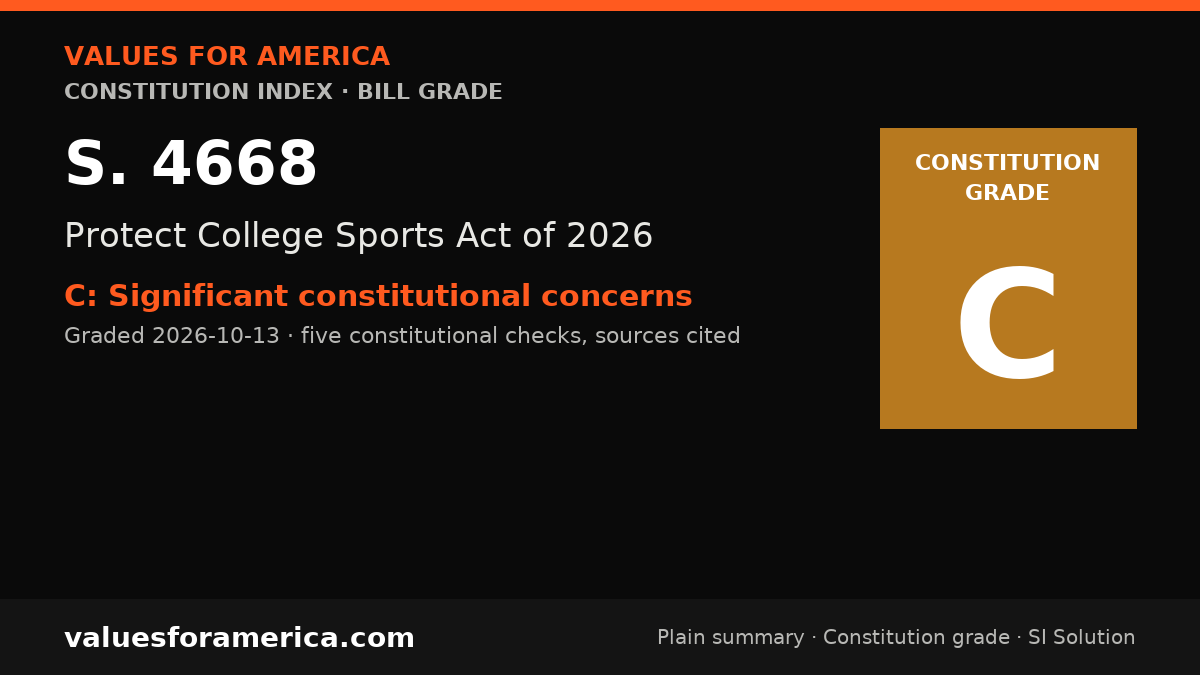
Protect College Sports Act of 2026
Cosponsors: 9 (5 D, 4 R) · per Congress.gov, 2026-10-14
Introduced: 2026-06-02
Latest action (2026-10-05): Held at the desk.
What S. 4668 does, in plain terms
Protect College Sports Act of 2026 This bill establishes requirements for name, image, or likeness (NIL) agreements for college student athletes and provides a limited antitrust exemption for schools and conferences to pool and sell certain college sports media rights. The requirements address elements of the court-approved agreement to settle In re College Athlete NIL Litigation (i.e., House settlement). First, the bill statutorily prohibits institutions, conferences, or interstate intercollegiate athletic associations (e.g., the National Collegiate Athletic Association [NCAA]) from restricting student athletes from entering NIL agreements (subject to specified limitations). Students must report to their institution NIL compensation greater than $600. The bill requires agents to register with a state and caps agent endorsement contract fees at 5%. The bill also provides student athletes with one transfer without losing athletic eligibility and restricts football personnel from becoming the head football coach at a different institution during the same season. Further, the bill prohibits institutions, conferences, or specified entities acting for the benefit of an institution from providing athletes with compensation that circumvents the limit on sharing revenue with student athletes established under the House settlement. The bill also makes the limit permanent and provides for an annual inflation adjustment. The bill generally prohibits Division I conferences from reducing the number of varsity or Olympic sports teams that a member institution must sponsor. Specifically, large institutions ($80 million or more in annual athletics revenue) must offer and maintain at least as many grant-in-aid opportunities and roster spots for sports that do not generate positive net revenue as the institution provided during academic year 2024-25. The bill provides for a waiver of this requirement under certain circumstances of financial hardship and the requirements expire nine years after the enactment of the bill. Additionally, the bill establishes (subject to specified conditions) a limited antitrust exemption for institutions or conferences that form joint agreements to transfer their sports telecasting rights to a third party. Such an agreement requires participation from at least 75% of the institutions in the Football Bowl Subdivision.
Official summary by the Congressional Research Service, via Congress.gov.
Constitution Index
“VFA Constitution grade”
Significant constitutional concerns
Graded 2026-10-13
SI-generated grade · five published checks · not individually reviewed by a person · methodology
The bill presents a mixed constitutional picture. It restricts the NCAA and conferences from limiting NIL agreements, which aligns with individual sovereignty and the First Amendment, but it also imposes federal mandates on private institutions and conferences, raising questions about enumerated powers. The limited antitrust exemption is a federal action that may exceed Congress's Commerce Clause authority by regulating non-commercial aspects of college sports. The bill also imposes specific operational requirements on institutions, which may infringe on state and institutional autonomy, and it creates a complex regulatory scheme that could bypass due process in enforcement. Overall, the bill has significant constitutional issues that require structural revision.
-
✗ Concern · Enumerated powers
Congress's authority to regulate interstate commerce (Article I, Section 8, Clause 3) may extend to certain aspects of college sports, particularly those involving interstate broadcasting and NIL agreements that affect interstate commerce. However, the bill's provisions go beyond regulating commerce and impose detailed mandates on educational institutions, such as requiring specific roster sizes a… -
✗ Concern · Bill of Rights
The bill's prohibition on restricting NIL agreements protects student athletes' First Amendment rights to freedom of speech and association, as NIL deals often involve expressive activities. However, the bill also imposes restrictions on athletes, such as the requirement to report compensation over $600 and the cap on agent fees, which may implicate privacy and contractual freedoms but are not dir… -
✓ Passes · Individual sovereignty
The bill enhances individual sovereignty by prohibiting institutions from restricting student athletes' ability to enter NIL agreements, thereby protecting their right to profit from their own name, image, and likeness. This aligns with the principle that individuals should have control over their own labor and property. However, the bill also imposes some restrictions, such as the reporting requi… -
✗ Concern · Decentralization
The bill fails the decentralization test because it consolidates decision-making at the federal level for matters that could be handled by states, conferences, or institutions. For example, NIL regulations and transfer rules could be addressed by individual states or athletic conferences without federal intervention. The bill's requirement for a 75% participation threshold for antitrust exemption … -
✗ Concern · Due process and takings
The bill's enforcement mechanisms are not fully specified, but it creates a regulatory framework that could lead to penalties or loss of eligibility without clear due process protections. The bill also imposes permanent revenue-sharing limits and roster requirements that could be seen as taking property (e.g., revenue opportunities) from institutions without just compensation, though this is not a…
Sources: Congress.gov: S 4668 summary
Report an error in this grade
What should pass
“VFA SI Solution”
No solution yet
A sourced SI draft appears here once it passes automated checks (Constitution citation, source verification, independent SI critic). How publication works.
Related on VFA

For journalists and bloggers
“Embed this grade”
Free to use with the link back. The badge and card update when the grade changes. Embed terms →
