S. 4465 explained · 119th Congress · Became law
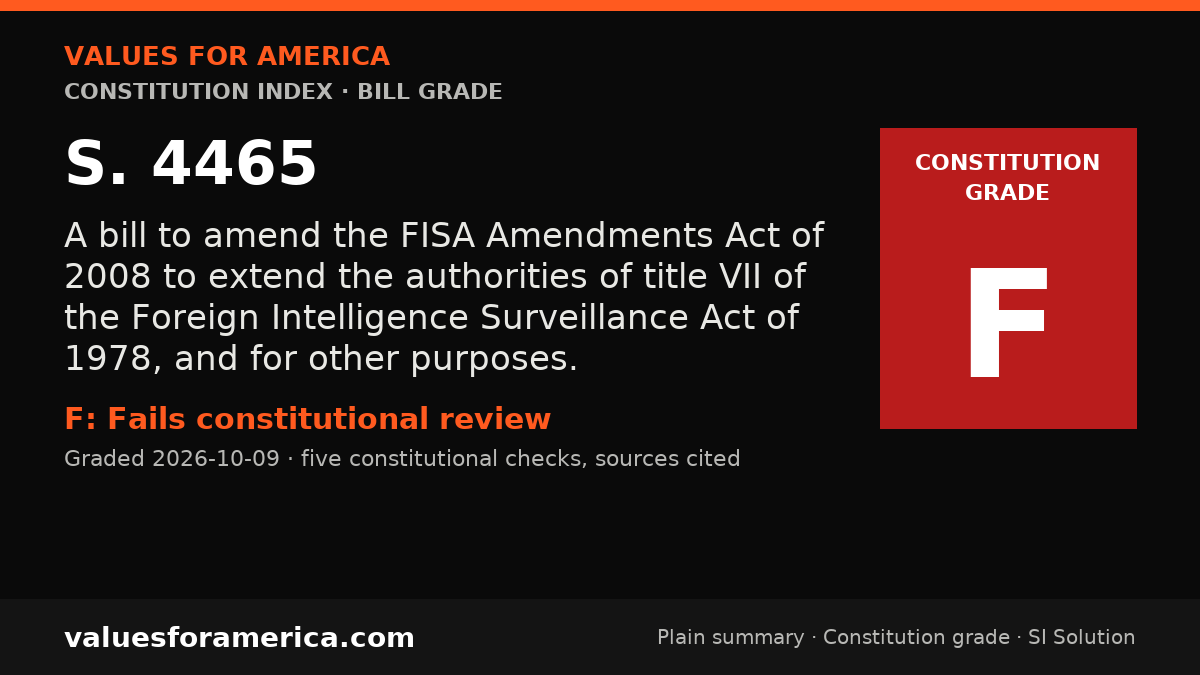
A bill to amend the FISA Amendments Act of 2008 to extend the authorities of title VII of the Foreign Intelligence Surveillance Act of 1978, and for other purposes.
Cosponsors: 1 (1 D, 0 R) · per Congress.gov, 2026-10-08
Introduced: 2026-04-30
Latest action (2026-04-30): Became Public Law No: 119-87.
What S. 4465 does, in plain terms
This act extends the authorities of Title VII of the Foreign Intelligence Surveillance Act (FISA) until June 12, 2026. Title VII of FISA generally addresses electronic surveillance and other methods of acquiring foreign intelligence information that are directed at targets outside the United States. Title VII includes surveillance under Section 702, which concerns acquiring communications of non-U.S. persons believed to be outside the United States to obtain foreign intelligence information. Information about U.S. persons may incidentally be acquired by this type of surveillance and subsequently queried (searched) under certain circumstances. For additional information see CRS In Focus, IF11451 Foreign Intelligence Surveillance Act (FISA); and CRS Report, R48592 FISA Section 702 and the 2024 Reforming Intelligence and Securing America Act.
Official summary by the Congressional Research Service, via Congress.gov.
Constitution Index
“VFA Constitution grade”
Fails constitutional review
Graded 2026-10-09
SI-generated grade · five published checks · not individually reviewed by a person · methodology
This reauthorization continues a surveillance regime that permits warrantless backdoor searches of Americans' communications, violating the Fourth Amendment's protection against unreasonable searches and seizures. While foreign intelligence gathering falls within federal authority, the inclusion of U.S. persons' communications without individualized probable cause and without a warrant fails the standards of individual sovereignty and due process.
-
✓ Passes · Enumerated powers
Congress has authority under Article I, Section 8, Clause 18 (the Necessary and Proper Clause) and Article II, Section 2 (Commander-in-Chief) to provide for national defense and foreign intelligence collection. The extension of Title VII of FISA falls within the federal government's enumerated powers over foreign affairs and national security. -
✗ Concern · Bill of Rights
The Fourth Amendment protects the right of the people to be secure against unreasonable searches and seizures. Section 702 as extended allows the government to acquire communications of non-U.S. persons abroad, but it also permits incidental collection and subsequent querying of U.S. persons' communications without a warrant or probable cause. These backdoor searches violate the Fourth Amendment's… -
✗ Concern · Individual sovereignty
Individuals have a sovereign right to be free from government intrusion into their private communications without due cause. The bill extends mass surveillance machinery that captures and queries the communications of Americans, chilling free expression and private association. The government has not met the heavy burden required to justify this warrantless intrusion into the lives of U.S. persons… -
✓ Passes · Decentralization
Foreign intelligence surveillance is an inherent federal responsibility. It cannot be performed by individuals, local communities, or states without chaos and inconsistency. The federal government is the minimum necessary level to conduct such operations, so the law does not needlessly consolidate power upward. -
✗ Concern · Due process and takings
The Fifth Amendment guarantees due process of law. The secret court framework and lack of notice to Americans whose communications are searched deprive them of any meaningful opportunity to contest the government's use of their private information. While the Foreign Intelligence Surveillance Court exists, it does not operate as an adversarial process with respect to U.S. persons, and the takings c…
Sources: Congress.gov: S 4465 summary
Report an error in this grade
What should pass
“VFA SI Solution”
No solution yet
A sourced SI draft appears here once it passes automated checks (Constitution citation, source verification, independent SI critic). How publication works.
Related on VFA

For journalists and bloggers
“Embed this grade”
Free to use with the link back. The badge and card update when the grade changes. Embed terms →
