S. 4429 explained · 119th Congress · Pending in Congress
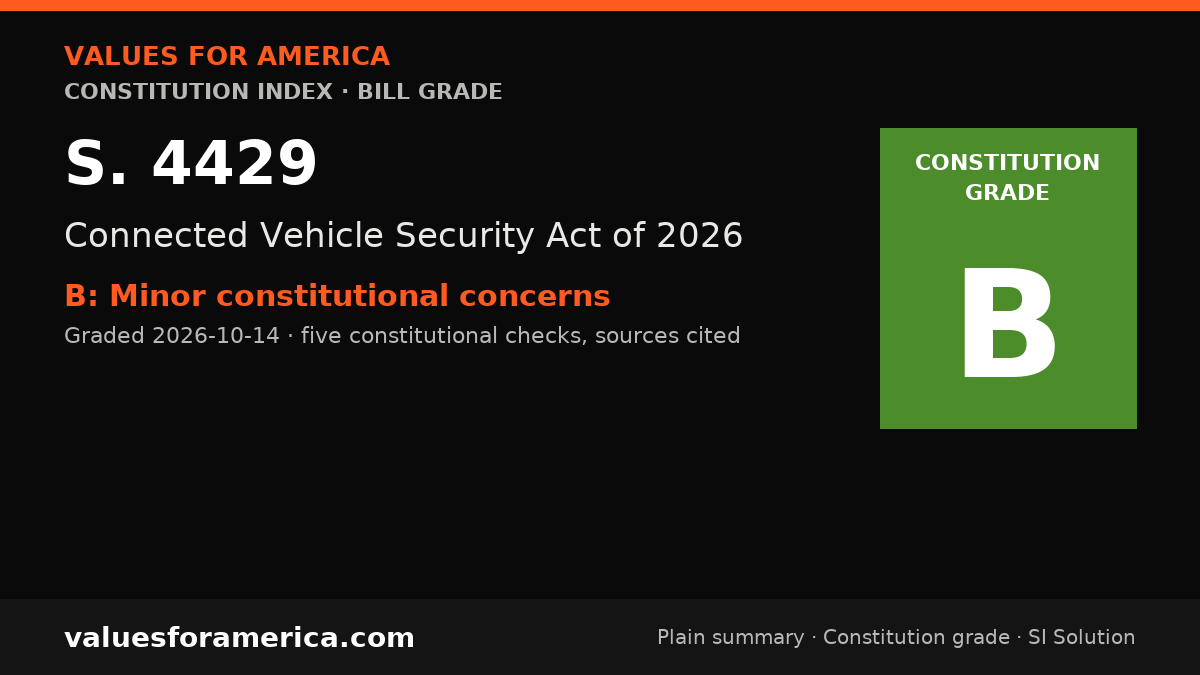
Connected Vehicle Security Act of 2026
Cosponsors: 57 (21 D, 36 R) · per Congress.gov, 2026-10-14
Introduced: 2026-04-29
Latest action (2026-09-22): Placed on Senate Legislative Calendar under General Orders. Calendar No. 671.
What S. 4429 does, in plain terms
Connected Vehicle Security Act of 2026 This bill prohibits the importation, manufacture, sale, resale, or introduction into U.S. interstate commerce of connected vehicles and related software and hardware components associated with China, Russia, Iran, or North Korea. Connected vehicle means a vehicle that (1) integrates onboard networked hardware with automotive software systems to communicate with any other network or device using certain methods (e.g., wireless spectrum connectivity); or (2) is designed, manufactured, or originally equipped to communicate via such methods, regardless of whether such capability is enabled, disabled, or removed at the time the vehicle enters the United States. Current regulations administered by the Department of Commerce's Bureau of Industry and Security (BIS) prohibit transactions involving vehicle connectivity system hardware and covered software designed, developed, manufactured, or supplied by persons owned by, controlled by, or subject to the jurisdiction or direction of China or Russia. The bill expands the BIS regulatory framework, including by (1) expanding the countries covered by the prohibition to include China, Russia, Iran, and North Korea (Current BIS regulations apply only to China and Russia.); and (2) specifying that certain artificial intelligence components are covered by the prohibition. By January 1, 2027, BIS must publish a list of items that are authorized for the importation, manufacture, sale, resale, or introduction into U.S. interstate commerce and would otherwise be subject to the bill's prohibition. The bill also includes enforcement mechanisms, including that BIS must assess civil penalties for violations of the prohibition.
Official summary by the Congressional Research Service, via Congress.gov.
Constitution Index
“VFA Constitution grade”
Minor constitutional concerns
Graded 2026-10-14
SI-generated grade · five published checks · not individually reviewed by a person · methodology
The Connected Vehicle Security Act of 2026 is a federal action grounded in the Commerce Clause and foreign affairs powers, aimed at national security. It does not directly infringe on individual rights, but its broad definition of 'connected vehicle' and the potential for overbreadth in restricting software and hardware components raise minor due process and decentralization concerns. The bill is mostly sound but requires careful implementation to avoid overreach.
-
✓ Passes · Enumerated powers
The federal government has explicit authority under Article I, Section 8, Clause 3 (Commerce Clause) to regulate interstate and foreign commerce, including the importation and sale of goods. Additionally, the bill addresses national security concerns related to foreign adversaries, which falls under the federal government's foreign affairs powers. The prohibition on importation and interstate comm… -
✓ Passes · Bill of Rights
The bill does not directly infringe on any of the first ten amendments. It regulates commercial transactions involving specific foreign entities, which does not implicate speech, religion, assembly, press, petition, arms, quartering, search and seizure, self-incrimination, due process, takings, fair trial, jury, cruel and unusual punishment, unenumerated rights, or reserved powers. The prohibition… -
✓ Passes · Individual sovereignty
The bill restricts the importation and sale of certain connected vehicles and components, which are commercial activities. While it does limit what individuals can purchase, the government has a compelling constitutional justification: national security and the protection of U.S. infrastructure from foreign adversaries. The restriction is not on personal speech, belief, or labor but on specific pr… -
✗ Concern · Decentralization
The bill fails the decentralization test because it consolidates decision-making at the federal level. While an individual or family could not handle the national security aspects of this issue, and local communities or states could not effectively regulate foreign trade, the federal government is the appropriate level for regulating international commerce. However, the bill's broad definition of … -
✓ Passes · Due process and takings
The bill provides for civil penalties for violations, which implies a process for enforcement. However, the bill does not explicitly outline procedural due process protections, such as notice and hearing, for those affected by the prohibition. The requirement for BIS to publish a list of authorized items by January 1, 2027, provides some clarity, but the broad definition of 'connected vehicle' cou…
Sources: Congress.gov: S 4429 summary
Report an error in this grade
What should pass
“VFA SI Solution”
No solution yet
A sourced SI draft appears here once it passes automated checks (Constitution citation, source verification, independent SI critic). How publication works.
Related on VFA

For journalists and bloggers
“Embed this grade”
Free to use with the link back. The badge and card update when the grade changes. Embed terms →
