S. 4394 explained · 119th Congress · Pending in Congress
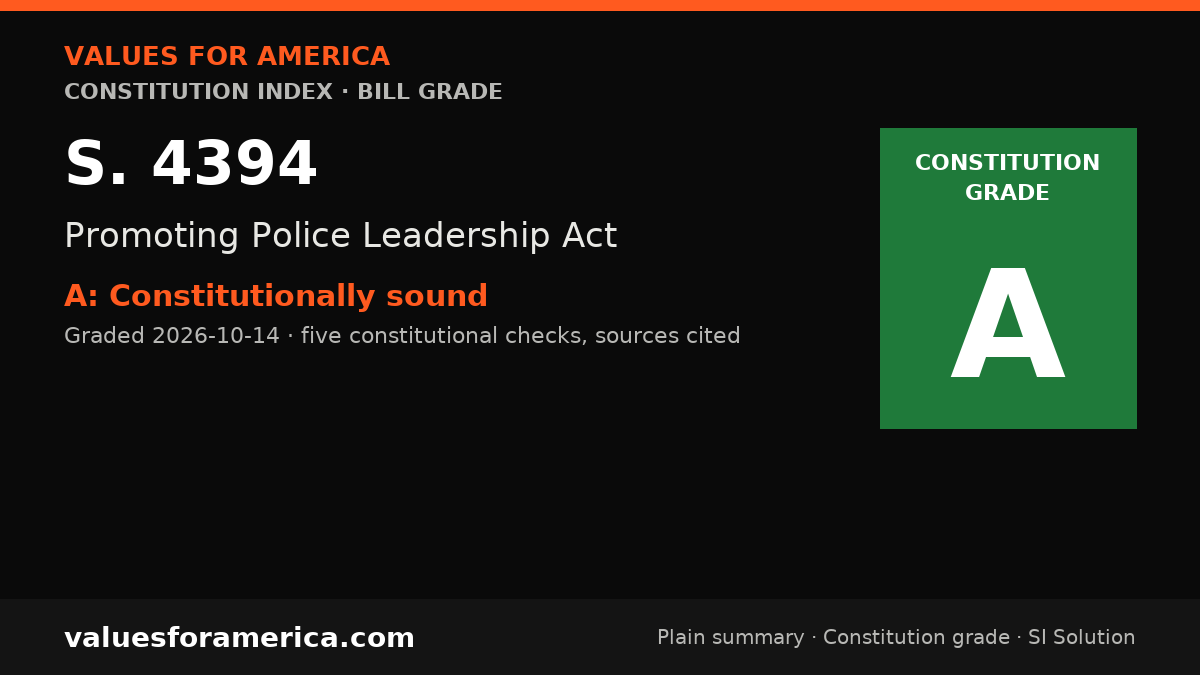
Promoting Police Leadership Act
Cosponsors: 14 (9 D, 5 R) · per Congress.gov, 2026-10-14
Introduced: 2026-04-27
Latest action (2026-06-15): Held at the desk.
What S. 4394 does, in plain terms
Promoting Police Leadership Act This bill directs the Department of Justice (DOJ) to develop training curricula or identify existing training curricula for command-level personnel related to leadership and strategic thinking, critical incident response and management, risk management, officer wellness, data analysis and data-driven policing tactics, evidence-based decision-making, and building community trust. The term command-level personnel means state, local, or tribal law enforcement officers whose responsibilities include managing, directing, or overseeing law enforcement operations in a geographic subunit of the jurisdiction. In developing and identifying curricula, the bill requires DOJ to consult with relevant state and local law enforcement agencies, organizations and fraternal associations, universities with appropriate enforcement or leadership programs, and other entities. DOJ must also develop a process for certifying training programs that include the curricula. Finally, the bill requires the Government Accountability Office to review and report on the process for developing and identifying curricula and the certification of training programs.
Official summary by the Congressional Research Service, via Congress.gov.
Constitution Index
“VFA Constitution grade”
Constitutionally sound
Graded 2026-10-14
SI-generated grade · five published checks · not individually reviewed by a person · methodology
The Promoting Police Leadership Act is fully constitutional. It directs the Department of Justice to develop or identify voluntary training curricula for state and local law enforcement command personnel, and to certify training programs. This is a permissible exercise of Congress's spending and general welfare power, as it does not mandate compliance, restrict rights, or preempt state authority. The bill respects federalism by consulting with state and local entities and by leaving adoption entirely to the states.
-
✓ Passes · Enumerated powers
Congress has authority under Article I, Section 8, Clause 1 (the Spending Clause) to provide for the general welfare by funding and developing voluntary training programs. The bill does not commandeer state resources or impose mandates; it merely offers curricula and certification that states may choose to use. This is consistent with the Supreme Court's holding in South Dakota v. Dole that Congre… -
✓ Passes · Bill of Rights
The bill does not restrict speech, religion, assembly, press, petition, arms, quartering, search and seizure, self-incrimination, due process, takings, trial rights, or cruel and unusual punishment. It imposes no criminal penalties, no surveillance, and no restrictions on individual conduct. The First, Second, Fourth, Fifth, Sixth, Seventh, Eighth, Ninth, and Tenth Amendments are not implicated. -
✓ Passes · Individual sovereignty
The bill does not restrict what any person may do with their own person, property, speech, labor, or belief. It imposes no mandates, prohibitions, or penalties on individuals. It merely authorizes the federal government to create optional training materials for law enforcement agencies. Individual sovereignty is fully preserved. -
✓ Passes · Decentralization
The bill passes all four questions of the decentralization test. (1) An individual or family cannot handle police command training alone, but that is not the relevant unit—the training is for government agencies. (2) Local communities and counties can and do handle their own police training; the bill does not require them to use federal curricula. (3) States can handle this without federal involve… -
✓ Passes · Due process and takings
The bill does not deprive any person of life, liberty, or property without due process, nor does it take private property for public use without just compensation. It imposes no penalties, fines, or forfeitures. The Fifth Amendment's Due Process and Takings Clauses are not implicated.
Sources: Congress.gov: S 4394 summary
Report an error in this grade
The Framers
“Founders’ Verdict”
Confidence 1.00
Archived SI output (machine-generated)No editorial review recorded. This historical SI verdict was machine-generated by software and predates the review desk; check it against the official bill text.
Synthesis
The bill is constitutional only if it provides voluntary federal financial assistance to state and local police leadership without coercing or commandeering state officers, and imposes clear, unambiguous conditions that states may freely accept or decline. It must not directly mandate state policies or displace state primacy in law enforcement.
This bill's constitutionality hinges on the extent to which it provides federal financial assistance to state and local police leadership without coercing or commandeering state officers into federal service. Congress may, under the Spending Clause (Article I, Section 8, Clause 1), attach conditions to grants to promote the general welfare, provided those conditions are unambiguous and related to the federal interest. However, if the bill imposes directives that effectively require state executives to implement federal policies, it may violate the anti-commandeering principle inherent in the s…
The Constitution does not grant the federal government a general police power; such authority is reserved to the States by the Tenth Amendment. Federal legislation in law enforcement must be strictly limited to powers expressly delegated, such as regulating interstate commerce, coining money, or punishing counterfeiting. If this Act merely provides voluntary, non-coercive guidance or conditional funding to state and local police, it may be permissible—provided it does not commandeer state officers or exceed enumerated federal powers. However, if it imposes direct federal mandates, creates new …
The constitutionality of this bill hinges on its specific provisions. If it merely offers federal funds to states for voluntary police leadership programs, it may be permissible under the spending power (Article I, Section 8, Clause 1), as long as conditions are clearly stated and not coercive. However, if it imposes direct mandates or prescribes standards for state and local police forces, it would exceed the enumerated powers of Congress and encroach upon the police powers reserved to the states by the Tenth Amendment. The federal government possesses no general police power, and the states …
The proposed Act authorizes federal grants to states and localities for police leadership training programs. Under the Constitution, Congress may condition the receipt of federal funds upon compliance with certain conditions, provided such conditions are unambiguous and relate to the general welfare. See McCulloch v. Maryland, 17 U.S. 316 (1819) (implied powers). However, the Act must not violate the Tenth Amendment by commandeering state officers to implement federal programs. The Act must also respect the separation of powers and not delegate legislative authority without an intelligible pri…
Report an error in this Founders' Verdict
What should pass
“VFA SI Solution”
Archived SI output (machine-generated) · No editorial review recorded
This historical draft has no editorial review time on record. Check its claims against the original bill and current law.
Police Leadership Enhancement Grant Act of 2025
Generated by VFA SI Solutions
To improve the quality and accountability of police leadership at state and local levels through federal support for training, certification, and adoption of best practices.
Bipartisan rationale: Honors Democratic priorities: police accountability through use-of-force standards, early warning systems, and decertification database. Honors Republican priorities: local control (voluntary participation), support for law enforcement through training funds, and no federal mandates on state officers.
Report an error in this Solution
Citizen Consensus
“Do you support this VFA SI Solution?”
One vote per verified account; you can change it any time. Only verified accounts count, results publish once 30 verified people have voted, and state and district results count only people who attested a home ZIP code. How this works.
Email verification is not switched on yet, so no vote counts toward results yet. Votes cast now are saved and count once the voter verifies their email address.
Sign in or create a free account to vote.
Add a short reason (optional)
/280 · no links or contact details · reasons are reviewed before anyone sees them, and many never are shown.
Your vote is saved but held out of published results by an automated integrity check (for example, several accounts voting from one browser).
Your vote is saved. It will count once you verify your email address. Verify on your account page.
Your vote counts nationally. Add your home ZIP code to count in your state and district too.
Your vote counts nationally and in .
Reason saved privately; it is shown only if it passes review.
Verified participants nationwide · n =
Self-selected participants, not a random sample; ± is the 95% sampling margin.
Not enough verified votes yet. Results publish at verified votes.
A sudden surge of votes on this item was flagged and is under review; votes from new accounts in that surge are held out until it is resolved.
Related on VFA

For journalists and bloggers
“Embed this grade”
Free to use with the link back. The badge and card update when the grade changes. Embed terms →
