S. 4110 explained · 119th Congress · Pending in Congress
EMPOWER for Health Act
Cosponsors: 1 (0 D, 1 R) · per Congress.gov, 2026-10-14
Introduced: 2026-03-17
Latest action (2026-07-28): Placed on Senate Legislative Calendar under General Orders. Calendar No. 529.
What S. 4110 does, in plain terms
Educating Medical Professionals and Optimizing Workforce Efficiency and Readiness for Health Act or the EMPOWER for Health Act This bill reauthorizes through FY2031 and revises a range of programs that provide funding and other resources to support recruiting, training, and retaining individuals to work or teach in the health professions. These programs are administered by the Health Resources and Services Administration (HRSA). For instance, the bill revises an educational loan repayment program for certain pediatric health specialists that agree to practice in areas with shortages of such specialists. The bill (1) requires direct clinical care to comprise at least half of the required service hours, (2) broadens the eligible specialties to include any pediatric mental or behavioral health discipline HRSA determines appropriate, and (3) specifically authorizes focusing care on children enrolled in Medicaid. Also, the bill specifically authorizes grants to entities such as states and health professions schools for supporting the nursing workforce by providing analysis, technical assistance, and best practices for alleviating nursing workforce shortages. Finally, the bill expands grants for recruiting youth into public health careers to include outreach to middle school students (current law only includes outreach to high school students).
Official summary by the Congressional Research Service, via Congress.gov.
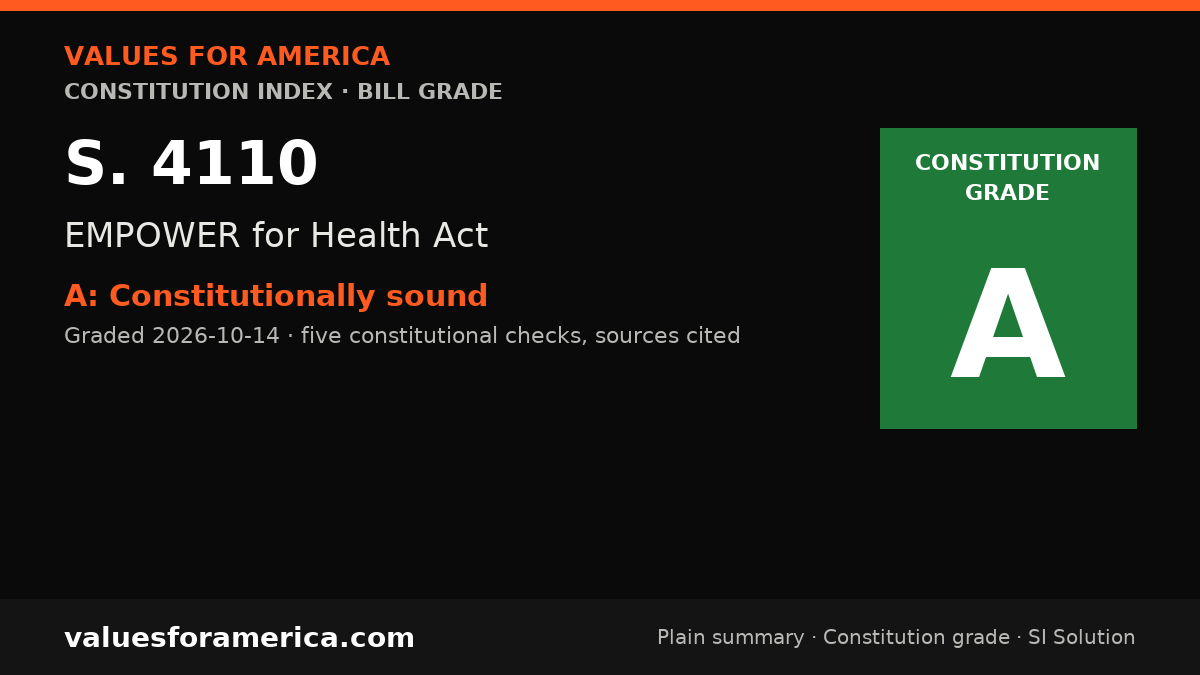
Constitution Index
“VFA Constitution grade”
Constitutionally sound
Graded 2026-10-14
SI-generated grade · five published checks · not individually reviewed by a person · methodology
The EMPOWER for Health Act is a federal spending and program authorization bill that operates within Congress's enumerated powers under the Spending Clause and the General Welfare Clause. It does not infringe on any constitutional rights, respects individual sovereignty by using voluntary incentives rather than mandates, and appropriately delegates implementation to states and local entities. The bill passes all five constitutional checks.
-
✓ Passes · Enumerated powers
Congress has the power to tax and spend for the general welfare under Article I, Section 8, Clause 1. This bill authorizes federal spending on health workforce training and loan repayment programs, which is a permissible exercise of the spending power. The programs are voluntary and conditional, consistent with the Spending Clause jurisprudence. -
✓ Passes · Bill of Rights
The bill does not restrict speech, religion, assembly, press, petition, the right to bear arms, or any other enumerated right. It imposes no searches or seizures, no self-incrimination, no deprivation of life, liberty, or property without due process, and no cruel or unusual punishment. The First through Tenth Amendments are not implicated. -
✓ Passes · Individual sovereignty
The bill uses voluntary incentives—loan repayment and grants—to encourage individuals to enter health professions. It does not compel anyone to work, teach, or practice in any particular field or location. Individuals retain full freedom to choose their careers and where to practice. The government is not restricting any personal autonomy but rather offering benefits in exchange for service, which… -
✓ Passes · Decentralization
The bill authorizes grants to states, health professions schools, and other entities, allowing local and state decision-making about how to address workforce shortages. It does not consolidate decision-making at the federal level beyond the necessary allocation of funds. The federal role is limited to providing resources, while implementation is decentralized. The four-question test: (1) individua… -
✓ Passes · Due process and takings
The bill does not take property without just compensation, nor does it deprive anyone of life, liberty, or property without due process. The loan repayment program is contractual and voluntary, with clear terms. There is no arbitrary government action; the bill specifies eligibility and service requirements. Procedural and substantive due process are fully respected.
Sources: Congress.gov: S 4110 summary
Report an error in this grade
What should pass
“VFA SI Solution”
No solution yet
A sourced SI draft appears here once it passes automated checks (Constitution citation, source verification, independent SI critic). How publication works.
Related on VFA

For journalists and bloggers
“Embed this grade”
Free to use with the link back. The badge and card update when the grade changes. Embed terms →
