S. 3971 explained · 119th Congress · Became law
Small Business Innovation and Economic Security Act
Cosponsors: 1 (1 D, 0 R) · per Congress.gov, 2026-10-09
Introduced: 2026-03-03
Latest action (2026-04-13): Became Public Law No: 119-83.
What S. 3971 does, in plain terms
Small Business Innovation and Economic Security Act This act reauthorizes through FY2031 and modifies the Small Business Innovation Research (SBIR) program, the Small Business Technology Transfer (STTR) program, and related pilot programs. (The SBIR and STTR programs are administered by various federal agencies and provide competitive awards for domestic small businesses to conduct research and development projects that have the potential for commercialization.) Specifically, the act expands the requirements for federal agencies administering these programs to evaluate the security risks of the small businesses that apply for awards under the programs. If an agency denies an application for security reasons, the agency must provide the small business with the basis for such determination. Further, each agency must set a maximum number of proposals per fiscal year that a small business concern may submit in response to Phase I and Phase II solicitations. The act expands the training requirements for agencies' contracting officers and acquisition workforce with respect to Phase III (commercialization of technologies) awards under the SBIR and STTR programs. The act also establishes strategic breakthrough allocations for critical technology areas. These are additional Phase II SBIR and STTR awards to small businesses that demonstrate an effective technology and receive matching funds.
Official summary by the Congressional Research Service, via Congress.gov.
Constitution Index
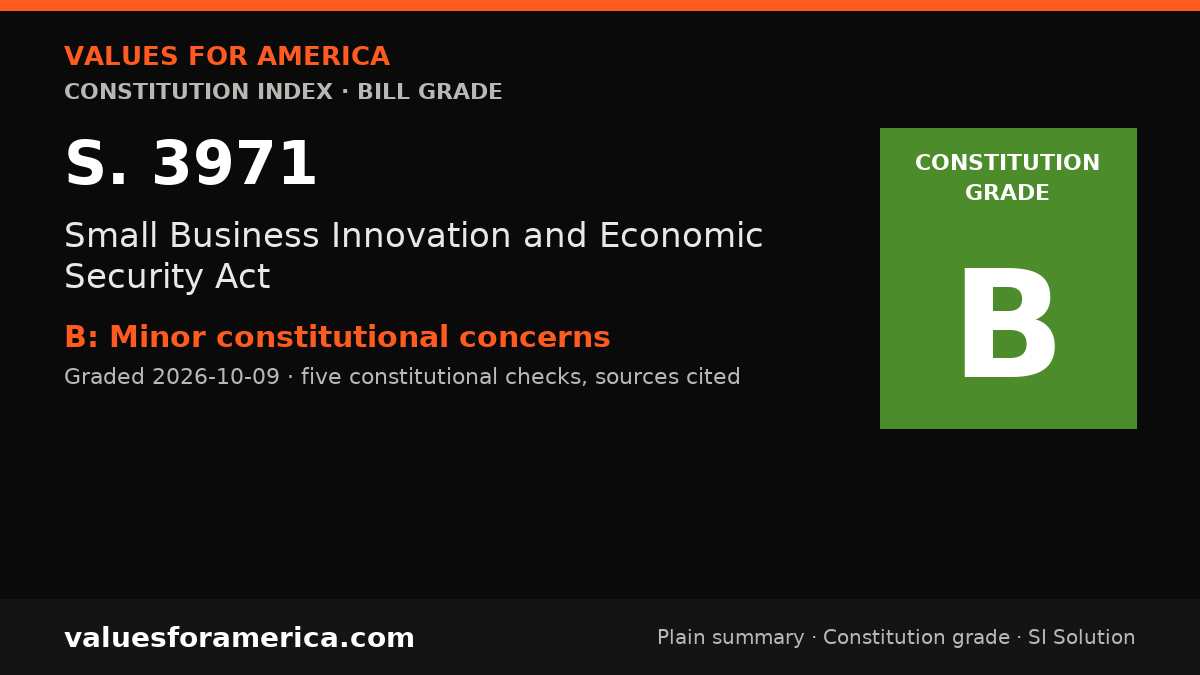
“VFA Constitution grade”
Minor constitutional concerns
Graded 2026-10-09
SI-generated grade · five published checks · not individually reviewed by a person · methodology
The Small Business Innovation and Economic Security Act (S 3971) is mostly sound but has minor constitutional tensions. It operates within Congress's enumerated commerce and spending powers, does not directly infringe the Bill of Rights, and preserves individual sovereignty. However, the security-risk evaluation requirement for small businesses raises minor due process concerns, and the program's federal administration fails the decentralization test by consolidating decision-making at the federal level when states or localities could manage similar R&D support. Overall, the bill is constitutional with fixable issues.
-
✓ Passes · Enumerated powers
Congress has explicit authority under Article I, Section 8, Clause 1 (General Welfare) and Clause 3 (Commerce) to fund and regulate programs that promote economic development and national security through small business innovation. The SBIR/STTR programs are exercises of the spending power, and the security-risk evaluation requirement is a permissible condition on federal funding. -
✓ Passes · Bill of Rights
The bill does not restrict speech, religion, assembly, press, petition, arms, quartering, search and seizure, self-incrimination, due process, takings, fair trial, jury, cruel and unusual punishment, or unenumerated rights. The security-risk evaluation does not involve criminal penalties or searches; it is a funding eligibility criterion. No provision violates the First through Tenth Amendments. -
✓ Passes · Individual sovereignty
The bill does not restrict what individuals can do with their own person, property, speech, labor, or belief. It creates voluntary funding opportunities for small businesses. The security-risk evaluation is a condition on receiving federal money, not a prohibition on private activity. Individuals remain free to conduct R&D without government involvement. -
✗ Concern · Decentralization
The bill fails the decentralization test because it consolidates decision-making at the federal level. (1) Individuals and families cannot handle national R&D funding programs alone. (2) Local communities could administer similar programs, but the bill centralizes them. (3) States could manage SBIR/STTR-type programs without federal involvement. (4) The act consolidates upward by requiring federal… -
✗ Concern · Due process and takings
The bill requires agencies to provide the basis for security-risk denials, which satisfies procedural due process (fair notice). However, the security-risk evaluation itself lacks clear standards and could be applied arbitrarily, raising substantive due process concerns. No property is taken without just compensation because the awards are discretionary grants, not vested property rights. The mino…
Sources: Congress.gov: S 3971 summary
Report an error in this grade
What should pass
“VFA SI Solution”
No solution yet
A sourced SI draft appears here once it passes automated checks (Constitution citation, source verification, independent SI critic). How publication works.
Related on VFA

For journalists and bloggers
“Embed this grade”
Free to use with the link back. The badge and card update when the grade changes. Embed terms →
