S. 3945 explained · 119th Congress · Pending in Congress
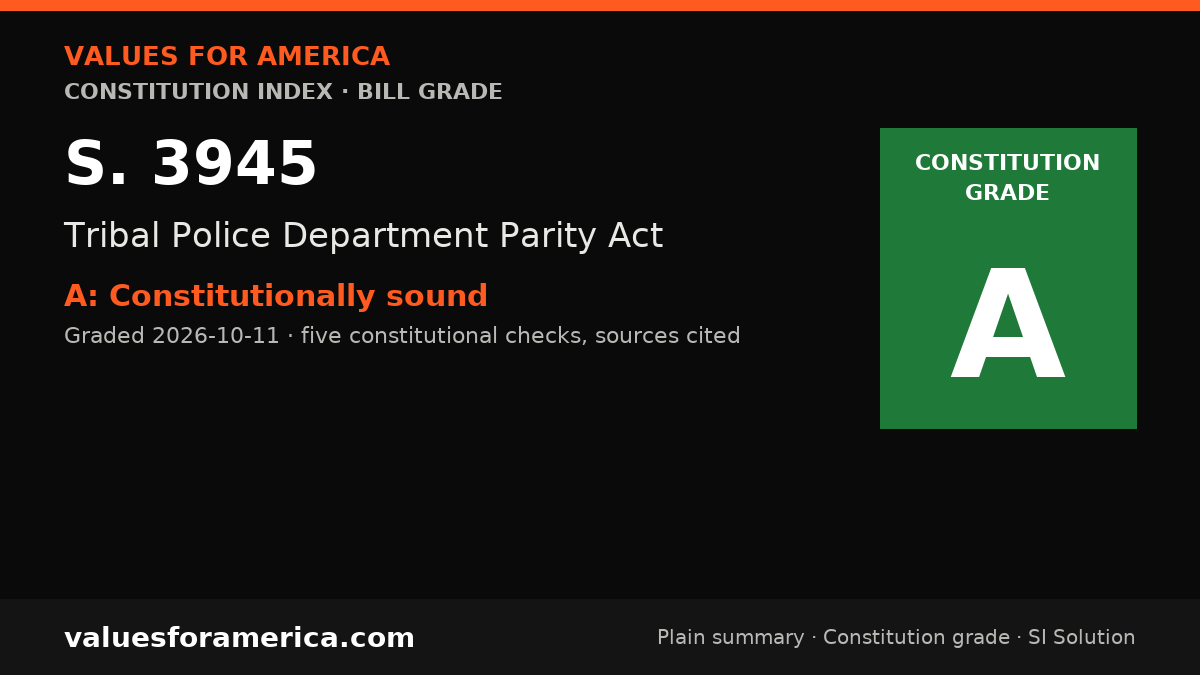
Tribal Police Department Parity Act
Cosponsors: 3 (0 D, 3 R) · per Congress.gov, 2026-10-10
Introduced: 2026-02-26
Latest action (2026-02-26): Read twice and referred to the Committee on Finance.
What S. 3945 does, in plain terms
Tribal Police Department Parity Act This bill treats tribal law enforcement agencies in the same manner as federal, state, and local law enforcement agencies for purposes of accessing firearms. The National Firearms Act (NFA) generally imposes a tax on the transfer of an NFA firearm; however, specified governmental entities (e.g., federal, state, and local law enforcement agencies) are exempt from this transfer tax. This bill extends this exemption to Indian tribes (and consequently, to tribal law enforcement agencies). The Gun Control Act (GCA) generally prohibits the interstate shipment of firearms to unlicensed persons, but exempts specified governmental entities from this prohibition. This bill makes Indian tribes (and consequently, tribal law enforcement agencies) eligible to receive firearms interstate. The GCA also prohibits the transfer or possession of machine guns manufactured after 1986, but exempts specified governmental entities from this prohibition. This bill makes Indian tribes (and consequently, tribal law enforcement agencies) eligible to transfer or possess these machine guns.
Official summary by the Congressional Research Service, via Congress.gov.
Constitution Index
“VFA Constitution grade”
Constitutionally sound
Graded 2026-10-11
SI-generated grade · five published checks · not individually reviewed by a person · methodology
The Tribal Police Department Parity Act is a straightforward extension of existing federal exemptions to tribal law enforcement agencies, aligning them with state and local agencies. It does not expand federal power beyond existing enumerated authority over interstate commerce and taxation, nor does it infringe on individual rights. The bill enhances tribal sovereignty by treating tribal agencies as equal to other governmental entities, and it does not consolidate power upward. No due process or takings concerns arise.
-
✓ Passes · Enumerated powers
The bill operates within Congress's enumerated powers under Article I, Section 8, Clause 3 (Interstate Commerce) and Clause 1 (Taxing and Spending). It modifies existing federal firearms statutes (NFA and GCA) that are already grounded in these powers. Extending exemptions to tribal governments is a permissible exercise of federal authority over commerce with Indian tribes, which is also recognize… -
✓ Passes · Bill of Rights
The bill does not infringe any provision of the Bill of Rights. It does not restrict speech, religion, assembly, press, petition, arms, quartering, search and seizure, self-incrimination, due process, takings, trial rights, or cruel and unusual punishment. In fact, by facilitating tribal law enforcement access to firearms, it may support the Second Amendment rights of tribal members, though the pr… -
✓ Passes · Individual sovereignty
The bill does not restrict individual liberty. It only extends existing governmental exemptions to tribal law enforcement agencies, which are government entities. It does not impose new restrictions on individuals' person, property, speech, labor, or belief. The burden of justification for any restriction is not triggered because no restriction is imposed. -
✓ Passes · Decentralization
The bill does not consolidate decision-making at a higher level of government. It actually supports decentralization by recognizing tribal governments as sovereign entities with the same law enforcement capabilities as state and local agencies. The questions: (1) Individuals cannot handle this—it concerns government agency access to firearms; (2) Local communities cannot handle this—it requires fe… -
✓ Passes · Due process and takings
The bill does not bypass due process or take property without just compensation. It is a statutory amendment that grants exemptions to tribal governments; it does not affect any individual's property rights or legal procedures. No Fifth Amendment concerns are implicated.
Sources: Congress.gov: S 3945 summary
Report an error in this grade
What should pass
“VFA SI Solution”
No solution yet
A sourced SI draft appears here once it passes automated checks (Constitution citation, source verification, independent SI critic). How publication works.
Related on VFA

For journalists and bloggers
“Embed this grade”
Free to use with the link back. The badge and card update when the grade changes. Embed terms →
