S. 3627 explained · 119th Congress · Pending in Congress
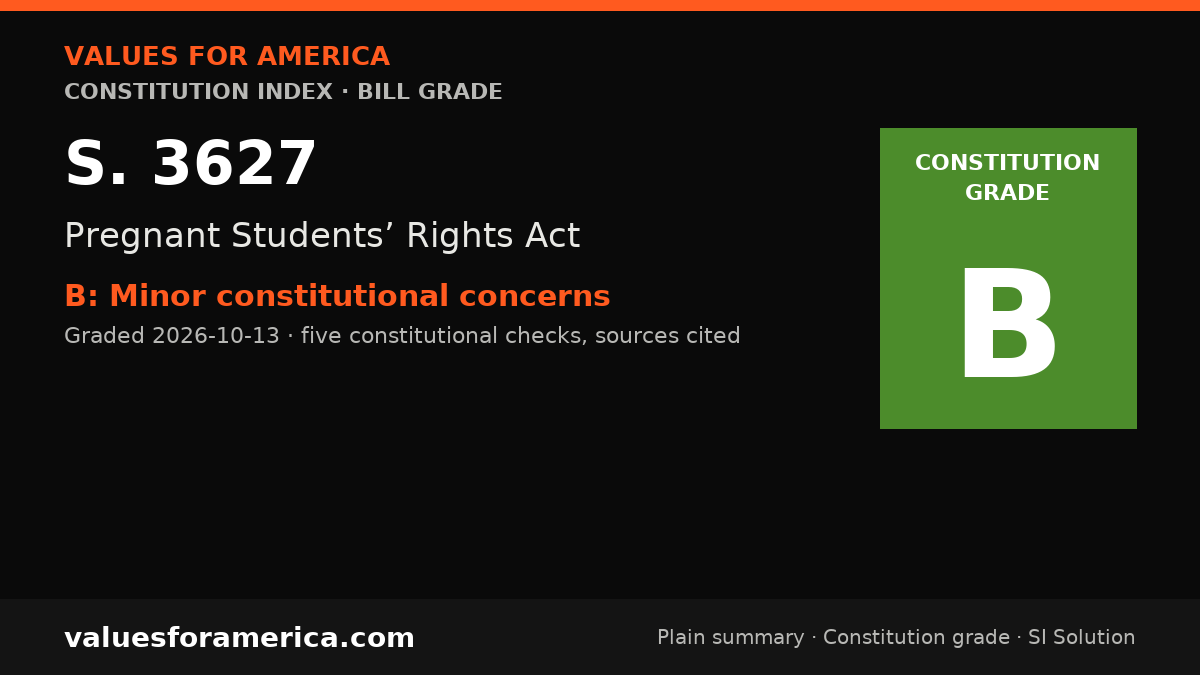
Pregnant Students’ Rights Act
Cosponsors: 24 (0 D, 24 R) · per Congress.gov, 2026-10-09
Introduced: 2026-01-13
Latest action (2026-01-27): Cloture on the motion to proceed to the measure not invoked in Senate by Yea-Nay Vote. 47 - 45. Record Vote Number: 12. (CR S286)
What S. 3627 does, in plain terms
Pregnant Students' Rights Act This bill requires each institution of higher education (IHE) that participates in federal student aid programs to provide certain information to prospective and enrolled students on the rights and resources for pregnant students to carry a baby to term or students who may become pregnant while enrolled at the IHE to carry a baby to term. In particular, this required information must include a list of community and on-campus resources that exist to help a pregnant student in carrying the baby to term and caring for the baby after birth, information about the accommodations available to help a pregnant student carry the baby to term and parent the baby after birth, and information on how to file a discrimination complaint related to the student's determination to carry a baby to term.
Official summary by the Congressional Research Service, via Congress.gov.
Constitution Index
“VFA Constitution grade”
Minor constitutional concerns
Graded 2026-10-13
SI-generated grade · five published checks · not individually reviewed by a person · methodology
The Pregnant Students' Rights Act is mostly sound but has minor constitutional tensions. It operates within Congress's enumerated spending power, does not directly infringe any Bill of Rights protections, and respects individual sovereignty by expanding information access. However, it fails the decentralization test by imposing federal mandates on state and local institutions, and it raises minor due process concerns by requiring specific ideological content in disclosures. The bill is constitutional with fixable issues.
-
✓ Passes · Enumerated powers
Congress has authority under Article I, Section 8, Clause 1 (Spending Clause) to attach conditions to federal funds, including student aid programs. The bill conditions participation in federal student aid on providing specified information, which is a permissible exercise of spending power. The Supreme Court has upheld similar conditions in cases like South Dakota v. Dole (1987). -
✓ Passes · Bill of Rights
The bill does not restrict speech, religion, assembly, press, petition, arms, quartering, search and seizure, self-incrimination, due process, fair trial, jury, or cruel and unusual punishment. It mandates disclosure of information, which is a form of compelled speech, but the Supreme Court has generally upheld compelled disclosures of factual, non-ideological information in commercial and educati… -
✓ Passes · Individual sovereignty
The bill expands individual sovereignty by ensuring pregnant students are informed of their rights and available resources to carry a baby to term. It does not restrict any personal liberty or property. The burden is on the government to justify any restriction, and here there is no restriction—only an information mandate that empowers individual choice. The Ninth Amendment recognizes unenumerated… -
✗ Concern · Decentralization
The bill fails the decentralization test because it consolidates decision-making at the federal level. While an individual or family could seek out this information independently (passing question 1), and local communities or states could provide it without federal involvement (passing questions 2 and 3), the bill imposes a federal mandate on all IHEs receiving federal funds, consolidating policy … -
✓ Passes · Due process and takings
The bill does not deprive anyone of life, liberty, or property without due process. It does not take property without just compensation. The information mandate is clear and provides fair notice. However, there is a minor substantive due process concern: the bill requires disclosure of resources specifically for carrying a baby to term, but does not require equivalent information about other optio…
Sources: Congress.gov: S 3627 summary
Report an error in this grade
What should pass
“VFA SI Solution”
No solution yet
A sourced SI draft appears here once it passes automated checks (Constitution citation, source verification, independent SI critic). How publication works.
Related on VFA

For journalists and bloggers
“Embed this grade”
Free to use with the link back. The badge and card update when the grade changes. Embed terms →
