S. 3386 explained · 119th Congress · Pending in Congress
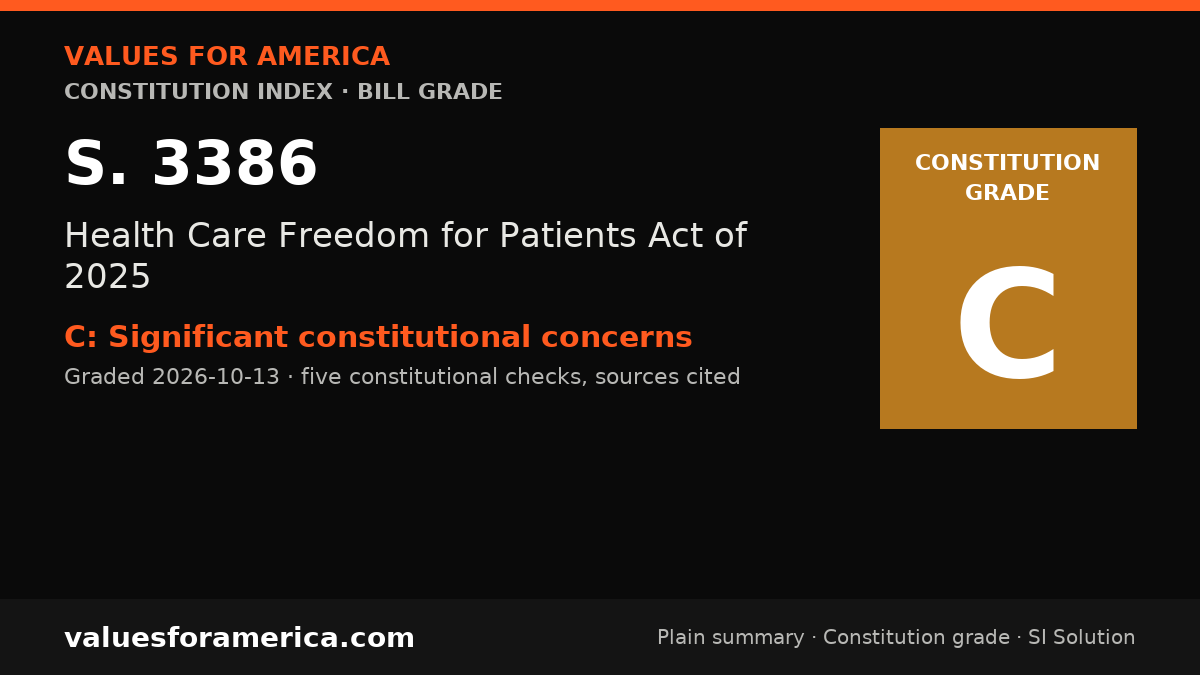
Health Care Freedom for Patients Act of 2025
Cosponsors: 1 (0 D, 1 R) · per Congress.gov, 2026-10-09
Introduced: 2025-12-08
Latest action (2025-12-11): Cloture on the motion to proceed to the measure not invoked in Senate by Yea-Nay Vote. 51 - 48. Record Vote Number: 643. (CR S8654)
What S. 3386 does, in plain terms
Health Care Freedom for Patients Act of 2025 This bill allows certain individuals with health savings accounts (HSAs) to receive federal payments. It also restricts payments under Medicaid and the Children's Health Insurance Program (CHIP) regarding certain noncitizens and restricts coverage of gender-transition procedures. Specifically, the bill provides funds for the Department of Health and Human Services to deposit payments into an individual’s HSA during 2026-2027 if the individual has a bronze or catastrophic plan through a health insurance exchange, is between the ages of 18 and 64, and has income up to 700% of the federal poverty level (FPL). Individuals may receive $1,000 or $1,500 annually, depending on age. The bill also provides funds, beginning in 2027, for cost-sharing reductions for certain individuals who have a silver plan and income up to 250% of the FPL. Beginning in 2027, the bill allows any individual to enroll in a catastrophic plan. Currently, these plans are limited to those under the age of 30 or who have certain exemptions. The bill also reduces the enhanced federal matching rate for the Medicaid expansion population in states that provide any health benefits for individuals who are not qualified aliens under federal law. The bill makes Medicaid and CHIP coverage of individuals while their status is being verified optional and conditions federal payment during this period on verification. Finally, the bill prohibits exchange plans from covering gender-transition procedures as an essential health benefit and prohibits federal payment under Medicaid and CHIP for these procedures.
Official summary by the Congressional Research Service, via Congress.gov.
Constitution Index
“VFA Constitution grade”
Significant constitutional concerns
Graded 2026-10-13
SI-generated grade · five published checks · not individually reviewed by a person · methodology
The Health Care Freedom for Patients Act of 2025 contains provisions that are constitutionally mixed. While the HSA deposit and catastrophic plan expansion likely fall within federal spending power, the restrictions on Medicaid/CHIP coverage for noncitizens and gender-transition procedures raise significant concerns under the Equal Protection component of the Fifth Amendment's Due Process Clause and the Spending Clause's limits on coercive conditions. The bill also centralizes health policy decisions at the federal level, failing the decentralization test on multiple questions. Overall, the bill has significant constitutional issues requiring structural rewrite.
-
✗ Concern · Enumerated powers
The federal government's power to regulate health insurance and Medicaid/CHIP derives from the Spending Clause (Article I, Section 8, Clause 1) and the Commerce Clause (Article I, Section 8, Clause 3). However, the bill's restrictions on coverage for gender-transition procedures and noncitizens go beyond merely setting conditions on federal funds—they effectively dictate state policy choices in ar… -
✗ Concern · Bill of Rights
The bill's prohibition on federal payment for gender-transition procedures under Medicaid and CHIP, and its restriction on exchange plans covering such procedures, likely violates the Equal Protection component of the Fifth Amendment's Due Process Clause. In Bostock v. Clayton County (2020), the Supreme Court held that discrimination based on transgender status is a form of sex discrimination. Whi… -
✗ Concern · Individual sovereignty
The bill restricts individual choice in medical care by prohibiting coverage of gender-transition procedures in exchange plans and under federal health programs. This infringes on the individual's right to make personal medical decisions, which is protected under the substantive due process component of the Fifth Amendment. The Supreme Court in Planned Parenthood v. Casey (1992) recognized a const… -
✗ Concern · Decentralization
The bill fails three of the four decentralization questions. (1) Individuals cannot handle health insurance regulation on their own—this requires collective action. (2) Local communities could potentially regulate health insurance and Medicaid within their jurisdictions, but the bill centralizes these decisions at the federal level. (3) States have traditionally regulated health insurance and Medi… -
✓ Passes · Due process and takings
The bill does not appear to bypass procedural due process or take property without just compensation. The restrictions on coverage are prospective and apply to future benefits, not retroactively. Individuals retain the right to purchase private insurance outside of exchanges and to pay for medical procedures out-of-pocket. The bill does not deprive anyone of existing property rights or impose pena…
Sources: Congress.gov: S 3386 summary
Report an error in this grade
What should pass
“VFA SI Solution”
No solution yet
A sourced SI draft appears here once it passes automated checks (Constitution citation, source verification, independent SI critic). How publication works.
Related on VFA

For journalists and bloggers
“Embed this grade”
Free to use with the link back. The badge and card update when the grade changes. Embed terms →
