S. 3385 explained · 119th Congress · Pending in Congress
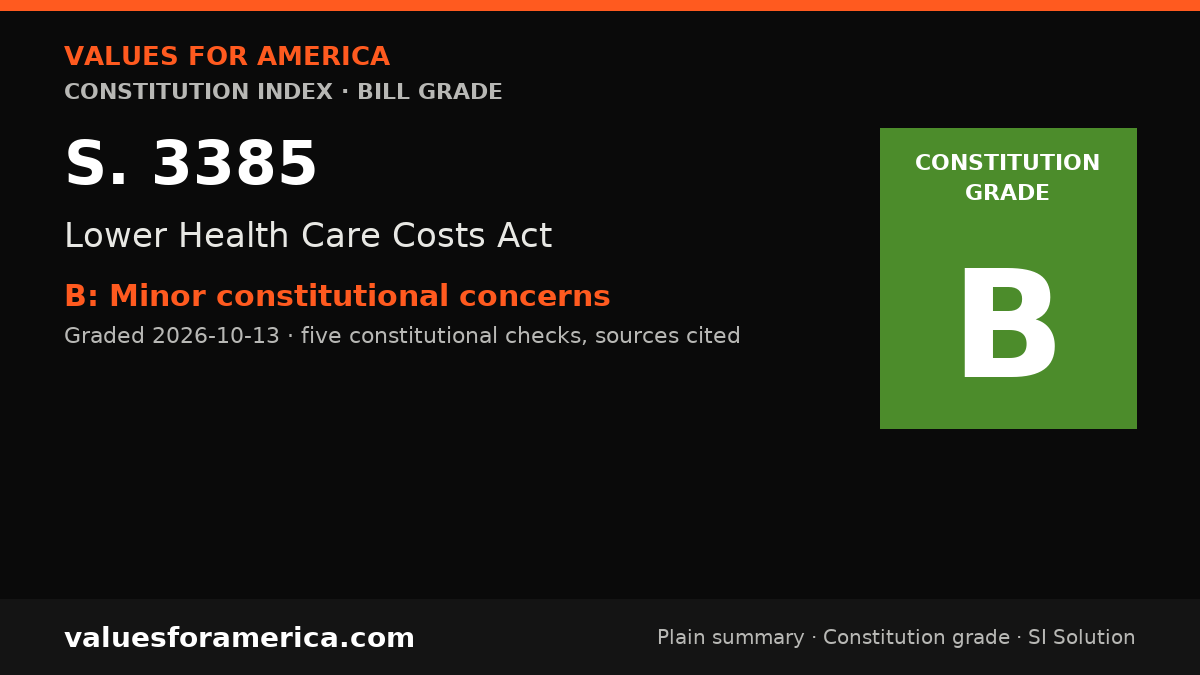
Lower Health Care Costs Act
Cosponsors: none · per Congress.gov, 2026-10-09
Introduced: 2025-12-08
Latest action (2025-12-11): Cloture on the motion to proceed to the measure not invoked in Senate by Yea-Nay Vote. 51 - 48. Record Vote Number: 644. (CR S8654-8655)
What S. 3385 does, in plain terms
Lower Health Care Costs Act This bill extends for three years, through 2028, temporary changes enacted by the American Rescue Plan Act of 2021 (ARPA) and the Inflation Reduction Act of 2022 (IRA) that generally expand eligibility for and increase the amount of the premium tax credit. Currently, eligible taxpayers may be able to claim the premium tax credit, which applies toward the cost of obtaining health insurance through health insurance exchanges. To be eligible for the premium tax credit, a taxpayer’s household income must meet or exceed 100% of the federal poverty level (FPL) and, after 2025, may not exceed 400% of the FPL (maximum income limit). For 2021-2025, the ARPA and IRA eliminated the maximum income limit, which generally expands eligibility for the premium tax credit. Further, under current law, the amount of the premium tax credit is (1) generally the plan premium (conditions apply), minus (2) the taxpayer’s household income multiplied by the applicable percentage. The applicable percentage is a specific percentage that varies depending on which of six income ranges (adjusted for inflation after 2025) the taxpayer’s household income falls within. For 2021-2025, the ARPA and IRA lowered the applicable percentages and eliminated the adjustment of the applicable percentages for inflation, which generally increases the amount of the premium tax credit. The bill extends for three years, through 2028, the elimination of the 400% maximum income limit, the lower applicable percentages, and the elimination of the inflation adjustment for the applicable percentages.
Official summary by the Congressional Research Service, via Congress.gov.
Constitution Index
“VFA Constitution grade”
Minor constitutional concerns
Graded 2026-10-13
SI-generated grade · five published checks · not individually reviewed by a person · methodology
The bill is a federal tax expenditure that extends existing premium tax credit provisions. It operates within Congress's enumerated taxing and spending powers, does not infringe on individual rights, and does not raise due process or takings concerns. However, it consolidates health insurance subsidy policy at the federal level, which could be handled by states or individuals, and thus raises minor decentralization concerns.
-
✓ Passes · Enumerated powers
The bill uses the federal tax system to provide subsidies for health insurance. Congress has the power to lay and collect taxes and to spend for the general welfare under Article I, Section 8, Clause 1. The premium tax credit is a tax expenditure, and extending it is a valid exercise of the taxing and spending power. The bill does not regulate commerce or mandate purchases; it only modifies tax cr… -
✓ Passes · Bill of Rights
The bill does not restrict speech, religion, assembly, press, petition, the right to bear arms, or any other enumerated right. It does not involve searches, seizures, self-incrimination, or cruel and unusual punishment. It is a purely financial incentive, not a restriction on liberty. -
✓ Passes · Individual sovereignty
The bill does not restrict individual freedom. It expands eligibility for a tax credit, which is a benefit, not a burden. Individuals remain free to choose their own health insurance or not. The bill does not compel any action or restrict any personal choice. -
✗ Concern · Decentralization
The bill fails the decentralization test because it continues and extends a federal program that could be handled at the state or individual level. While individuals and families cannot fully handle health insurance costs alone, states could design their own subsidy programs. The federal government is consolidating decision-making about health insurance subsidies at the national level, which is no… -
✓ Passes · Due process and takings
The bill does not deprive anyone of life, liberty, or property without due process. It does not take property for public use without just compensation. It only provides a tax credit, which is a benefit, and does not impose any penalty or seizure.
Sources: Congress.gov: S 3385 summary
Report an error in this grade
The Framers
“Founders’ Verdict”
Confidence 0.75
Archived SI output (machine-generated)No editorial review recorded. This historical SI verdict was machine-generated by software and predates the review desk; check it against the official bill text.
Synthesis
Congress's taxing power under Article I, Section 8, Clause 1 permits the Lower Health Care Costs Act to promote general welfare (Hamilton, Madison, Marshall)
The Congress possesses the sovereign authority to lay and collect taxes, duties, imposts, and excises, a power indispensable to the vigor of the federal government and the execution of its enumerated functions. A measure denominated the Lower Health Care Costs Act, situated in the policy area of taxation, aligns with this grant, enabling the regulation of economic burdens through fiscal means to promote public welfare. As I argued, the taxing power must be ample and unconfined, lest the Union perish for want of revenue; such legislation, employing taxation to mitigate health care expenses, res…
The proposed 'Lower Health Care Costs Act,' purporting to act through taxation to influence health care costs, exceeds the limited powers delegated to the federal government. The Constitution grants Congress authority to lay and collect taxes solely for purposes of paying debts, providing for the common defense, and general welfare, but such welfare must be confined strictly to the enumerated powers that follow. Health care costs, being a matter of local concern affecting individual and state affairs, fall outside these bounds and are reserved to the States or the people. Any federal taxation …
The proposed legislation, titled 'Lower Health Care Costs Act' and categorized in the policy area of taxation, invokes the express power of Congress to lay and collect taxes. This power is necessary for funding the general welfare and is a cornerstone of the federal structure, as it enables the government to address public needs without encroaching on unenumerated domains. While the specific mechanisms are not detailed, actions within the taxing authority do not exceed constitutional bounds, provided they adhere to uniformity and apportionment rules where applicable. The failure of cloture doe…
The proposed Lower Health Care Costs Act falls within the ambit of federal legislation concerning taxation, a power expressly enumerated in the Constitution. Congress possesses the authority 'To lay and collect Taxes... to pay the Debts and provide for the common Defence and general Welfare of the United States.' This taxing power is plenary in its sphere and admits of measures designed to lower costs in areas affecting the general welfare, provided they do not exceed constitutional bounds. The necessary and proper clause further sustains such legislation as a means to execute the taxing power…
Report an error in this Founders' Verdict
What should pass
“VFA SI Solution”
No solution yet
A sourced SI draft appears here once it passes automated checks (Constitution citation, source verification, independent SI critic). How publication works.
Related on VFA

For journalists and bloggers
“Embed this grade”
Free to use with the link back. The badge and card update when the grade changes. Embed terms →
