S. 3373 explained · 119th Congress · Pending in Congress
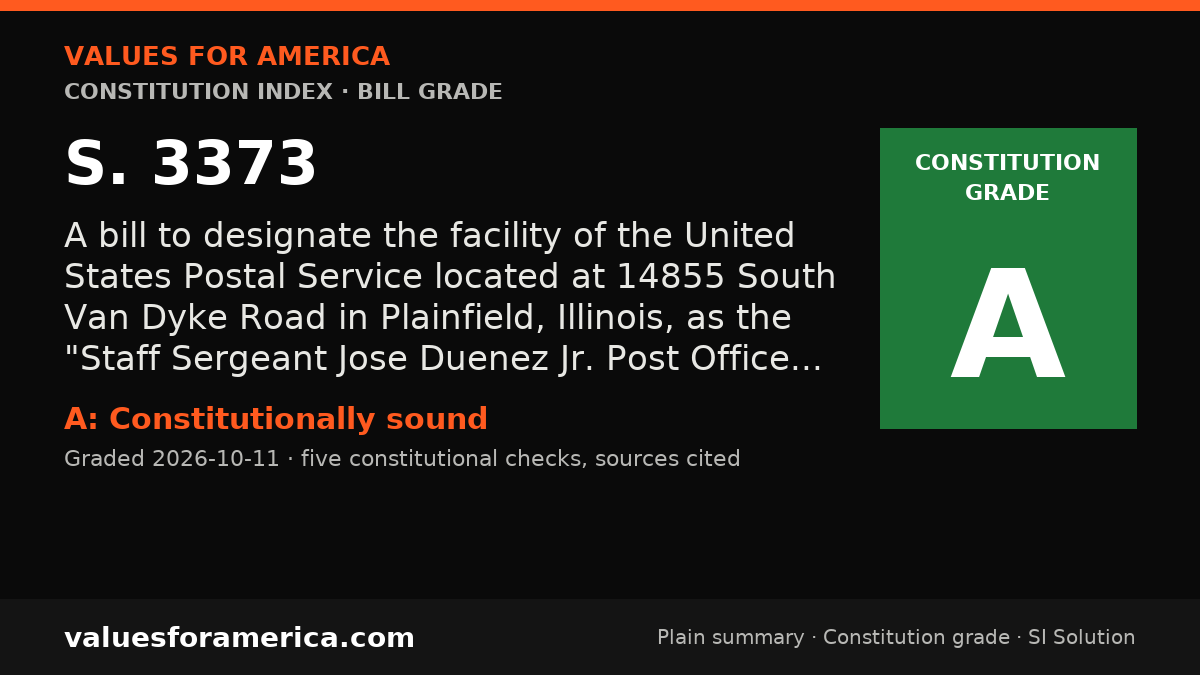
A bill to designate the facility of the United States Postal Service located at 14855 South Van Dyke Road in Plainfield, Illinois, as the "Staff Sergeant Jose Duenez Jr. Post Office Building".
Cosponsors: 1 (1 D, 0 R) · per Congress.gov, 2026-10-14
Introduced: 2025-12-04
Latest action (2026-09-14): Placed on Senate Legislative Calendar under General Orders. Calendar No. 582.
What S. 3373 does, in plain terms
This bill designates the facility of the United States Postal Service located at 14855 South Van Dyke Road in Plainfield, Illinois, as the "Staff Sergeant Jose Duenez Jr. Post Office Building".
Official summary by the Congressional Research Service, via Congress.gov.
Constitution Index
“VFA Constitution grade”
Constitutionally sound
Graded 2026-10-11
SI-generated grade · five published checks · not individually reviewed by a person · methodology
This bill simply names a federal post office building after a fallen service member. It does not expand federal power, restrict rights, or affect individual sovereignty. The action falls within Congress's enumerated power to establish post offices under Article I, Section 8, Clause 7, and naming a building is a routine exercise of that authority. No constitutional concerns arise.
-
✓ Passes · Enumerated powers
Article I, Section 8, Clause 7 grants Congress the power to establish post offices and post roads. Naming a specific postal facility is a minor administrative action directly tied to that enumerated power. No other constitutional authority is needed for this designation. -
✓ Passes · Bill of Rights
The bill does not implicate any of the first ten amendments. It does not affect speech, religion, assembly, press, petition, arms, quartering, search and seizure, self-incrimination, due process, takings, trial rights, jury rights, cruel and unusual punishment, unenumerated rights, or reserved powers. It is purely a naming designation. -
✓ Passes · Individual sovereignty
The bill imposes no restrictions on personal liberty, property, speech, labor, or belief. It does not require any individual to do or refrain from doing anything. The burden of justification for government action is not triggered because there is no restriction on individual freedom. -
✓ Passes · Decentralization
The naming of a federal post office is a matter of federal property and federal administration. While the local community may have an interest, the facility is owned and operated by the United States Postal Service, a federal entity. The decision to name it is appropriately made at the federal level, as it concerns federal property. This does not consolidate decision-making beyond the minimum nece… -
✓ Passes · Due process and takings
The bill does not deprive any person of life, liberty, or property, nor does it take private property for public use. It does not affect any legal rights or procedures. There is no due process or takings issue.
Sources: Congress.gov: S 3373 summary
Report an error in this grade
What should pass
“VFA SI Solution”
No solution yet
A sourced SI draft appears here once it passes automated checks (Constitution citation, source verification, independent SI critic). How publication works.
Related on VFA

For journalists and bloggers
“Embed this grade”
Free to use with the link back. The badge and card update when the grade changes. Embed terms →
