S. 331 explained · 119th Congress · Became law
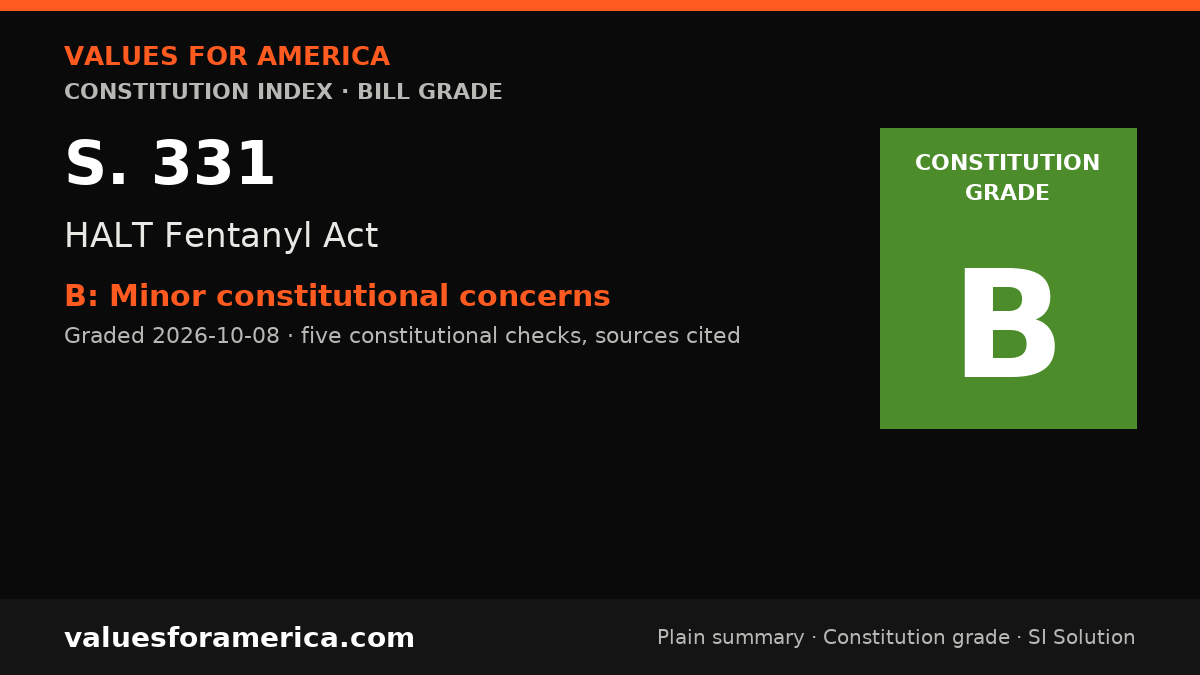
HALT Fentanyl Act
Cosponsors: 31 (6 D, 24 R, 1 other) · per Congress.gov, 2026-10-11
Introduced: 2025-01-30
Latest action (2025-07-16): Became Public Law No: 119-26.
What S. 331 does, in plain terms
Halt All Lethal Trafficking of Fentanyl Act or the HALT Fentanyl Act This act permanently places fentanyl-related substances as a class into schedule I of the Controlled Substances Act. A schedule I controlled substance is a drug, substance, or chemical that has a high potential for abuse; has no currently accepted medical value; and is subject to regulatory controls and administrative, civil, and criminal penalties under the Controlled Substances Act. Under the act, offenses involving fentanyl-related substances are triggered by the same quantity thresholds and subject to the same penalties as offenses involving fentanyl analogues (e.g., offenses involving 100 grams or more trigger a 10-year mandatory minimum prison term). Additionally, the act establishes a new, alternative registration process for certain schedule I research. The act also makes several other changes to registration requirements for conducting research with controlled substances, including permitting a single registration for related research sites in certain circumstances, waiving the requirement for a new inspection in certain situations, and allowing a registered researcher to perform certain manufacturing activities with small quantities of a substance without obtaining a manufacturing registration. Finally, the act expresses the sense that Congress agrees with the interpretation of the Controlled Substances Act in United States v. McCray, a 2018 case decided by the U.S. District Court for the Western District of New York. In that case, the court held that butyryl fentanyl, a controlled substance, can be considered an analogue of fentanyl even though, under the Controlled Substances Act, the term controlled substance analogue specifically excludes a controlled substance.
Official summary by the Congressional Research Service, via Congress.gov.
Constitution Index
“VFA Constitution grade”
Minor constitutional concerns
Graded 2026-10-08
SI-generated grade · five published checks · not individually reviewed by a person · methodology
Permanent Schedule I placement and uniform penalties for fentanyl-related trafficking fall within commerce authority and preserve trial rights, with a strong protective justification for a lethal interstate drug. Mandatory minimums and class-wide scheduling create minor Eighth Amendment, due-process, and liberty tensions that keep this from a clean A, but no direct violation is shown.
-
✓ Passes · Enumerated powers
Congress relies on Article I, Section 8, Clause 3 to regulate interstate commerce, combined with Article I, Section 8, Clause 18 to make laws necessary and proper for that regulation. Permanent class scheduling of fentanyl-related substances, quantity-triggered penalties, and uniform research registration directly govern interstate distribution of a dangerous trafficked chemical. This is within th… -
✓ Passes · Bill of Rights
The act does not on its face censor speech, press, assembly, religion or petition under the First Amendment, disarm the people under the Second Amendment, or authorize searches without warrant under the Fourth Amendment. Penalties apply after arrest and prosecution. A 10-year mandatory minimum for 100 grams or more of fentanyl-related substances raises Eighth Amendment proportionality concerns, bu… -
✓ Passes · Individual sovereignty
The act restricts possession, distribution, and manufacture of fentanyl-related substances, which is a restraint on person, property, and labor. The government offers a compelling constitutional justification: preventing mass poisoning deaths from an interstate trafficked poison with no accepted medical value in the scheduled class, under the Fifth Amendment liberty interest subject to reasonable … -
✓ Passes · Decentralization
Lethal fentanyl trafficking is interstate and cross-border commerce that individuals, counties, and single states cannot contain alone. Federal scheduling, uniform quantity thresholds, and researcher registration address a national market and prevent safe-haven gaps under Article I, Section 8, Clause 3 and the Tenth Amendment. The act does not commandeer state legislatures or police, and leaves st… -
✓ Passes · Due process and takings
The act creates no summary seizure, civil forfeiture without hearing, or presumption of guilt. Criminal liability still requires indictment, proof beyond a reasonable doubt, jury trial under the Sixth Amendment, and sentencing by a court under the Fifth Amendment Due Process Clause. No property is taken for public use without just compensation under the Fifth Amendment Takings Clause. Severity is …
Sources: Congress.gov: S 331 summary
Report an error in this grade
What should pass
“VFA SI Solution”
No solution yet
A sourced SI draft appears here once it passes automated checks (Constitution citation, source verification, independent SI critic). How publication works.
Related on VFA

For journalists and bloggers
“Embed this grade”
Free to use with the link back. The badge and card update when the grade changes. Embed terms →
