S. 3302 explained · 119th Congress · Pending in Congress
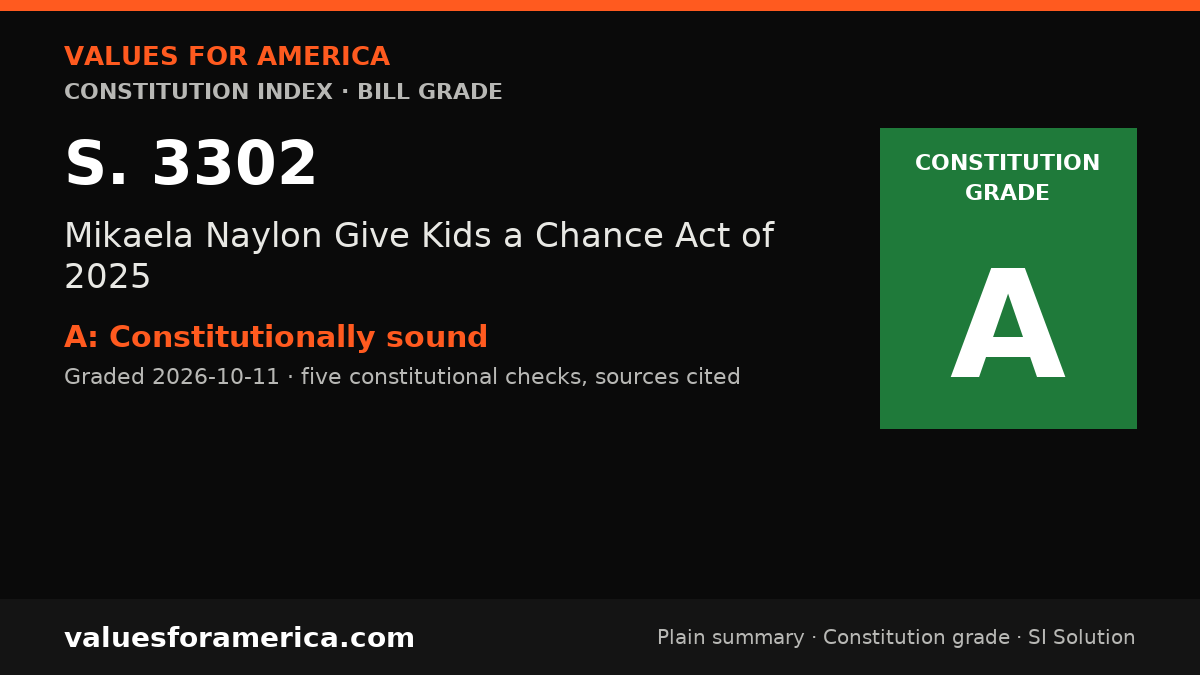
Mikaela Naylon Give Kids a Chance Act of 2025
Cosponsors: 37 (20 D, 17 R) · per Congress.gov, 2026-10-10
Introduced: 2025-12-02
Latest action (2025-12-02): Read twice and referred to the Committee on Health, Education, Labor, and Pensions.
What S. 3302 does, in plain terms
Mikaela Naylon Give Kids a Chance Act of 2025 This bill authorizes certain targeted clinical trials involving combinations of drugs to treat pediatric cancer, and renews the Food and Drug Administration’s (FDA’s) authority to award priority review vouchers (PRVs) to sponsors of new products for rare pediatric diseases. Specifically, the bill modifies requirements relating to molecularly targeted pediatric cancer investigations to permit research on new drugs used in combination with active ingredients that have already been approved and that (1) have been determined to be part of the standard of care for treating a pediatric cancer, or (2) have been approved to treat an adult cancer and are directed at molecular targets for pediatric cancer. The FDA must issue guidance on the implementation of these provisions and report to Congress on its efforts to ensure implementation. The Government Accountability Office (GAO) must report on the effectiveness of the bill's changes with respect to the development of pediatric cancer drugs. The bill also renews the FDA’s authority to issue PRVs to sponsors of new products intended to treat rare pediatric diseases through September 30, 2030. This is known as the Rare Pediatric Disease PRV program. The program expired in December 2024. GAO must report on the effectiveness of the Rare Pediatric Disease PRV program, including to what extent PRVs were successful in promoting drug development and expediting patient access to drugs for the treatment or prevention of rare pediatric diseases.
Official summary by the Congressional Research Service, via Congress.gov.
Constitution Index
“VFA Constitution grade”
Constitutionally sound
Graded 2026-10-11
SI-generated grade · five published checks · not individually reviewed by a person · methodology
The bill is a constitutional exercise of Congress's enumerated power to regulate interstate commerce and promote medical progress, does not infringe on any constitutional rights, and appropriately delegates implementation to federal agencies without overreaching into state or individual authority.
-
✓ Passes · Enumerated powers
Congress has authority under Article I, Section 8, Clause 3 (Commerce Clause) to regulate drugs and medical devices that move in interstate commerce. The FDA's oversight of clinical trials and priority review vouchers falls squarely within this power. Additionally, the bill's provisions to encourage pediatric cancer research are a valid exercise of the spending power and the general welfare clause… -
✓ Passes · Bill of Rights
The bill does not restrict speech, religion, assembly, press, petition, the right to bear arms, or any other enumerated right. It does not involve searches, seizures, self-incrimination, or criminal procedure. It imposes no punishment and does not affect trial rights. The bill is purely regulatory and incentive-based, with no impact on the Bill of Rights. -
✓ Passes · Individual sovereignty
The bill does not restrict individual liberty. It authorizes clinical trials and provides incentives for drug development, which expands options for patients and families. It does not compel participation in trials or mandate any medical treatment. The burden on individuals is minimal and justified by the compelling interest in advancing pediatric cancer treatments. -
✓ Passes · Decentralization
The bill addresses a national issue—pediatric cancer drug development—that cannot be effectively handled by individuals, local communities, or states alone due to the interstate nature of drug approval and the need for consistent federal standards. The FDA's role is necessary for national drug safety and efficacy. The bill does not consolidate decision-making upward beyond the minimum necessary; i… -
✓ Passes · Due process and takings
The bill does not deprive any person of life, liberty, or property without due process. It does not take private property for public use without just compensation. The priority review voucher program is a voluntary incentive, not a taking. The bill includes reporting and guidance requirements that ensure procedural regularity and transparency.
Sources: Congress.gov: S 3302 summary
Report an error in this grade
What should pass
“VFA SI Solution”
No solution yet
A sourced SI draft appears here once it passes automated checks (Constitution citation, source verification, independent SI critic). How publication works.
Related on VFA

For journalists and bloggers
“Embed this grade”
Free to use with the link back. The badge and card update when the grade changes. Embed terms →
