S. 32 explained · 119th Congress · Became law
LACA
Cosponsors: 1 (1 D, 0 R) · per Congress.gov, 2026-10-15
Introduced: 2025-01-08
Latest action (2026-09-16): Became Public Law No: 119-109.
What S. 32 does, in plain terms
Local Access to Courts Act or LACA This act adds College Station to the list of places where court must be held in the Galveston Division of the Southern District of Texas. Additionally, the act adds El Centro to the list of places where court must be held in the Southern District of California.
Official summary by the Congressional Research Service, via Congress.gov.
Constitution Index
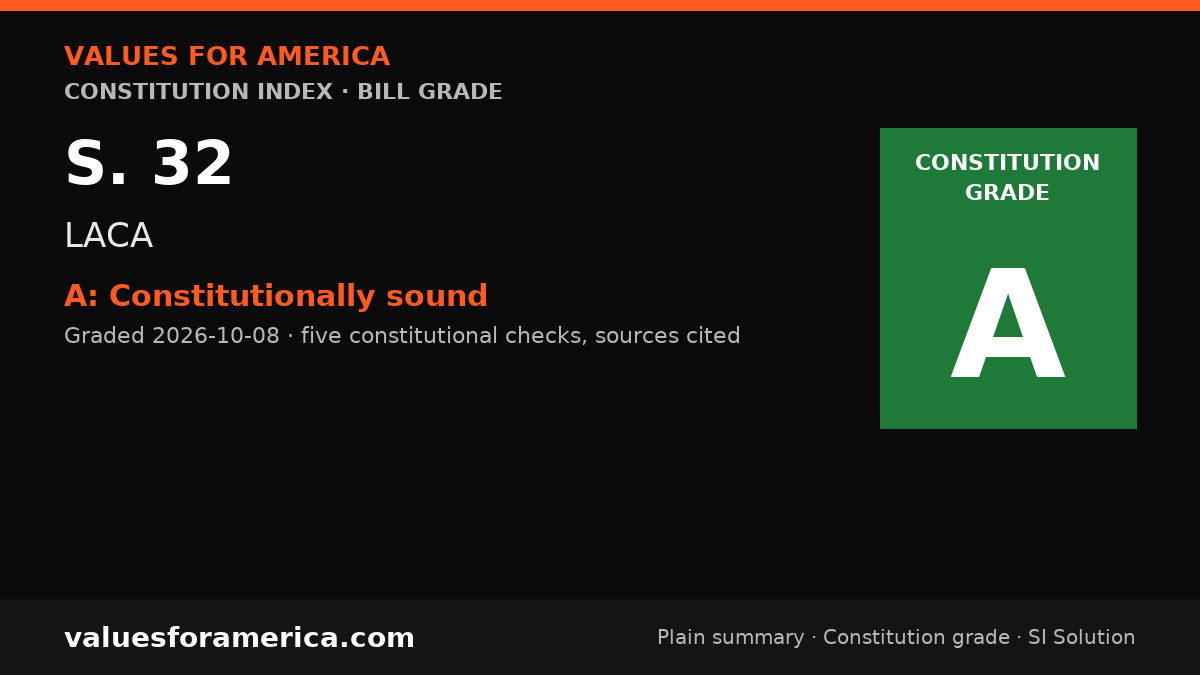
“VFA Constitution grade”
Constitutionally sound
Graded 2026-10-08
SI-generated grade · five published checks · not individually reviewed by a person · methodology
LACA is a routine Article I and Article III housekeeping measure that designates additional federal court locations. It stays within enumerated power, infringes no rights, expands court access and due process, and decentralizes proceedings. Fully constitutional.
-
✓ Passes · Enumerated powers
Congress has explicit authority under Article I, Section 8, Clause 9 to constitute tribunals inferior to the Supreme Court, and under Article III, Section 1 to ordain and establish lower federal courts and fix where they sit. Designating places of holding court in the Southern District of Texas and Southern District of California is a direct exercise of that power. -
✓ Passes · Bill of Rights
This act expands physical access to federal courts in two districts. It does not restrict speech, religion, press, assembly under the First Amendment, does not implicate the Second, Third, Fourth, Fifth, Sixth, Seventh, or Eighth Amendments, and in fact supports Sixth Amendment rights to trial and Seventh Amendment jury access by reducing travel burdens. No unenumerated right under the Ninth Amend… -
✓ Passes · Individual sovereignty
The act restricts no personal conduct, property use, speech, labor, or belief. It imposes no mandate, prohibition, or license on individuals. It lowers practical barriers to vindicating rights in court, leaving individual sovereignty intact. -
✓ Passes · Decentralization
Federal courts cannot be operated by individuals, counties, or states acting alone; Article III vests the federal judicial power in federal courts. Adding hearing locations within existing districts decentralizes access rather than consolidating power upward, bringing proceedings closer to litigants and witnesses. -
✓ Passes · Due process and takings
The act strengthens procedural due process under the Fifth Amendment and Fourteenth Amendment by improving notice, hearing access, and opportunity to be heard. It creates no presumption of guilt, imposes no punishment without trial, and takes no private property under the Fifth Amendment Takings Clause.
Sources: Congress.gov: S 32 summary
Report an error in this grade
What should pass
“VFA SI Solution”
No solution yet
A sourced SI draft appears here once it passes automated checks (Constitution citation, source verification, independent SI critic). How publication works.
Related on VFA

For journalists and bloggers
“Embed this grade”
Free to use with the link back. The badge and card update when the grade changes. Embed terms →
