S. 2677 explained · 119th Congress · Pending in Congress
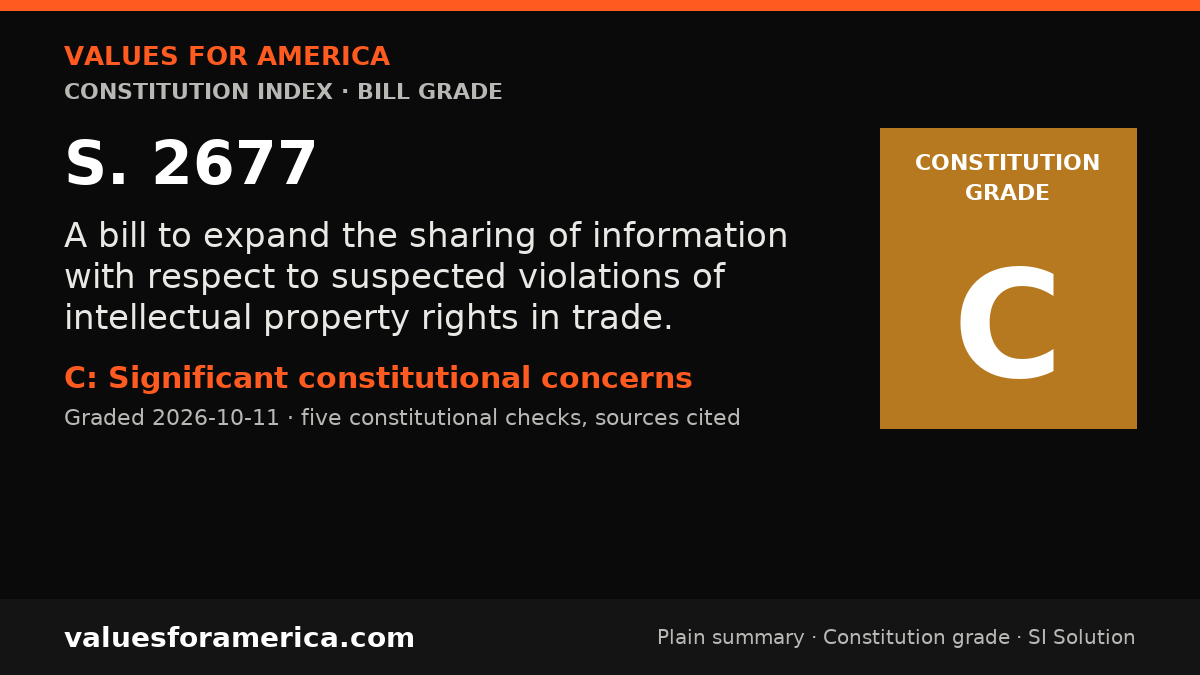
A bill to expand the sharing of information with respect to suspected violations of intellectual property rights in trade.
Cosponsors: 1 (1 D, 0 R) · per Congress.gov, 2026-10-14
Introduced: 2025-08-01
Latest action (2026-08-10): Held at the desk.
What S. 2677 does, in plain terms
This bill expands the authority of U.S. Customs and Border Protection (CBP) to provide information to certain persons (e.g., trademark or copyright owners) regarding suspected violations of intellectual property rights in trade. Under current law, if CBP suspects that merchandise is being imported in violation of certain trademark and copyright laws, it may request assistance from specified persons when determining whether the merchandise is imported in violation of these laws. To permit the party to conduct examination and testing, CBP must provide them with specified information that appears on the merchandise and its packaging and labels. This bill (1) expands the definition of person to allow CBP to request assistance from any other appropriate party with an interest in the imported merchandise, and (2) expands the scope of information that CBP is authorized to share with others to include information on and images of packing materials and shipping containers. The bill allows CBP to request this assistance if it has a reasonable suspicion (currently, suspects) that the merchandise being imported is in violation of certain trademark and copyright laws. Additionally, CBP may provide a person with nonpublic information about the imported merchandise that was generated by an online marketplace or similar market platform, express consignment operator, freight forwarder, or any other entity that plays a role in the sale, importation, or facilitation of the merchandise into the United States and has been provided to, shared with, or obtained by CBP.
Official summary by the Congressional Research Service, via Congress.gov.
Constitution Index
“VFA Constitution grade”
Significant constitutional concerns
Graded 2026-10-11
SI-generated grade · five published checks · not individually reviewed by a person · methodology
The bill raises significant concerns under the Fourth Amendment and principles of due process by expanding the sharing of nonpublic information about imported merchandise without clear procedural safeguards. While it operates within federal commerce authority, the expansion of information sharing to a broader set of private parties, including information from online marketplaces and freight forwarders, could infringe on privacy and property interests without adequate oversight. The bill also centralizes information sharing at the federal level, but the subject matter (international trade) is inherently federal, so decentralization concerns are limited. Overall, the bill requires structural revisions to ensure that information sharing is narrowly tailored and accompanied by due process protections.
-
✓ Passes · Enumerated powers
The bill falls under the federal government's enumerated power to regulate foreign commerce under Article I, Section 8, Clause 3. Customs and Border Protection's role in enforcing intellectual property rights at the border is a legitimate exercise of this power. -
✗ Concern · Bill of Rights
The expansion of information sharing to include nonpublic information from online marketplaces and other entities raises Fourth Amendment concerns. The Fourth Amendment protects against unreasonable searches and seizures, and the sharing of nonpublic commercial information without a warrant or clear statutory safeguards may be considered an unreasonable search. Additionally, the bill's 'reasonable… -
✗ Concern · Individual sovereignty
The bill allows CBP to share nonpublic information about imported merchandise with private parties, including information generated by online marketplaces and freight forwarders. This could expose individuals and businesses to increased surveillance and potential misuse of their proprietary or personal information without their consent. The government has not demonstrated a compelling justificatio… -
✓ Passes · Decentralization
International trade is a matter of federal concern, and the enforcement of intellectual property rights at the border cannot be effectively handled by individuals, local communities, or states alone. The bill does not consolidate decision-making at a higher level than necessary, as the federal government is the appropriate authority for customs and border enforcement. -
✗ Concern · Due process and takings
The bill's expansion of information sharing lacks clear procedural safeguards, such as notice to the importer or an opportunity to contest the sharing of nonpublic information. This could deprive individuals and businesses of property interests (e.g., trade secrets, confidential business information) without due process of law, violating the Fifth Amendment's Due Process Clause. The bill also does…
Sources: Congress.gov: S 2677 summary
Report an error in this grade
The Framers
“Founders’ Verdict”
Confidence 0.75
Archived SI output (machine-generated)No editorial review recorded. This historical SI verdict was machine-generated by software and predates the review desk; check it against the official bill text.
Synthesis
The bill is a constitutional exercise of Congress's power to regulate foreign commerce and to secure exclusive rights to authors and inventors. The expansion of information sharing by Customs and Border Protection is a necessary and proper means to enforce intellectual property rights in imports, and does not violate any express constitutional prohibition.
The proposed bill is a proper exercise of Congress's power to regulate foreign commerce and to secure exclusive rights to authors and inventors. By expanding the authority of Customs and Border Protection to share information with right holders, it strengthens enforcement against counterfeit and pirated goods entering the United States. This falls squarely within the federal government's constitutional duties to protect intellectual property and to police the flow of imports, and it serves the general welfare by promoting innovation and fair trade. The sharing of nonpublic information obtained…
This bill offends the spirit of the Fourth Amendment, which secures the people against unreasonable searches and seizures, and the Tenth Amendment, which reserves to the States or the people all powers not delegated to the United States. Expanding the sharing of nonpublic information—including images of packing materials and data from online marketplaces—with private parties upon mere 'reasonable suspicion' rather than probable cause or a warrant, grants federal agents a power to expose private commercial transactions without judicial oversight. Moreover, the Constitution nowhere delegates to …
This bill is a constitutional exercise of Congress's power to regulate foreign commerce. The authority to control imports and protect intellectual property rights in trade is a core aspect of the foreign commerce power under Article I, Section 8, Clause 3. The expansion of information sharing by Customs and Border Protection to facilitate the detection of trademark and copyright violations is a necessary and proper means to enforce those laws, as authorized by the Necessary and Proper Clause (Article I, Section 8, Clause 18). The bill does not exceed the enumerated powers of the federal govern…
This bill is constitutional as it falls within the enumerated power of Congress to regulate foreign commerce. The Constitution grants Congress the authority 'To regulate Commerce with foreign Nations' (Article I, Section 8, Clause 3). The expansion of information sharing by Customs and Border Protection to enforce intellectual property rights in imported merchandise is a proper exercise of this power, as it directly relates to the flow of goods across national borders. Moreover, the necessary and proper clause (Article I, Section 8, Clause 18) authorizes Congress to make all laws which shall b…
Report an error in this Founders' Verdict
What should pass
“VFA SI Solution”
No solution yet
A sourced SI draft appears here once it passes automated checks (Constitution citation, source verification, independent SI critic). How publication works.
Related on VFA

For journalists and bloggers
“Embed this grade”
Free to use with the link back. The badge and card update when the grade changes. Embed terms →
