S. 254 explained · 119th Congress · Became law
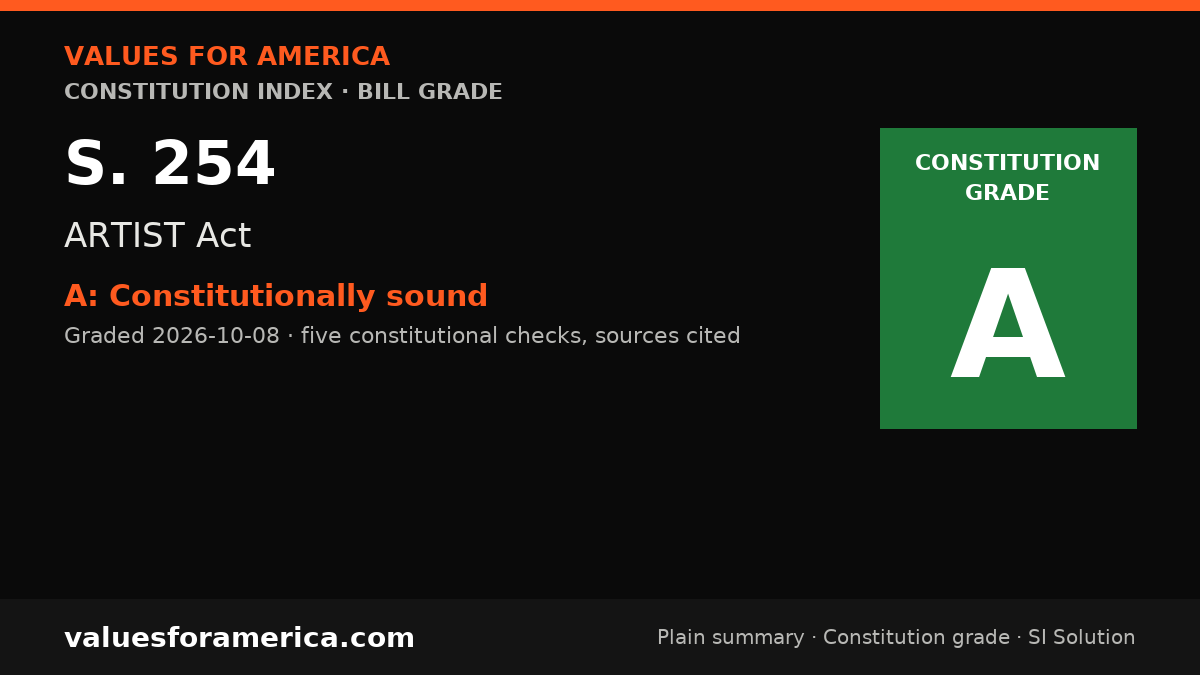
ARTIST Act
Cosponsors: 1 (0 D, 1 R) · per Congress.gov, 2026-10-08
Introduced: 2025-01-24
Latest action (2026-06-12): Became Public Law No: 119-99.
What S. 254 does, in plain terms
Alaska’s Right to Ivory Sales and Tradition Act or the ARTIST Act This act prohibits states from imposing bans on marine mammal products produced by Alaska Natives. Specifically, states may not prohibit the interstate commerce, importation, sale, transfer, trade, barter, or possession of marine mammal ivory, marine mammal bone, or baleen legally produced by an Alaska Native as an authentic Alaska Native article of handicrafts and clothing.
Official summary by the Congressional Research Service, via Congress.gov.
Constitution Index
“VFA Constitution grade”
Constitutionally sound
Graded 2026-10-08
SI-generated grade · five published checks · not individually reviewed by a person · methodology
Constitutional federal protection of lawful interstate commerce in authentic Alaska Native handicrafts under the Commerce Clause, with no rights infringement and no centralization of power.
-
✓ Passes · Enumerated powers
Federal authority is explicit under Article I, Section 8, Clause 3, the Commerce Clause, which grants Congress power to regulate Commerce among the several States, and also to regulate Commerce with the Indian Tribes. Barring state bans on interstate commerce, importation, sale, and possession of lawful Alaska Native handicrafts is a direct exercise of that commerce and tribal-commerce authority, … -
✓ Passes · Bill of Rights
No right in Amendments 1-10 is infringed. The law expands liberty to sell, possess, and trade lawful handicrafts, supporting First Amendment expression through cultural art, Second Amendment is not implicated, Fourth Amendment search protections are not altered, and the Tenth Amendment is respected because federal preemption here rests on an enumerated commerce power rather than a general police p… -
✓ Passes · Individual sovereignty
The measure enlarges individual sovereignty rather than restricting it. Alaska Native artisans retain control over their labor, property, cultural expression, and livelihood, protected under the Ninth Amendment retained rights and the liberty component of the Fifth Amendment. No compelled speech, belief, labor, or transfer of property is imposed, and the government bears no unmet burden to justify… -
✓ Passes · Decentralization
Four-question test passes. (1) Individuals cannot by themselves stop other states from banning their goods in interstate transit; (2) Local counties cannot resolve cross-state trade barriers; (3) A single state cannot control the laws of sister states; (4) Federal action is the minimum level capable of securing uniform interstate commerce, and it removes rather than concentrates regulatory control… -
✓ Passes · Due process and takings
No deprivation of life, liberty, or property without due process under the Fifth Amendment and Fourteenth Amendment Section 1. No criminal penalty, no warrantless seizure, no presumption-of-guilt regime, and no taking of private property for public use. The law protects existing property and livelihood interests of Alaska Native artisans rather than confiscating them.
Sources: Congress.gov: S 254 summary
Report an error in this grade
What should pass
“VFA SI Solution”
No solution yet
A sourced SI draft appears here once it passes automated checks (Constitution citation, source verification, independent SI critic). How publication works.
Related on VFA

For journalists and bloggers
“Embed this grade”
Free to use with the link back. The badge and card update when the grade changes. Embed terms →
