S. 2503 explained · 119th Congress · Pending in Congress
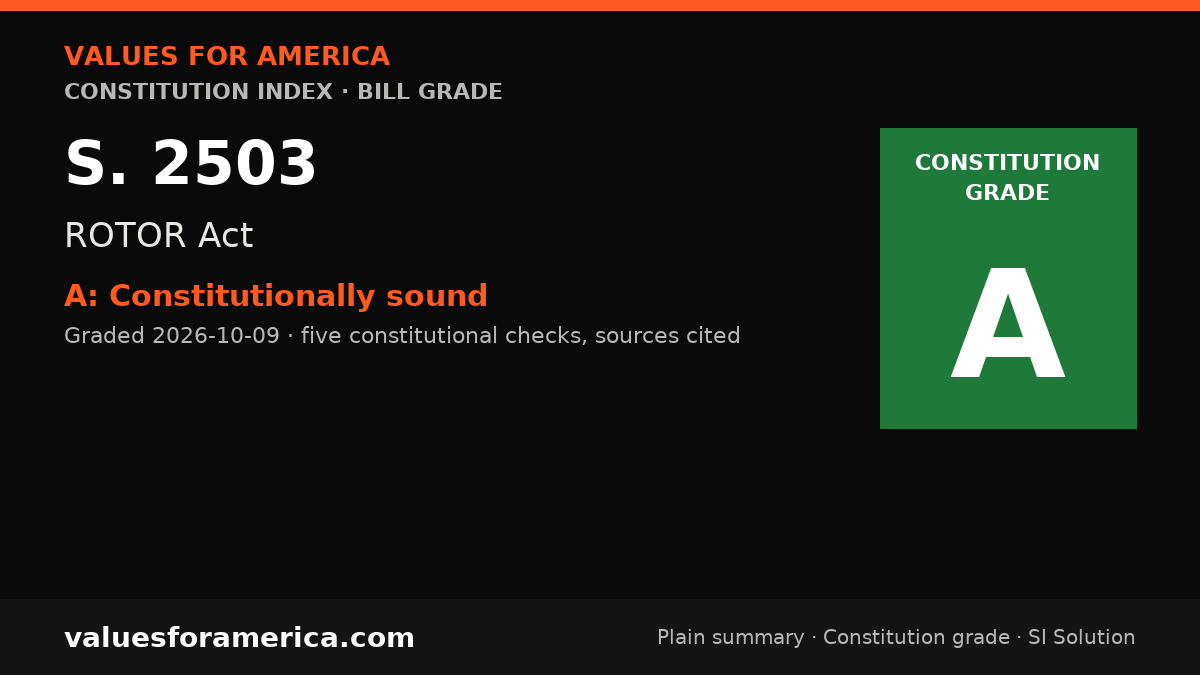
ROTOR Act
Cosponsors: 21 (11 D, 10 R) · per Congress.gov, 2026-10-09
Introduced: 2025-07-29
Latest action (2026-02-24): On motion to suspend the rules and pass the bill Failed by the Yeas and Nays: (2/3 required): 264 - 133 (Roll no. 72).
What S. 2503 does, in plain terms
Rotorcraft Operations Transparency and Oversight Reform Act or the ROTOR Act This bill addresses aviation safety by increasing requirements for aircraft tracking and communication using Automatic Dependent Surveillance-Broadcast (ADS-B) technology and expanding oversight. As background, ADS-B for broadcasting (Out) and receiving (In) transmits information (e.g., location and weather information) between aircraft and air traffic control. Under the bill, aircraft must generally operate with ADS-B In equipment to provide the aircraft with location information of other aircraft and traffic advisories. Current law does not require this equipment. Current Federal Aviation Administration (FAA) regulations allow aircraft performing a sensitive government mission to be excepted from requirements for using ADS-B Out equipment. This bill limits which flights may be considered sensitive government missions (e.g., not training flights) and requires additional reporting and notifications for the exception. The Government Accountability Office must review the use of the ADS-B Out exception and the Office of the Inspector General (OIG) of the Department of Transportation must annually audit FAA oversight of operations that use the exception. Further, the bill repeals a 2025 law that exempts certain military helicopters from the ADS-B Out requirements for the Washington, DC, metropolitan area. The bill also requires the OIG of the Army to audit the Army’s coordination with the FAA, the FAA to establish an office to coordinate airspace usage of military aircraft and review the safety of flight operations and routes around airports, and the FAA to enter into memoranda of understanding with military agencies for safety information sharing.
Official summary by the Congressional Research Service, via Congress.gov.
Constitution Index
“VFA Constitution grade”
Constitutionally sound
Graded 2026-10-09
SI-generated grade · five published checks · not individually reviewed by a person · methodology
The ROTOR Act is a federal aviation safety statute within Congress's enumerated interstate-commerce power. It imposes equipment and oversight requirements for aircraft, narrows a safety exception, and directs audits and interagency coordination. It does not infringe the Bill of Rights, does not single out individuals for punishment, and does not take property without just compensation. Because aviation safety over interstate and foreign airspace requires uniform national regulation, this is not an improper centralization of state or local authority.
-
✓ Passes · Enumerated powers
Congress has express authority under Article I, Section 8, Clause 3 to regulate interstate and foreign commerce, which includes the national airspace and aircraft navigation. The act's equipment mandates, exception limits, audits, and coordination requirements are all directed at aviation safety and are reasonably adapted to that enumerated end. -
✓ Passes · Bill of Rights
No provision implicates the First, Second, Third, Fourth, Fifth, Sixth, Seventh, Eighth, Ninth, or Tenth Amendments. The bill regulates aircraft equipment and government oversight; it does not restrict speech, religion, assembly, press, petition, bearing arms, or search and seizure protections, and it imposes no criminal punishment or defeat of jury rights. -
✓ Passes · Individual sovereignty
The act imposes reasonable safety conditions on the privilege of operating aircraft in the national airspace. The government has a compelling interest in aviation safety and collision avoidance. It does not forbid a person from owning property, working, or holding beliefs, and the burdens are regulatory and incidental to a heavily regulated field. -
✓ Passes · Decentralization
Aircraft operations move across state lines and through federal-controlled airspace; aviation safety cannot be effectively secured by individuals, local communities, or individual states. The federal government is the appropriate minimum level for uniform technical standards, airspace coordination, and oversight. The bill does not consolidate power beyond the necessary federal role. -
✓ Passes · Due process and takings
The bill sets clear statutory equipment requirements and reporting obligations; it does not deprive anyone of life, liberty, or property without a fair hearing. Requiring ADS-B equipment may impose compliance costs, but it is a safety regulation, not a taking of private property for public use requiring just compensation under the Fifth Amendment.
Sources: Congress.gov: S 2503 summary
Report an error in this grade
What should pass
“VFA SI Solution”
No solution yet
A sourced SI draft appears here once it passes automated checks (Constitution citation, source verification, independent SI critic). How publication works.
Related on VFA

For journalists and bloggers
“Embed this grade”
Free to use with the link back. The badge and card update when the grade changes. Embed terms →
