S. 2398 explained · 119th Congress · Became law
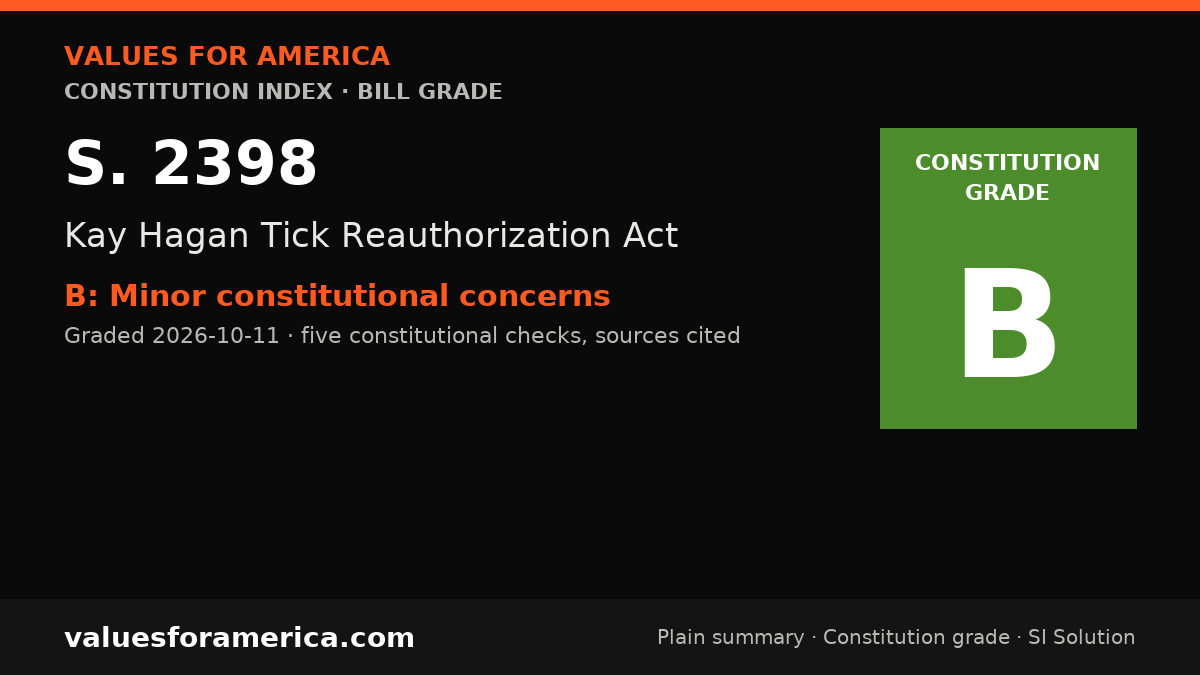
Kay Hagan Tick Reauthorization Act
Cosponsors: 23 (15 D, 7 R, 1 other) · per Congress.gov, 2026-10-14
Introduced: 2025-07-23
Latest action (2026-09-30): Became Public Law No: 119-118.
What S. 2398 does, in plain terms
Kay Hagan Tick Reauthorization Act This act reauthorizes through FY2030 activities of the Centers for Disease Control and Prevention to address vector-borne diseases (e.g., diseases spread by bites from ticks or mosquitoes). These activities include (1) a national strategy, (2) grants for regional centers of excellence, and (3) cooperative agreements with state, local, and tribal health departments to increase capacity for preventing and responding to vector-borne diseases.
Official summary by the Congressional Research Service, via Congress.gov.
Constitution Index
“VFA Constitution grade”
Minor constitutional concerns
Graded 2026-10-11
SI-generated grade · five published checks · not individually reviewed by a person · methodology
The bill reauthorizes CDC activities to address vector-borne diseases, which falls within the federal government's enumerated power to spend for the general welfare and to regulate interstate commerce, as diseases spread across state lines. It does not infringe on individual rights, and it appropriately delegates implementation to state and local health departments. However, the bill centralizes strategy and funding at the federal level, which raises minor decentralization concerns, but the cooperative structure mitigates this. Overall, the bill is constitutional with minor structural tension.
-
✓ Passes · Enumerated powers
The federal government has authority to spend for the general welfare under Article I, Section 8, Clause 1, and to regulate interstate commerce under Article I, Section 8, Clause 3. Vector-borne diseases do not respect state borders, and a national strategy to prevent and respond to such diseases is a legitimate exercise of the spending power and commerce power. The bill authorizes grants and coop… -
✓ Passes · Bill of Rights
The bill does not restrict speech, religion, assembly, press, petition, the right to bear arms, or any other enumerated right. It imposes no searches or seizures, no self-incrimination, no deprivation of life, liberty, or property without due process, and no cruel or unusual punishment. The activities are public health measures that do not touch upon the Bill of Rights. -
✓ Passes · Individual sovereignty
The bill does not restrict individual autonomy over person, property, speech, labor, or belief. It provides federal funding and coordination for public health activities, but does not mandate any individual action. Individuals are not compelled to participate in any program, and no property is taken. The burden of justification for any restriction is not triggered because there is no restriction. -
✗ Concern · Decentralization
The bill fails the decentralization test because it consolidates decision-making at the federal level for a national strategy and funding, whereas states and localities could handle vector-borne disease prevention and response with less federal involvement. However, the bill does include cooperative agreements with state, local, and tribal health departments, which mitigates the centralization. Th… -
✓ Passes · Due process and takings
The bill does not bypass due process or take property without just compensation. It does not impose penalties, fines, or mandates on individuals or entities. It simply authorizes federal spending and cooperative agreements, which do not implicate the Fifth Amendment's Due Process or Takings Clauses.
Sources: Congress.gov: S 2398 summary
Report an error in this grade
The Framers
“Founders’ Verdict”
Confidence 0.75
Archived SI output (machine-generated)No editorial review recorded. This historical SI verdict was machine-generated by software and predates the review desk; check it against the official bill text.
Synthesis
The reauthorization is constitutional only if narrowly confined to interstate commerce and federal enumerated powers, does not impose unfunded mandates or commandeer state governments, and is tailored to genuine interstate public health concerns.
This bill, concerning the reauthorization of a health-related measure, falls within the enumerated powers of Congress under Article I, Section 8, Clause 1, which grants Congress the power to 'provide for the common Defence and general Welfare of the United States.' The regulation of public health, particularly the prevention of disease through tick-borne illness surveillance and control, is a legitimate object of the general welfare. Additionally, the Necessary and Proper Clause (Article I, Section 8, Clause 18) empowers Congress to enact laws that are appropriate to carry out its enumerated p…
The proposed act, being a reauthorization of federal spending on tick-borne disease research and prevention, must be examined under the strict limits of enumerated powers. The Constitution grants Congress no general police power over public health; such authority resides with the states and the people under the Tenth Amendment. However, if this act is narrowly confined to matters of interstate commerce—such as regulating ticks that cross state lines or funding research that directly facilitates such commerce—it may pass constitutional muster. Yet, any provision that extends federal control ove…
The proposed legislation, if it merely reauthorizes existing federal programs for tick-borne disease research and prevention, may be consistent with the enumerated powers of Congress, particularly the power to provide for the general welfare and to regulate interstate commerce, as such diseases do not respect state boundaries and their control may require national coordination. However, the Constitution grants Congress only limited and enumerated powers, and any expansion of federal authority beyond those bounds would be an encroachment upon the reserved powers of the states. Therefore, the co…
This bill, concerning the reauthorization of tick-related health measures, must be examined under the principles of enumerated powers and necessary and proper means. The Constitution grants Congress power to regulate interstate commerce (Article I, Section 8, Clause 3) and to make all laws necessary and proper for executing that power (Article I, Section 8, Clause 18). If the tick-borne disease measures directly affect interstate commerce—such as by preventing the spread of disease across state lines or regulating the sale of related products—then Congress may act, as held in Gibbons v. Ogden …
Report an error in this Founders' Verdict
What should pass
“VFA SI Solution”
No solution yet
A sourced SI draft appears here once it passes automated checks (Constitution citation, source verification, independent SI critic). How publication works.
Related on VFA

For journalists and bloggers
“Embed this grade”
Free to use with the link back. The badge and card update when the grade changes. Embed terms →
