S. 2296 explained · 119th Congress · Pending in Congress
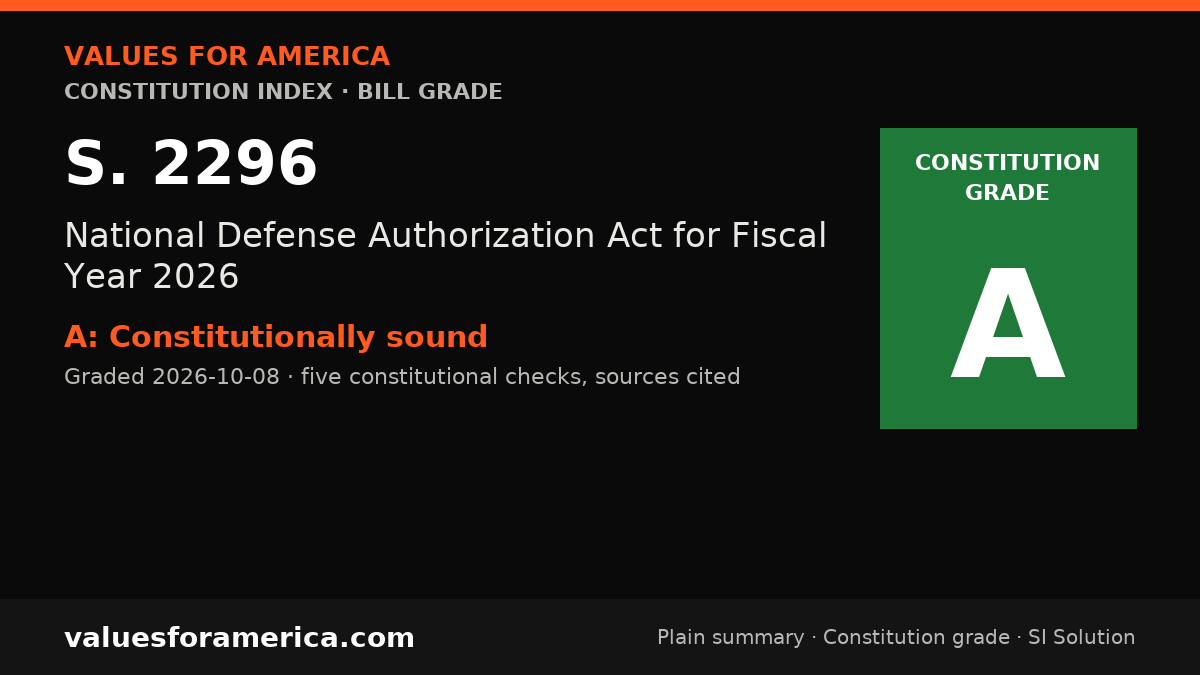
National Defense Authorization Act for Fiscal Year 2026
Cosponsors: none · per Congress.gov, 2026-10-10
Introduced: 2025-07-15
Latest action (2025-11-12): Held at the desk.
What S. 2296 does, in plain terms
National Defense Authorization Act for Fiscal Year 2026 This bill sets forth policies and authorities for FY2026 for Department of Defense (DOD) programs and activities, military construction, and the national security programs of the Department of Energy (DOE). It also authorizes the Defense Nuclear Facilities Safety Board for FY2026. The bill authorizes appropriations but it does not provide budget authority, which is provided by appropriations legislation. Among other elements, the bill authorizes the procurement of various items, including aircraft, ships, and missiles; authorizes active duty and reserve component personnel strength levels; authorizes specified military construction projects and extends the authorization of certain projects from previous fiscal years; requires DOD to develop a strategy on the national security implications of emerging biotechnologies; requires the Navy to implement certain processes to improve the material condition and combat readiness of Navy surface ships maintained and repaired at private shipyards; extends the Pacific Deterrence Initiative (an initiative to enhance U.S. deterrence and defense posture, assure allies and partners, and increase capability and readiness in the Indo-Pacific region) through FY2026; and repeals various statutory provisions related to diversity, equity, and inclusion within DOD, including a provision establishing the position of Chief Diversity Officer of DOD. For additional information on the National Defense Authorization Act (NDAA) see In Focus IF10516, Defense Primer: Navigating the NDAA, and In Focus IF10515, Defense Primer: The NDAA Process.
Official summary by the Congressional Research Service, via Congress.gov.
Constitution Index
“VFA Constitution grade”
Constitutionally sound
Graded 2026-10-08
SI-generated grade · five published checks · not individually reviewed by a person · methodology
Annual defense authorization is a core enumerated federal power under Article I, Section 8, Clauses 11-16. The summary shows procurement, personnel, construction, and readiness measures with no rights infringement, no taking without compensation, and no improper consolidation because defense cannot be handled at a lower level.
-
✓ Passes · Enumerated powers
Congress has explicit authority over national defense: Article I, Section 8, Clauses 11-16 covering declaration of war, raising and supporting armies, providing and maintaining a navy, regulating forces, and calling forth the militia, plus Clause 18 necessary and proper authority and Article I, Section 9 appropriations framework. Authorizing defense programs, personnel levels, construction, and De… -
✓ Passes · Bill of Rights
No provision described restricts speech, religion, press, assembly, arms, searches, trial rights, or other protections under Amendments 1-10. Procurement, personnel levels, construction, readiness, deterrence posture, biotechnology strategy, and repeal of internal diversity offices do not on their face infringe the Bill of Rights. Tenth Amendment reserved powers are not infringed because national … -
✓ Passes · Individual sovereignty
The bill does not restrict what a person may do with their person, property, speech, labor, or belief. It governs Department of Defense organization, procurement, and posture. No mandate, prohibition, or compelled belief is placed on private individuals, so no individual-sovereignty justification burden is triggered. -
✓ Passes · Decentralization
National defense is the core case where higher-level action is the minimum necessary. Individuals, counties, and states cannot separately provide for common defense, maintain naval forces, or deter foreign aggression. The bill keeps decision-making at the federal level where the Constitution places it, and does not pull traditionally local matters upward. Tenth Amendment is satisfied. -
✓ Passes · Due process and takings
No bypass of notice, hearing, presumption of innocence, or judicial process is described. Authorization of procurement, personnel strengths, and construction does not take private property; any future taking would still require just compensation under the Fifth Amendment Takings Clause. Action is non-arbitrary and tied to legislated purposes.
Sources: Congress.gov: S 2296 summary
Report an error in this grade
What should pass
“VFA SI Solution”
No solution yet
A sourced SI draft appears here once it passes automated checks (Constitution citation, source verification, independent SI critic). How publication works.
Related on VFA

For journalists and bloggers
“Embed this grade”
Free to use with the link back. The badge and card update when the grade changes. Embed terms →
