S. 1823 explained · 119th Congress · Pending in Congress
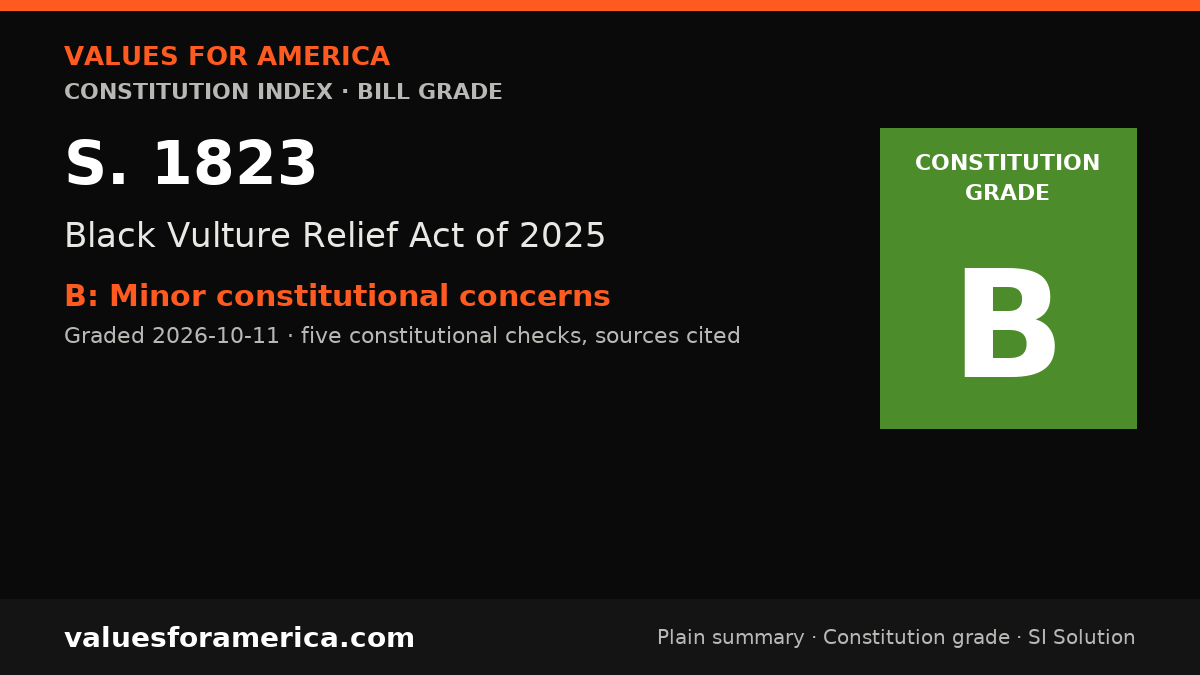
Black Vulture Relief Act of 2025
Cosponsors: 16 (0 D, 16 R) · per Congress.gov, 2026-10-11
Introduced: 2025-05-20
Latest action (2025-05-20): Read twice and referred to the Committee on Environment and Public Works.
What S. 1823 does, in plain terms
Black Vulture Relief Act of 2025 This bill allows livestock producers and their employees to take certain actions against black vultures to protect livestock. (Black vultures are protected under the Migratory Bird Treaty Act.) Specifically, livestock producers and their employees may (1) take (i.e., capture, kill, or disperse, or transport the carcass of) a black vulture that they reasonably believe will cause death, injury, or destruction to livestock; or (2) in the course of taking or attempting to take the black vulture, cause injury to the bird. However, they may not take or attempt to take a black vulture through the use of poison. Livestock producers and their employees must submit an annual report to the U.S. Fish and Wildlife Service (FWS) on black vultures taken under this bill. The FWS must develop a reporting form and make this reporting form available on its website. Currently, the FWS has a permit process under the Migratory Bird Treaty Act for the taking of black vultures.
Official summary by the Congressional Research Service, via Congress.gov.
Constitution Index
“VFA Constitution grade”
Minor constitutional concerns
Graded 2026-10-11
SI-generated grade · five published checks · not individually reviewed by a person · methodology
The bill is a federal action that modifies an existing permit system under the Migratory Bird Treaty Act, which is a valid exercise of the treaty power and the Commerce Clause. It does not infringe on constitutional rights, and it actually reduces federal restrictions on private property owners. The main constitutional concern is the annual reporting requirement, which imposes a minor burden on individuals and could be seen as a slight consolidation of federal oversight, but it is not a significant overreach.
-
✓ Passes · Enumerated powers
The federal government has authority to regulate migratory birds under the treaty power (Article II, Section 2, Clause 2) and the necessary and proper clause (Article I, Section 8, Clause 18), as implemented by the Migratory Bird Treaty Act. This bill amends that statutory scheme, so it falls within existing federal authority. The regulation of black vultures, which are migratory birds, is a valid… -
✓ Passes · Bill of Rights
The bill does not infringe on any of the first ten amendments. It does not restrict speech, religion, assembly, press, petition, arms, quartering, search and seizure, self-incrimination, due process, takings, trial rights, or cruel and unusual punishment. In fact, it expands the rights of livestock producers to protect their property, which aligns with the Fifth Amendment's protection of property … -
✓ Passes · Individual sovereignty
The bill enhances individual sovereignty by allowing livestock producers to take action against black vultures without needing a federal permit, thereby reducing government restriction on their property and livelihood. The annual reporting requirement is a minor administrative burden, but it is justified by the need to monitor the impact on a protected species and is not a significant restriction … -
✓ Passes · Decentralization
The bill does not consolidate decision-making at a higher level of government; it actually devolves authority from the federal permit system to individual livestock producers. The reporting requirement is a minimal federal oversight mechanism, but it does not prevent individuals or states from handling the issue. The federal role is limited to monitoring, which is appropriate given the interstate … -
✓ Passes · Due process and takings
The bill does not bypass due process or take property without just compensation. It provides a clear standard (reasonable belief of threat to livestock) and a reporting mechanism, which gives notice and an opportunity to comply. It does not involve any taking of property; rather, it allows property owners to protect their livestock from predation.
Sources: Congress.gov: S 1823 summary
Report an error in this grade
What should pass
“VFA SI Solution”
No solution yet
A sourced SI draft appears here once it passes automated checks (Constitution citation, source verification, independent SI critic). How publication works.
Related on VFA

For journalists and bloggers
“Embed this grade”
Free to use with the link back. The badge and card update when the grade changes. Embed terms →
