S. 1637 explained · 119th Congress · Pending in Congress
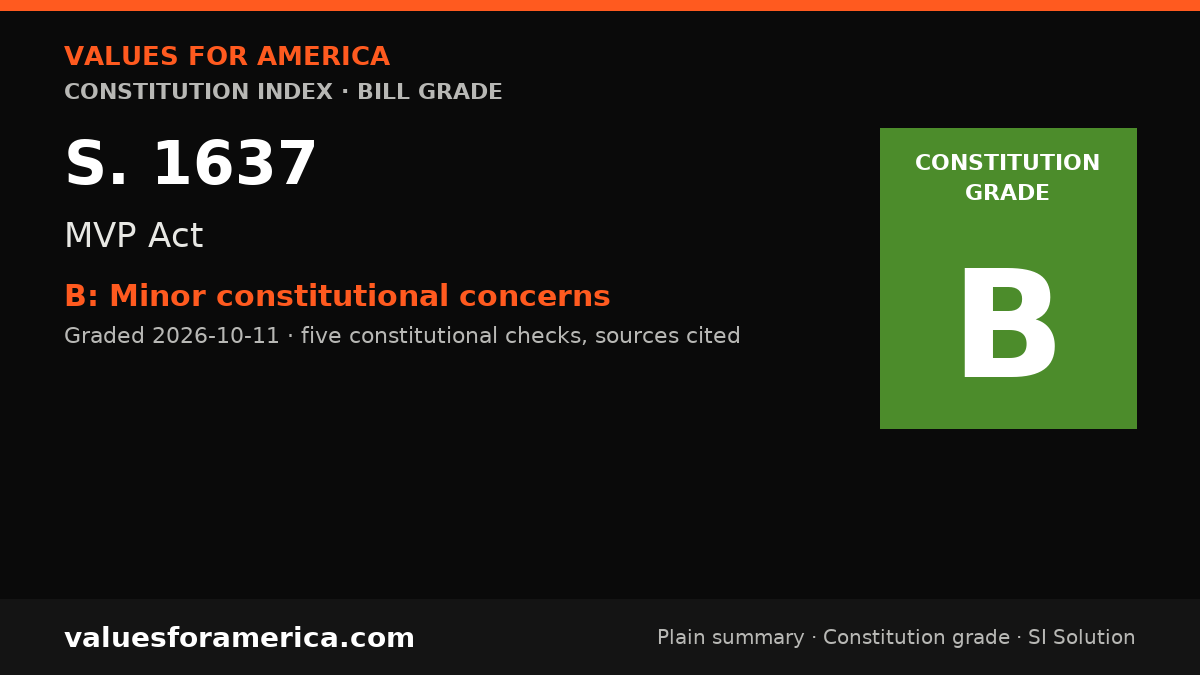
MVP Act
Cosponsors: 2 (1 D, 1 R) · per Congress.gov, 2026-10-11
Introduced: 2025-05-07
Latest action (2025-05-07): Read twice and referred to the Committee on Finance.
What S. 1637 does, in plain terms
Medicaid VBPs for Patients Act or the MVP Act This bill provides statutory authority for regulations that allow for the use of varying best price points under value-based purchasing arrangements for purposes of the Medicaid Drug Rebate Program. (Value-based purchasing arrangements refer to arrangements in which the price of a drug is linked to clinical outcomes; such arrangements are particularly used for new high-cost treatments, such as gene therapies.) The Government Accountability Office must study the impact of value-based purchasing arrangements on federal health care programs, including with respect to the bill's changes. Additionally, the bill (1) exempts sales of drugs that are made under value-based purchasing arrangements from calculations of the manufacturer average sales price for purposes of payments under Medicare medical services, if the manufacturer reports multiple best prices under Medicaid in accordance with the bill's changes; and (2) requires the Centers for Medicare & Medicaid Services to issue guidance on how state Medicaid programs may cover drugs in inpatient settings via value-based purchasing arrangements.
Official summary by the Congressional Research Service, via Congress.gov.
Constitution Index
“VFA Constitution grade”
Minor constitutional concerns
Graded 2026-10-11
SI-generated grade · five published checks · not individually reviewed by a person · methodology
The MVP Act is a federal statutory change to Medicaid and Medicare drug pricing rules, which falls within Congress's enumerated power to spend for the general welfare and to regulate interstate commerce. It does not infringe on individual rights, and it does not centralize authority beyond the federal role already established in these programs. The main constitutional tension is that it expands federal regulatory authority over drug pricing, but this is within the existing framework of federal health care programs and does not violate the Tenth Amendment.
-
✓ Passes · Enumerated powers
Congress has authority under Article I, Section 8, Clause 1 (Spending Clause) to provide for the general welfare, which includes establishing and modifying federal health care programs like Medicaid and Medicare. Additionally, the regulation of drug pricing in interstate commerce falls under Article I, Section 8, Clause 3 (Commerce Clause). The bill's provisions are directly tied to these federal … -
✓ Passes · Bill of Rights
The bill does not implicate any of the first ten amendments. It does not restrict speech, religion, assembly, press, petition, arms, quartering, search and seizure, self-incrimination, due process, takings, trial rights, or cruel and unusual punishment. It is a regulatory measure affecting drug pricing and reporting, not individual liberties. -
✓ Passes · Individual sovereignty
The bill does not restrict what individuals can do with their person, property, speech, labor, or belief. It imposes obligations on drug manufacturers and government agencies, not on private citizens. The burden of compliance falls on corporations participating in federal programs, which is a legitimate exercise of federal spending power. No individual right is restricted. -
✓ Passes · Decentralization
The bill operates within the existing federal Medicaid and Medicare programs, which are inherently federal-state partnerships. While it does direct states on how they may cover drugs in inpatient settings via guidance, this is within the framework of a cooperative federal program. The federal government already has a role in setting drug pricing rules for these programs, and the bill does not cons… -
✓ Passes · Due process and takings
The bill does not deprive any person of life, liberty, or property without due process. It does not involve any taking of private property for public use without just compensation. The changes to drug pricing calculations are regulatory and do not constitute a taking. There is no bypass of procedural or substantive due process; the bill is a legislative change with prospective effect.
Sources: Congress.gov: S 1637 summary
Report an error in this grade
What should pass
“VFA SI Solution”
No solution yet
A sourced SI draft appears here once it passes automated checks (Constitution citation, source verification, independent SI critic). How publication works.
Related on VFA

For journalists and bloggers
“Embed this grade”
Free to use with the link back. The badge and card update when the grade changes. Embed terms →
