S. 146 explained · 119th Congress · Became law
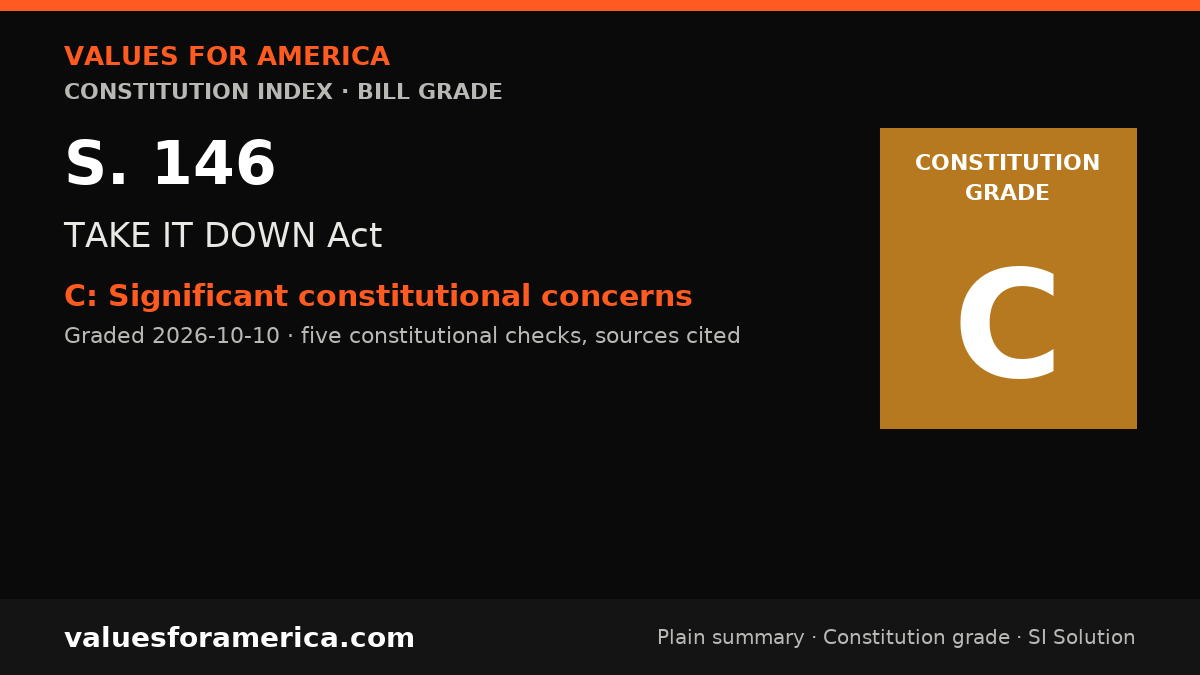
TAKE IT DOWN Act
Cosponsors: 21 (11 D, 10 R) · per Congress.gov, 2026-10-11
Introduced: 2025-01-16
Latest action (2025-05-19): Became Public Law No: 119-12.
What S. 146 does, in plain terms
Tools to Address Known Exploitation by Immobilizing Technological Deepfakes on Websites and Networks Act or the TAKE IT DOWN Act This act generally prohibits the nonconsensual online publication of intimate visual depictions of individuals, both authentic and computer-generated, and requires certain online platforms (e.g., social media platforms) to promptly remove such depictions upon receiving notice of their existence. Specifically, the act prohibits the online publication of intimate visual depictions of an adult subject where publication is intended to cause or does cause harm to the subject, and where the depiction was published without the subject’s consent or, in the case of an authentic depiction, was created or obtained under circumstances where the adult had a reasonable expectation of privacy; or a minor subject where publication is intended to abuse or harass the minor or to arouse or gratify the sexual desire of any person. Violators are subject to mandatory restitution and criminal penalties, including prison, a fine, or both. Threats to publish intimate visual depictions of a subject are similarly prohibited and subject to criminal penalties. Separately, covered platforms must establish a process through which subjects of intimate visual depictions may notify the platform of the existence of, and request removal of, an intimate visual depiction including the subject that was published without the subject’s consent. Covered platforms must remove such depictions within 48 hours of notification. Under the act, covered platforms are defined as public websites, online services, or applications that primarily provide a forum for user-generated content.
Official summary by the Congressional Research Service, via Congress.gov.
Constitution Index
“VFA Constitution grade”
Significant constitutional concerns
Graded 2026-10-10
SI-generated grade · five published checks · not individually reviewed by a person · methodology
The TAKE IT DOWN Act addresses a serious harm—nonconsensual intimate image abuse—and its core prohibitions align with protecting individual sovereignty and privacy. However, the law raises significant constitutional concerns regarding the compelled removal of protected speech on private platforms, the breadth of the 'harm' standard for adult content, and the delegation of enforcement to private platforms without adequate due process safeguards. The law also imposes federal criminal penalties in an area traditionally reserved to the states, though the interstate commerce nexus provides some justification. Overall, the law is a well-intentioned but constitutionally problematic attempt to regulate online speech and platform conduct.
-
✓ Passes · Enumerated powers
Congress has authority under the Commerce Clause (Article I, Section 8, Clause 3) to regulate interstate and foreign commerce, which includes online platforms and the transmission of intimate images across state lines. The law's provisions targeting platforms that operate in interstate commerce and criminalizing publication that affects interstate commerce fall within this enumerated power. Howeve… -
✗ Concern · Bill of Rights
The law implicates the First Amendment by compelling platforms to remove speech (intimate images) that may be protected, especially when the image is not obscene and the subject is an adult. The 'harm' standard for adult content is vague and could cover political satire, art, or newsworthy images, leading to overbroad suppression. The 48-hour removal requirement, without a prior judicial determina… -
✓ Passes · Individual sovereignty
The law protects individuals' control over their own intimate images, which is a core aspect of personal autonomy and privacy. It restricts the ability of others to publish such images without consent, thereby enhancing individual sovereignty. The law does not restrict the subject's own rights; rather, it empowers them to seek removal. The criminal penalties for threats to publish also protect ind… -
✗ Concern · Decentralization
The law fails the decentralization test because it consolidates at the federal level a matter that could be handled by states or even individuals. (1) Individuals can already seek removal through platform policies and state civil remedies, so the federal mandate is not strictly necessary. (2) Local communities and states have enacted their own laws against nonconsensual intimate imagery, demonstra… -
✗ Concern · Due process and takings
The law's removal requirement lacks procedural due process. Platforms are required to remove content within 48 hours of notice, without a hearing or judicial review, which could result in the removal of protected speech. The 'harm' standard for adult content is vague, potentially leading to arbitrary enforcement. While the law provides for criminal penalties, the removal process itself does not af…
Sources: Congress.gov: S 146 summary
Report an error in this grade
What should pass
“VFA SI Solution”
No solution yet
A sourced SI draft appears here once it passes automated checks (Constitution citation, source verification, independent SI critic). How publication works.
Related on VFA

For journalists and bloggers
“Embed this grade”
Free to use with the link back. The badge and card update when the grade changes. Embed terms →
