S. 1383 explained · 119th Congress · Pending in Congress
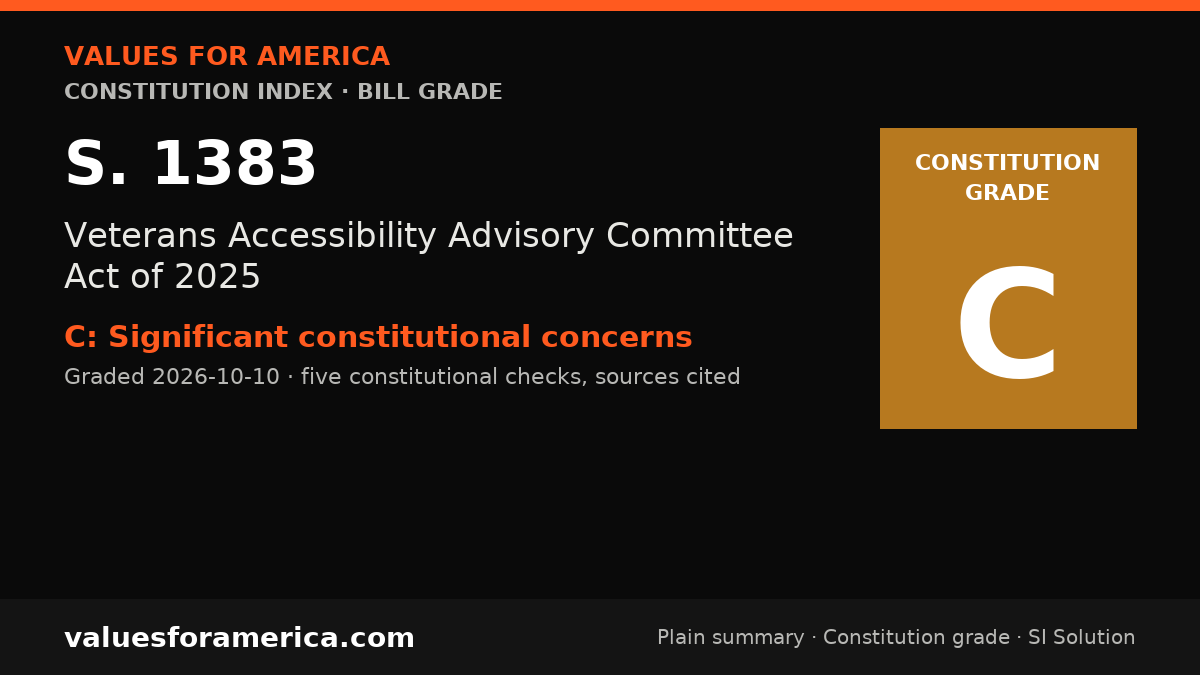
Veterans Accessibility Advisory Committee Act of 2025
Cosponsors: 2 (0 D, 2 R) · per Congress.gov, 2026-10-09
Introduced: 2025-04-09
Latest action (2026-03-26): Considered by Senate (Message from the House considered). (consideration: CR S1647)
What S. 1383 does, in plain terms
Safeguard American Voter Eligibility Act or the SAVE America Act This bill requires individuals to provide documentary proof of U.S. citizenship when registering to vote, and requires photo identification to vote, in federal elections. Specifically, the bill prohibits states from accepting and processing an application to register to vote in a federal election unless the applicant presents documentary proof of U.S. citizenship. The bill specifies what documents are considered acceptable proof of U.S. citizenship, such as identification that complies with the REAL ID Act of 2005 that indicates U.S. citizenship, a valid U.S. passport, or a valid government-issued photo identification card that shows the applicant's place of birth was in the United States. Further, the bill (1) requires states to accept and process a voter registration application in the event of a name discrepancy in the applicant's documentation, as long as the applicant provides additional documentation; and (2) requires states to establish an alternative process to demonstrate U.S. citizenship. Within 30 days of the bill's enactment, each state must take affirmative steps on an ongoing basis to ensure that only U.S. citizens are registered to vote, which shall include establishing a program to identify individuals who are not U.S. citizens using information supplied by certain sources. Further, each state must submit its complete official list of eligible voters to the Department of Homeland Security for comparison with the Systematic Alien Verification for Entitlements system, which is used to verify immigration status. Individuals who are identified as noncitizens must be given the opportunity to provide documentary proof of U.S. citizenship. Additionally, states must remove noncitizens from their official lists of eligible voters. The bill (1) provides for a private right of action for certain violations, and (2) establishes criminal penalties for certain offenses. The bill prohibits a state or local election official from providing a ballot for a federal election to an individual who does not present valid physical photo identification. An individual who does not present the required identification must be permitted to cast a provisional ballot. However, an election official may not determine that the individual is eligible under state law to vote in the election unless, not later than three days after casting the provisional ballot, the individual presents (1) the identification required, or (2) an affidavit attesting that the individual does not possess the identification because of a religious objection to being photographed. Further, an election official may not allow for voting methods other than in-person voting unless the individual submits the ballot with (1) a copy of their photo identification, or (2) the last four digits of their Social Security number with an affidavit attesting that the individual is unable to obtain a copy of a valid photo identification after making reasonable efforts to obtain a copy. This prohibition shall not apply to overseas military voters or individuals provided the right to vote other than in person under the Voting Accessibility for the Elderly and Handicapped Act. State and local government officials must provide, to the extent practicable, public access to a digital imaging device for the purpose of allowing individuals to use the device at no cost to make a copy of their valid photo identification.
Official summary by the Congressional Research Service, via Congress.gov.
Constitution Index
“VFA Constitution grade”
Significant constitutional concerns
Graded 2026-10-10
SI-generated grade · five published checks · not individually reviewed by a person · methodology
The SAVE America Act raises significant constitutional concerns. While Congress has authority under Article I, Section 4 to regulate the times, places, and manner of federal elections, the bill's voter registration and identification requirements may impose undue burdens on the right to vote, potentially violating the First and Fourteenth Amendments. The mandatory removal of voters based on database comparisons without adequate due process protections risks erroneous disenfranchisement. The bill also centralizes election administration by requiring states to coordinate with the Department of Homeland Security, raising federalism concerns under the Tenth Amendment. The bill is not a direct violation but requires substantial revision to align with constitutional protections.
-
✓ Passes · Enumerated powers
Congress has explicit authority under Article I, Section 4, Clause 1 to regulate the 'Times, Places and Manner of holding Elections for Senators and Representatives.' This includes setting voter qualifications for federal elections, as confirmed by the Supreme Court in cases like Arizona v. Inter Tribal Council of Arizona. The bill's requirements for documentary proof of citizenship and photo ID a… -
✗ Concern · Bill of Rights
The bill's voter ID and citizenship documentation requirements may burden the right to vote, which is a fundamental right protected by the First and Fourteenth Amendments. The Supreme Court in cases like Crawford v. Marion County Election Board has upheld reasonable voter ID laws, but the strict requirements here, including the three-day deadline for provisional ballots and the limited alternative… -
✗ Concern · Individual sovereignty
The bill restricts an individual's ability to vote without providing documentary proof of citizenship and photo ID. While the government has a compelling interest in preventing noncitizen voting, the burden is on the government to justify the restriction. The bill's requirements may disproportionately affect citizens who lack such documentation, such as the elderly, low-income individuals, and tho… -
✗ Concern · Decentralization
The bill consolidates election administration at the federal level by requiring states to submit voter lists to the Department of Homeland Security and to establish programs to identify noncitizens using federal databases. This undermines the traditional state and local control over elections. While the federal government has authority to regulate federal elections, the bill's mandates on states t… -
✗ Concern · Due process and takings
The bill's requirement that states remove noncitizens from voter rolls based on database comparisons may deprive eligible citizens of their right to vote without adequate due process. The bill provides an opportunity to provide documentary proof of citizenship, but the process may not be sufficient to prevent erroneous removals. The three-day deadline for provisional ballots may be too short for v…
Sources: Congress.gov: S 1383 summary
Report an error in this grade
What should pass
“VFA SI Solution”
No solution yet
A sourced SI draft appears here once it passes automated checks (Constitution citation, source verification, independent SI critic). How publication works.
Related on VFA

For journalists and bloggers
“Embed this grade”
Free to use with the link back. The badge and card update when the grade changes. Embed terms →
