S. 1318 explained · 119th Congress · Pending in Congress
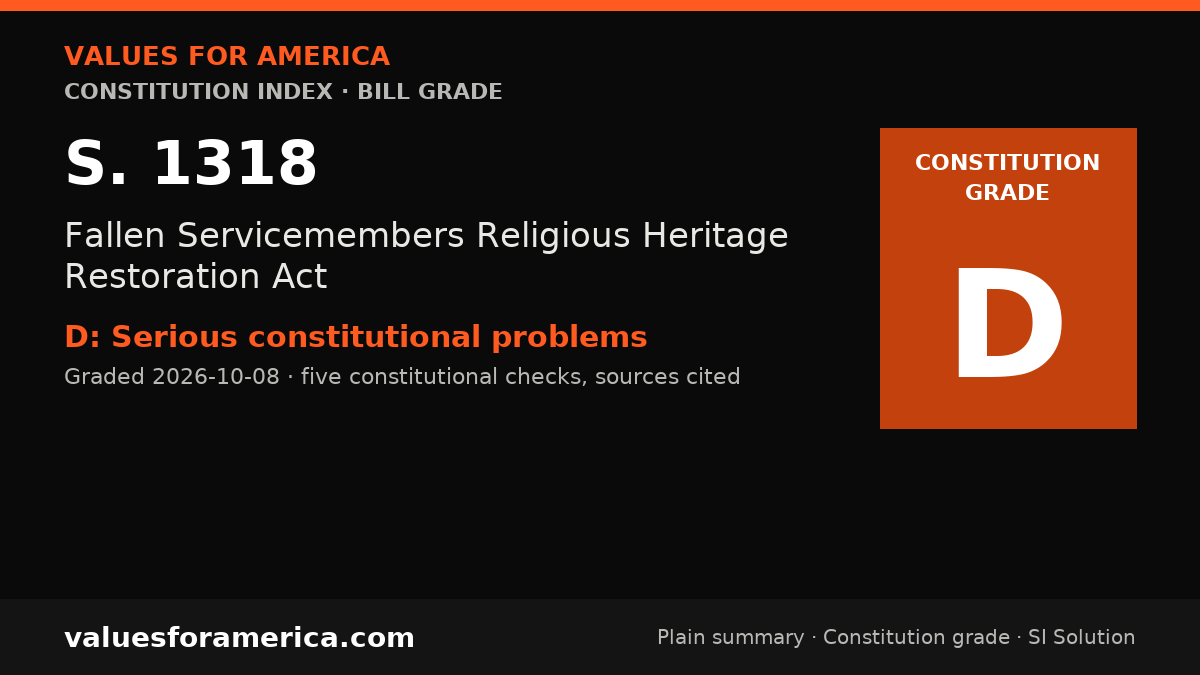
Fallen Servicemembers Religious Heritage Restoration Act
Cosponsors: 20 (11 D, 9 R) · per Congress.gov, 2026-10-08
Introduced: 2025-04-07
Latest action (2026-06-05): Motion to proceed to consideration of the House message to accompany S. 1318 rejected in Senate by Yea-Nay Vote. 47 - 52. Record Vote Number: 164.
What S. 1318 does, in plain terms
Foreign Intelligence Accountability Act and the Anti-CBDC Surveillance State Act This bill reauthorizes Title VII of the Foreign Intelligence Surveillance Act (FISA) until April 30, 2029, and expands protections related to surveillance under Section 702 of FISA. It also prohibits a Federal Reserve bank from offering financial products or services directly to an individual, maintaining an account on behalf of an individual, or issuing a central bank digital currency (CBDC). Section 702 of FISA concerns acquiring communications of non-U.S. persons believed to be outside the United States to obtain foreign intelligence information. Information about U.S. persons may incidentally be acquired by this type of surveillance and subsequently queried (searched) under certain circumstances. Changes to Section 702 include requiring monthly reviews by the Office of the Director of National Intelligence (ODNI) for each U.S. person query conducted by the Federal Bureau of Investigation (FBI). ODNI must refer queries that do not comply with established standards, as well as possible abuses of civil liberties or privacy, to the Office of the Intelligence Community Inspector General. The bill institutes criminal penalties for (1) those who knowingly and willingly falsify or materially misrepresent complying with querying procedures, and (2) FBI personnel who knowingly and willingly violate procedures related to U.S. person queries. FBI supervisors may no longer approve U.S. person queries; only certain FBI attorneys may do so. The Federal Reserve System's Board of Governors may not use a CBDC to implement monetary policy or test, study, create, or implement a CBDC, with certain exceptions.
Official summary by the Congressional Research Service, via Congress.gov.
Constitution Index
“VFA Constitution grade”
Serious constitutional problems
Graded 2026-10-08
SI-generated grade · five published checks · not individually reviewed by a person · methodology
A mixed bill with one protective title and one rights-violating title. Banning direct Federal Reserve retail accounts and CBDC limits federal monetary surveillance power. But reauthorizing Section 702 to April 2029 without a warrant requirement for FBI U.S.-person queries continues warrantless search of private communications, violating the Fourth Amendment and individual sovereignty despite new audits and penalties.
-
✓ Passes · Enumerated powers
Regulation of foreign intelligence collection tied to foreign persons abroad falls within federal authority over national defense and foreign affairs, including Article I, Section 8, Clauses 1, 11, and 18, and Article II, Section 2. Congress may set procedures and criminal penalties under the Necessary and Proper Clause, Article I, Section 8, Clause 18. The CBDC prohibition is also within enumerat… -
✗ Concern · Bill of Rights
Section 702 reauthorization continues warrantless collection of communications where U.S. persons' messages are incidentally collected and later queried, which conflicts with the Fourth Amendment requirement for warrants based on probable cause and particular description. Reforms such as ODNI review, attorney approval, and criminal penalties for misuse reduce risk but do not require a warrant befo… -
✗ Concern · Individual sovereignty
The bill lets the government collect, retain, and query private speech and correspondence of U.S. persons without their consent and without a warrant-supported showing. That restricts individual control over person, speech, papers, and effects without compelling constitutional justification proven in advance to a court. The burden is placed on the citizen to hope later audits catch misuse, rather … -
✗ Concern · Decentralization
Foreign-intelligence collection targeted at non-U.S. persons abroad is a core federal function under Article I, Section 8, Clause 11 and Article II, Section 2; individuals, counties, and states cannot conduct it. The decentralization failure is upward consolidation: Section 702 centralizes bulk collection and FBI backdoor queries at the federal level without a warrant or state-level check, contrar… -
✗ Concern · Due process and takings
Under the Fifth Amendment Due Process Clause, U.S. persons are subject to search and use of their incidentally collected communications without prior notice, hearing, or warrant approval by a neutral magistrate. Monthly ODNI after-action review and Inspector General referral are post-hoc remedies, not procedural due process before the search. No physical taking occurs, so the Takings Clause elemen…
Sources: Congress.gov: S 1318 summary
Report an error in this grade
What should pass
“VFA SI Solution”
No solution yet
A sourced SI draft appears here once it passes automated checks (Constitution citation, source verification, independent SI critic). How publication works.
Related on VFA

For journalists and bloggers
“Embed this grade”
Free to use with the link back. The badge and card update when the grade changes. Embed terms →
