S. 1071 explained · 119th Congress · Became law
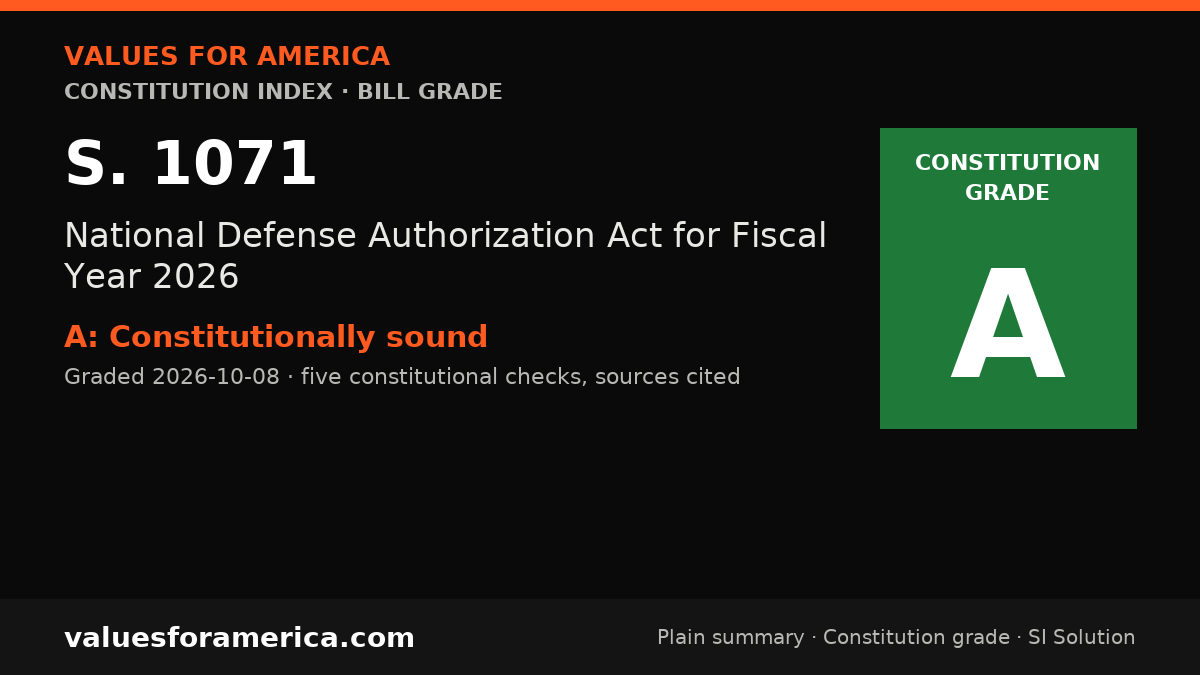
National Defense Authorization Act for Fiscal Year 2026
Cosponsors: 1 (0 D, 1 R) · per Congress.gov, 2026-10-09
Introduced: 2025-03-14
Latest action (2025-12-18): Became Public Law No: 119-60.
What S. 1071 does, in plain terms
National Defense Authorization Act for Fiscal Year 2026 This bill sets forth policies and authorities for FY2026 for Department of Defense (DOD) programs and activities, military construction, and the national security programs of the Department of Energy (DOE). The bill also sets forth policies and authorities for the Department of State, the Coast Guard, and the Intelligence Community (IC). Among other elements, the bill authorizes the procurement of various items, including aircraft, ships, and missiles; sets active duty and reserve component personnel strength levels; sets policy regarding various aspects of military health care and military compensation; sets policy regarding DOD acquisitions and acquisition management, including contracting authorities and domestic sourcing; sets policy for various matters related to DOD interactions with foreign nations, including matters concerning Israel, Ukraine, and the Indo-Pacific; sets policy for various matters related to DOD cyber operations, cybersecurity, and artificial intelligence; authorizes specified military construction projects and extends the authorization of certain projects from previous fiscal years; authorizes the National Nuclear Security Administration, Defense Nuclear Facilities Safety Board, Naval Petroleum Reserves, and Maritime Administration; sets policy regarding the organization and workforce of the State Department; sets acquisition and personnel policy for the Coast Guard; sets policy for merchant mariner credentials, vessel safety, and oil pollution response; and sets policy for the IC regarding artificial intelligence and biotechnology. For additional information on the National Defense Authorization Act (NDAA) see In Focus IF10516, Defense Primer: Navigating the NDAA, and In Focus IF10515, Defense Primer: The NDAA Process.
Official summary by the Congressional Research Service, via Congress.gov.
Constitution Index
“VFA Constitution grade”
Constitutionally sound
Graded 2026-10-08
SI-generated grade · five published checks · not individually reviewed by a person · methodology
The FY2026 defense authorization funds and organizes the core federal function of national defense, squarely within Article I, Section 8 defense powers. As summarized, it shows no Bill of Rights infringement, no individual-sovereignty restriction, no improper centralization, and no due-process or takings violation. Detailed provisions should still receive SI-assisted line review, but the measure as described is constitutional.
-
✓ Passes · Enumerated powers
National defense is an expressly enumerated federal power. Congress is empowered to provide for the common Defence under Article I, Section 8, Clause 1, to declare War under Article I, Section 8, Clause 11, to raise and support Armies under Article I, Section 8, Clause 12, to provide and maintain a Navy under Article I, Section 8, Clause 13, and to make Rules for the Government and Regulation of l… -
✓ Passes · Bill of Rights
The summarized bill authorizes funding, personnel, procurement, and policy for defense, State Department, Coast Guard, and Intelligence Community programs. On its face it does not restrict speech, religion, press, assembly under the First Amendment, does not infringe arms under the Second Amendment, and does not authorize searches, seizures, or surveillance programs that would implicate the Fourth… -
✓ Passes · Individual sovereignty
The bill as summarized directs government organization, procurement, personnel strength, compensation, health care for service members, acquisition, foreign cooperation, cybersecurity, and policy for artificial intelligence and biotechnology within government programs. It does not on its face restrict what a private person may do with their person, property, speech, labor, or belief. No mandate, b… -
✓ Passes · Decentralization
National defense is the paradigmatic function that cannot be handled at a lower level. (1) Individuals and families cannot provide armies, navies, nuclear deterrence, or intelligence. (2) Local communities and counties cannot conduct foreign policy or defend against foreign attack. (3) States cannot conduct national defense alone; the Constitution expressly forbids states keeping troops or ships o… -
✓ Passes · Due process and takings
The summary describes authorizations, procurement, personnel levels, compensation, construction, and organizational policy. It does not describe criminal punishment without trial, presumption-of-innocence reversals, summary seizure, or uncompensated takings. Military construction and Naval Petroleum Reserves activity operate under existing appropriations and property authorities subject to Fifth A…
Sources: Congress.gov: S 1071 summary
Report an error in this grade
What should pass
“VFA SI Solution”
No solution yet
A sourced SI draft appears here once it passes automated checks (Constitution citation, source verification, independent SI critic). How publication works.
Related on VFA

For journalists and bloggers
“Embed this grade”
Free to use with the link back. The badge and card update when the grade changes. Embed terms →
