S. 1020 explained · 119th Congress · Became law
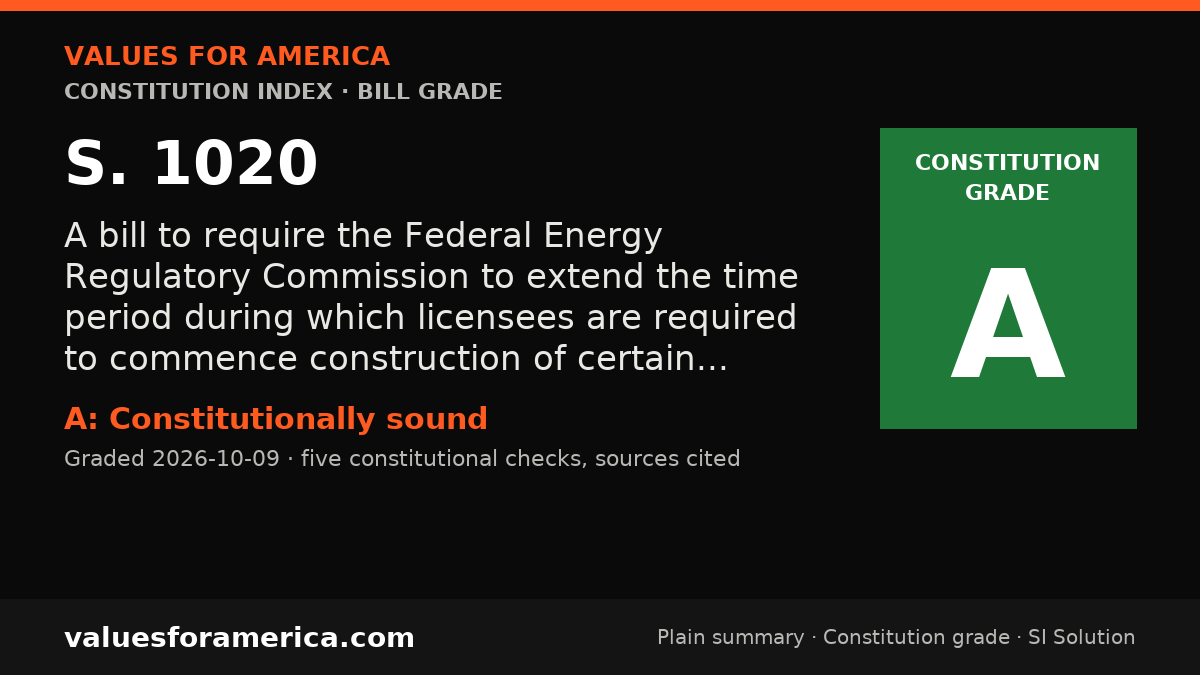
A bill to require the Federal Energy Regulatory Commission to extend the time period during which licensees are required to commence construction of certain hydropower projects.
Cosponsors: 7 (1 D, 6 R) · per Congress.gov, 2026-10-08
Introduced: 2025-03-13
Latest action (2026-05-11): Became Public Law No: 119-90.
What S. 1020 does, in plain terms
This act authorizes the Federal Energy Regulatory Commission (FERC) to extend construction deadlines for hydropower projects that were issued a license before March 13, 2020. FERC is authorized, upon the request of the licensees, to extend the deadline for beginning construction on such projects an additional six years beyond the eight-year extension FERC is authorized to provide under current law. The extension must consist of no more than three consecutive two-year periods. The act also provides that FERC may reinstate certain expired licenses for projects with construction deadlines extended under this act, effective as of the date they expire.
Official summary by the Congressional Research Service, via Congress.gov.
Constitution Index
“VFA Constitution grade”
Constitutionally sound
Graded 2026-10-09
SI-generated grade · five published checks · not individually reviewed by a person · methodology
This bill is fully constitutional. It merely extends construction deadlines for existing hydropower licenses, an action well within Congress's Commerce Clause authority. It does not infringe any Bill of Rights protections, restrict individual sovereignty, consolidate power upward, or violate due process or takings principles.
-
✓ Passes · Enumerated powers
Congress has authority under the Commerce Clause (Article I, Section 8, Clause 3) to regulate hydropower projects that affect navigable waters and interstate commerce. The Federal Power Act, which FERC administers, is a valid exercise of this power. Extending construction deadlines for licensed projects is a routine administrative adjustment that does not exceed enumerated federal authority. -
✓ Passes · Bill of Rights
The bill does not regulate speech, religion, assembly, press, petition, arms, quartering, search and seizure, self-incrimination, due process, takings, trial rights, cruel punishment, or any other right protected by the first ten amendments. It addresses only administrative deadlines for hydropower construction. -
✓ Passes · Individual sovereignty
The bill imposes no restrictions on individuals' use of their person, property, speech, labor, or belief. It grants licensees (typically corporations or public utilities) additional time to begin construction, which is a permissive extension rather than a restriction. No compelling governmental justification is needed because no individual liberty is burdened. -
✓ Passes · Decentralization
Hydropower projects often involve interstate waters and power grids, making federal regulation appropriate. The bill does not shift decision-making upward; it merely adjusts timelines within an existing federal framework. An individual or family cannot handle large-scale hydropower licensing; local communities may manage small projects but federal oversight remains necessary for interstate impacts… -
✓ Passes · Due process and takings
The bill provides licensees with additional time to commence construction, which is a benefit, not a deprivation. No property is taken, no hearing is bypassed, and no arbitrary government action occurs. The extension is requested by licensees and granted by FERC through established procedures, satisfying procedural and substantive due process.
Sources: Congress.gov: S 1020 summary
Report an error in this grade
What should pass
“VFA SI Solution”
No solution yet
A sourced SI draft appears here once it passes automated checks (Constitution citation, source verification, independent SI critic). How publication works.
Related on VFA

For journalists and bloggers
“Embed this grade”
Free to use with the link back. The badge and card update when the grade changes. Embed terms →
