S. 1007 explained · 119th Congress · Pending in Congress
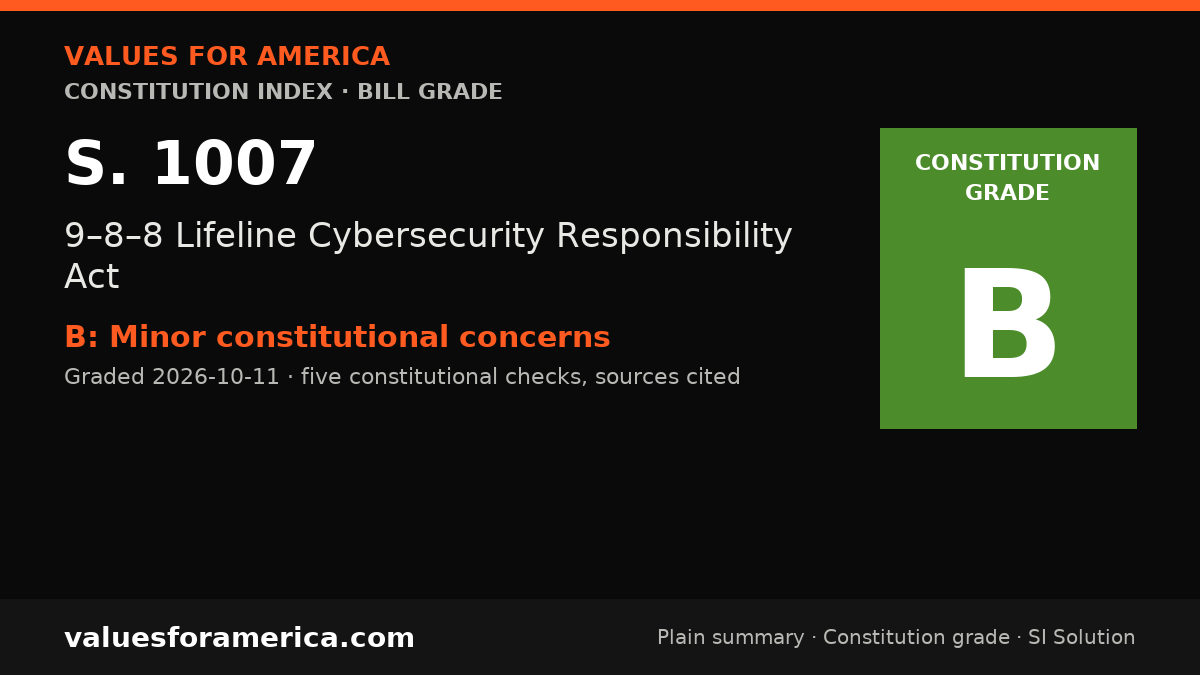
9–8–8 Lifeline Cybersecurity Responsibility Act
Cosponsors: 1 (1 D, 0 R) · per Congress.gov, 2026-10-12
Introduced: 2025-03-12
Latest action (2025-03-12): Read twice and referred to the Committee on Health, Education, Labor, and Pensions.
What S. 1007 does, in plain terms
9-8-8 Lifeline Cybersecurity Responsibility Act This bill requires the Substance Abuse and Mental Health Services Administration (SAMHSA) to undertake efforts to protect the 9-8-8 Suicide & Crisis Lifeline from cybersecurity threats. (The lifeline is a three-digit number that connects callers in suicidal crisis or mental health distress to a national network of crisis centers.) The bill also establishes related reporting requirements. Specifically, the network administrator for the lifeline must report identified cybersecurity incidents and vulnerabilities to SAMHSA, and local and regional crisis centers that participate in the lifeline must report identified cybersecurity incidents and vulnerabilities to the network administrator. Additionally, the Government Accountability Office must conduct a study that evaluates cybersecurity risks and vulnerabilities associated with the lifeline and report the findings to Congress.
Official summary by the Congressional Research Service, via Congress.gov.
Constitution Index
“VFA Constitution grade”
Minor constitutional concerns
Graded 2026-10-11
SI-generated grade · five published checks · not individually reviewed by a person · methodology
The bill generally operates within federal authority over interstate communications and public health, and it does not directly infringe on individual rights. However, it imposes reporting obligations on state and local crisis centers, which raises minor federalism concerns under the Tenth Amendment. The cybersecurity measures are reasonable and do not violate due process or property rights.
-
✓ Passes · Enumerated powers
The federal government has authority to regulate interstate communications under the Commerce Clause (Article I, Section 8, Clause 3). The 9-8-8 Suicide & Crisis Lifeline is a national network that operates across state lines, and protecting it from cybersecurity threats falls within the scope of regulating interstate commerce. Additionally, the bill's provisions for SAMHSA and GAO are tied to fed… -
✓ Passes · Bill of Rights
The bill does not infringe on any of the first ten amendments. It does not restrict speech, religion, assembly, press, or petition. It does not involve searches or seizures, self-incrimination, or cruel and unusual punishment. The reporting requirements are administrative and do not implicate the Fourth Amendment because they do not involve government searches of private property; rather, they req… -
✓ Passes · Individual sovereignty
The bill does not restrict individual liberty. It imposes obligations on government agencies and on crisis centers that voluntarily participate in the lifeline. Individuals are not directly affected; the bill does not limit personal autonomy, property use, or freedom of contract. The reporting requirements are placed on entities, not individuals, and are reasonably related to the government's inte… -
✗ Concern · Decentralization
The bill fails the decentralization test because it imposes federal reporting requirements on local and regional crisis centers, which are often operated by state or local entities. While the federal government has a role in protecting the national lifeline, the bill could have allowed states to handle cybersecurity reporting for their own centers. However, the consolidation is minimal and justifi… -
✓ Passes · Due process and takings
The bill does not deprive anyone of life, liberty, or property without due process. It does not involve takings of private property. The reporting requirements are clear and impose no penalties; they are administrative in nature. The GAO study is a fact-finding mission and does not affect individual rights.
Sources: Congress.gov: S 1007 summary
Report an error in this grade
What should pass
“VFA SI Solution”
No solution yet
A sourced SI draft appears here once it passes automated checks (Constitution citation, source verification, independent SI critic). How publication works.
Related on VFA

For journalists and bloggers
“Embed this grade”
Free to use with the link back. The badge and card update when the grade changes. Embed terms →
