S. 1003 explained · 119th Congress · Became law
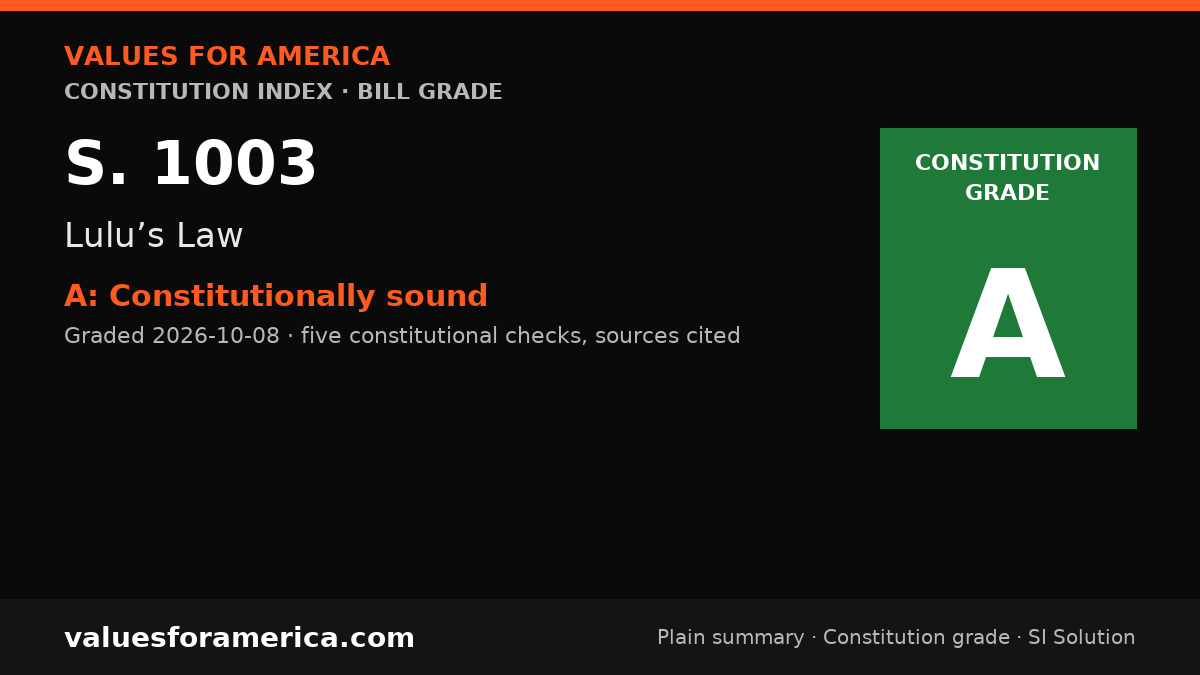
Lulu’s Law
Cosponsors: 9 (4 D, 5 R) · per Congress.gov, 2026-10-08
Introduced: 2025-03-12
Latest action (2026-06-26): Became Public Law No: 119-100.
What S. 1003 does, in plain terms
Lulu’s Law This act requires the Federal Communications Commission to issue an order explicitly permitting the transmission of wireless emergency alerts to mobile phones in the event of a shark attack. (Under current regulations, authorized government authorities are permitted to send wireless emergency alerts regarding public safety emergencies, including severe weather, missing children, and other threats to life or property.)
Official summary by the Congressional Research Service, via Congress.gov.
Constitution Index
“VFA Constitution grade”
Constitutionally sound
Graded 2026-10-08
SI-generated grade · five published checks · not individually reviewed by a person · methodology
Lulu's Law is a narrow administrative direction for the Federal Communications Commission to allow shark-attack warnings on the existing wireless alert system. It exercises a clear commerce power, restricts no rights, takes no property, and adds no federal control over local responders.
-
✓ Passes · Enumerated powers
Regulation of interstate electronic communications is within Article I, Section 8, Clause 3, the Commerce Clause, as applied to interstate communications networks, combined with Article I, Section 8, Clause 18, the Necessary and Proper Clause, to direct the Federal Communications Commission. S. 1003 only orders the Commission to permit an additional alert category on the existing federal alert sys… -
✓ Passes · Bill of Rights
No provision of S. 1003 restricts speech, religion, press, assembly, arms, searches, trial rights, or other protections under Amendments 1-10. It authorizes an additional category of voluntary public-safety alert for receipt on mobile phones, with no penalty, mandate to speak, or surveillance. First Amendment and Fourth Amendment are not implicated. -
✓ Passes · Individual sovereignty
S. 1003 imposes no restriction on what a person may do with their person, property, speech, labor, or belief. No one is compelled to send, receive, or act on an alert, and no expressive or economic conduct is prohibited. The government bears no additional burden here because no liberty is curtailed under the Ninth Amendment and the Tenth Amendment reservation of unenumerated rights. -
✓ Passes · Decentralization
The Wireless Emergency Alert system is an existing federal communications infrastructure. (1) Individuals and families cannot broadcast geographically targeted mobile alerts on their own. (2) A county alone cannot operate the nationwide carrier alert interface. (3) A state alone cannot authorize use of the federal alert codes without Federal Communications Commission action. (4) S. 1003 does not c… -
✓ Passes · Due process and takings
S. 1003 creates no criminal liability, no civil forfeiture, no property seizure, and no physical or regulatory taking under the Fifth Amendment Takings Clause. It provides no deprivation of life, liberty, or property requiring notice and hearing under the Fifth Amendment Due Process Clause and the Fourteenth Amendment Section 1 Due Process Clause. Action is non-arbitrary and narrowly administrativ…
Sources: Congress.gov: S 1003 summary
Report an error in this grade
What should pass
“VFA SI Solution”
No solution yet
A sourced SI draft appears here once it passes automated checks (Constitution citation, source verification, independent SI critic). How publication works.
Related on VFA

For journalists and bloggers
“Embed this grade”
Free to use with the link back. The badge and card update when the grade changes. Embed terms →
