H.Res. 988 explained · 119th Congress · Pending in Congress
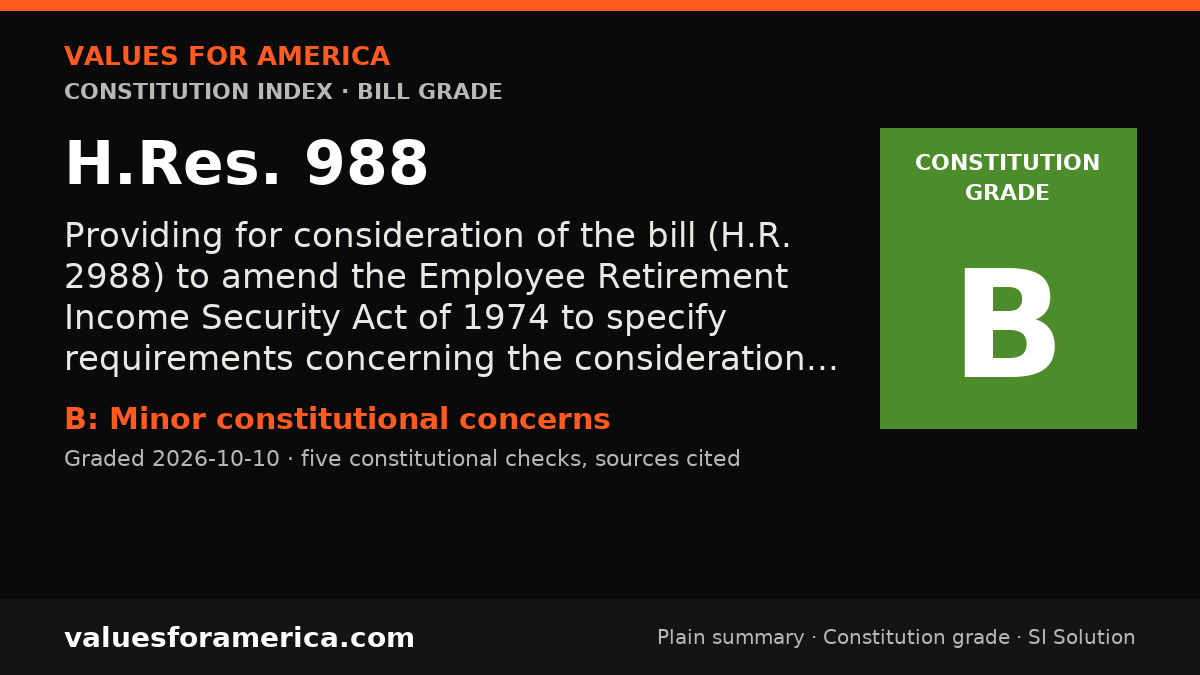
Providing for consideration of the bill (H.R. 2988) to amend the Employee Retirement Income Security Act of 1974 to specify requirements concerning the consideration of pecuniary and non-pecuniary factors, and for other purposes; providing for consideration of the bill (H.R. 2262) to amend the Fair Labor Standards Act of 1938 to exclude certain activities from hours worked, and for other purposes; providing for consideration of the bill (H.R. 2270) to amend the Fair Labor Standards Act of 1938 to exclude child and dependent care services and payments from the rate used to compute overtime compensation; providing for consideration of the bill (H.R. 2312) to amend the Fair Labor Standards Act of 1938 to revise the definition of the term ''tipped employee'', and for other purposes; and providing for consideration of the bill (H.R. 4366) to clarify the treatment of 2 or more employers as joint employers under the National Labor Relations Act and the Fair Labor Standards Act of 1938.
Cosponsors: none · per Congress.gov, 2026-10-09
Introduced: 2026-01-12
Latest action (2026-01-13): Motion to reconsider laid on the table Agreed to without objection.
What H.Res. 988 does, in plain terms
This resolution provides for the consideration of the bill (H.R. 2988) to amend the Employee Retirement Income Security Act of 1974 to specify requirements concerning the consideration of pecuniary and non-pecuniary factors, and for other purposes; providing for consideration of the bill (H.R. 2262) to amend the Fair Labor Standards Act of 1938 to exclude certain activities from hours worked, and for other purposes; providing for consideration of the bill (H.R. 2270) to amend the Fair Labor Standards Act of 1938 to exclude child and dependent care services and payments from the rate used to compute overtime compensation; providing for consideration of the bill (H.R. 2312) to amend the Fair Labor Standards Act of 1938 to revise the definition of the term ''tipped employee'', and for other purposes; and providing for consideration of the bill (H.R. 4366) to clarify the treatment of 2 or more employers as joint employers under the National Labor Relations Act and the Fair Labor Standards Act of 1938.
Official summary by the Congressional Research Service, via Congress.gov.
Constitution Index
“VFA Constitution grade”
Minor constitutional concerns
Graded 2026-10-10
SI-generated grade · five published checks · not individually reviewed by a person · methodology
This resolution is a procedural rule that sets the terms for debating and amending several bills. It does not itself enact substantive law, but it facilitates consideration of bills that touch on labor and retirement law. The resolution is within Congress's enumerated powers to structure its own proceedings, and the underlying bills fall within Congress's commerce power. However, the resolution's effect on the legislative process raises minor concerns about the speed and transparency of consideration, which could affect due process in the legislative sense, though not in the constitutional sense. Overall, the resolution is mostly sound, with minor procedural tensions.
-
✓ Passes · Enumerated powers
The resolution is a procedural measure under Article I, Section 5, Clause 2, which grants each House the power to determine the rules of its proceedings. The underlying bills address labor and retirement matters, which fall under Congress's power to regulate interstate commerce under Article I, Section 8, Clause 3. The resolution itself does not exceed Congress's enumerated powers. -
✓ Passes · Bill of Rights
The resolution does not infringe on any of the first ten amendments. It is a procedural rule and does not restrict speech, religion, assembly, press, petition, arms, quartering, search and seizure, self-incrimination, due process, takings, trial rights, jury rights, cruel and unusual punishment, unenumerated rights, or reserved powers. The underlying bills, if enacted, could affect labor rights, b… -
✓ Passes · Individual sovereignty
The resolution does not directly restrict individual liberty. It merely sets the terms for legislative debate. The underlying bills could affect employer-employee relationships, but the resolution itself does not impose any restriction on individual action. The burden of justification for any substantive restrictions would apply to the underlying bills, not this procedural rule. -
✓ Passes · Decentralization
This resolution is a federal legislative procedure, which is inherently a federal function. The four-question test is not directly applicable because the resolution is about how Congress considers legislation, not about policy implementation. However, the underlying bills address labor standards, which are traditionally within federal purview under the commerce power. The resolution does not conso… -
✓ Passes · Due process and takings
The resolution does not bypass due process or take property. It is a procedural rule that provides for consideration of bills, which will themselves go through the legislative process. The resolution does not affect any individual's procedural or substantive due process rights, nor does it involve any taking of property. The 'motion to reconsider' action is a standard parliamentary procedure.
Sources: Congress.gov: HRES 988 summary
Report an error in this grade
What should pass
“VFA SI Solution”
No solution yet
A sourced SI draft appears here once it passes automated checks (Constitution citation, source verification, independent SI critic). How publication works.
Related on VFA

For journalists and bloggers
“Embed this grade”
Free to use with the link back. The badge and card update when the grade changes. Embed terms →
